When 10x Speed Breaks Your Foundation: What Game Studios Miss
 Pranjal6 min read·1 hour ago
--
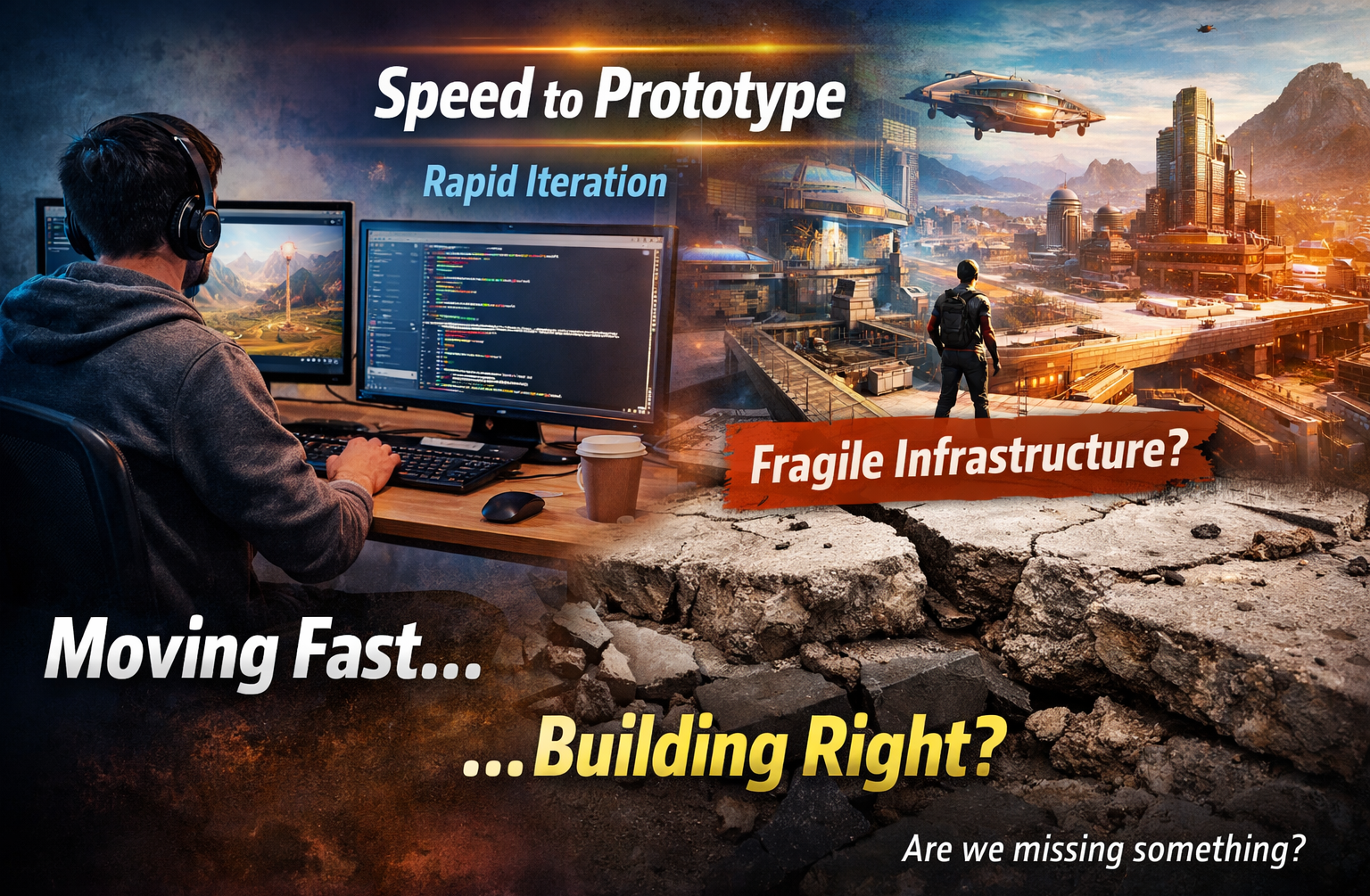
Game studios are shipping faster. The pattern is clear: streamlined production pipelines, distributed teams working in parallel, faster iteration cycles. The promise is real. Faster validation. Better ideas are tested more quickly. More flexibility to experiment.
But something is getting overlooked in the celebration.
When I think about this shift — the speed at which studios now move from concept to playable prototype, the compression of production timelines, the ability to iterate on complex systems in weeks instead of months — I keep thinking about something I’ve seen happen in fintech infrastructure over the past decade. The same pattern. The same euphoria. The same blind spot.
It’s the moment teams realize that going fast and building right are not the same thing.
The Seductive Logic of Velocity
Here’s what’s true: AI tools do accelerate output. Dramatically. A solo developer can now iterate on concepts that used to require a five-person production team.
This is genuinely powerful.
But velocity without clarity about what you’re building tends to produce a specific problem.
You move faster. You validate more ideas. You ship more frequently. Your metrics all look good. Productivity dashboards are green.
Then, somewhere between your third prototype and your tenth iteration, the cracks appear. Not in the code. In the architecture underneath.
I’ve watched this exact scenario play out in early-stage fintech startups for years. Teams move fast with AI-assisted development, automation, and outsourced infrastructure. They ship payment flows that work. Transaction volumes climb. Customer acquisition accelerates. Everything looks like success.
Until it doesn’t.
The Pattern: Speed Without Foundation
Game development teams are experiencing something fintech learned the hard way: velocity amplifies bad decisions.
When you can prototype a game mechanic in days instead of months, you’re no longer forced to think deeply about its constraints. Whether it actually scales. Whether it creates unintended dependencies. Whether the foundation supports what you’re building on top.
You just… keep building.
In fintech, this looks like:
- Payment flows that work fine at 100 transactions per second, then collapse at 1,000.
- Liquidity models that balance perfectly in the sandbox, then crack under real market volatility.
- Compliance architectures that satisfy regulators at launch, then require a complete overhaul when transaction patterns shift.
- Systems that are functionally sound but structurally fragile.
Game developers are walking into the same trap right now.
When teams produce game worlds rapidly, they’re not thinking about memory footprints. When mechanics get implemented quickly, they’re not stress-testing edge cases. When content ships at speed, they’re not considering how dependent systems will behave under load.
You’re optimizing for speed of creation, not resilience of design.
Why This Matters: The Hidden Cost
Here’s what happens next (and I’m saying this gently, because I’ve seen it destroy promising projects):
Technical debt becomes operational debt.
Your game runs fine on your machine. The prototype validates. The publisher loves the concept art. You scale the team, spend the budget, and start shipping to players. Then the first wave of load hits. Frame rate drops. Assets fail to load. Memory leaks cascade through systems that seemed independent but turned out to be tightly coupled.
You’re now in firefighting mode. Your “10x output” from AI becomes a 2x output from a team in crisis management. You’re refactoring systems you should have thought through three months ago. You’re shipping patches instead of features. You’re hemorrhaging player retention because performance is unpredictable.
In fintech, this costs millions. Dead money. Operational overhead that never produces revenue. Reputational damage that takes years to recover from.
In games, it costs player trust, critical reviews, and studio credibility.
The insidious part? They created things fast. The problem is that the speed of creation and soundness of architecture are not the same metric. And teams that confuse them tend to discover it expensively.
What The Popular Narrative Gets Wrong
The current discourse around game development velocity is all optimization-focused:
- “How do we reduce iteration cycles?”
- “How do we get more content shipped per sprint?”
- “How do we ship faster?”
These are legitimate questions. But they’re the wrong primary questions.
The questions no one’s asking:
- “How do we validate that our systems remain stable as complexity increases?”
- “What dependencies are we creating that we don’t understand yet?”
- “What constraints are we ignoring because shipping is now cheap?”
- “How do we know when something is ‘done’ if we can keep iterating infinitely?”
In fintech, we learned this lesson through regulatory audits, system failures, and customer refunds. The hard way.
Game development is learning it through frustrated players, poor reviews, and studios that shipped beautiful games built on foundations that couldn’t hold.
Where Mature Teams Think Differently
The studios that actually sustain growth aren’t the ones moving fastest. They’re the ones who treat velocity as a multiplier for good decisions, not a substitute for them.
Here’s what they’re doing differently:
1. Design-First, Execution-Second
They define architecture before they start production. They know their memory budgets, performance targets, and scaling assumptions. Then they execute efficiently.
2. Constraint-Aware Development
They don’t just iterate freely. They specify constraints. Performance budgets. Compatibility requirements. Interdependencies that matter. They keep execution within boundaries instead of letting it expand freely and dealing with the mess later.
3. Validation Discipline
For every system, they have explicit validation gates. Not just “does it work on my machine?” but “does it remain stable under realistic load?” They profile obsessively. They test failure modes. They don’t assume because something ran in a sandbox that it will run at scale.
4. Reversibility-First Decisions
They treat rapid prototypes as exploration, not implementation. When they find something that works, they rebuild it with intentional architecture instead of just polishing a quick iteration. They know the difference between “works” and “holds.”
This feels slower. It is slower, initially. But it’s the only way to sustain velocity without accumulating catastrophic debt.
The Early Warning Signs You’re Moving Too Fast
If you recognize any of these patterns in your game development project, you’re probably optimizing for speed at the expense of soundness:
“We can refactor later.” The most dangerous phrase in software. Later never comes, and the codebase only gets more tangled.
“It works in playtest.” But does it work when 100,000 concurrent players load it? When network latency spikes? When is memory fragmented?
“We ship and learn.” Sometimes true. But if you’re learning about fundamental architectural problems after launch, you’ve already lost.
“We iterated it quickly, so it must be solid.” Speed of creation doesn’t equal soundness of design. Fast execution on a weak foundation is still weak.
“We can patch it later if it breaks.” Until you can’t. Until the cost of fixing breaks the development schedule.
What This Actually Means For Your Studio
The game developers who thrive in a fast-shipping landscape won’t be the ones with the fastest cycles. They’ll be the ones with the clearest understanding of their systems.
Speed gives you iteration. Architecture gives you durability. You need both.
The hard part — the part no tool solves — is knowing which decisions require deep thinking and which ones are just execution problems. That judgment is where expertise lives.
Use rapid cycles to validate ideas. Use architectural discipline to scale them. Use fast iteration to explore. Use intentional design to prevent catastrophe.
Move fast on the things that don’t matter. Move thoughtfully on the things that do.
The teams that figure this out will ship beautiful, stable games that keep players happy for years. The teams that chase pure velocity will ship impressive-looking products with fragile foundations.
The market will eventually sort them out. It always does.
The Question Worth Sitting With
That question cuts through the velocity obsession. It forces you to think about resilience instead of just speed. It makes you design systems that can actually survive contact with reality.
Because in the end, 10x output only matters if the foundation doesn’t crack under the weight of it.