What's next after bitcoin's historic underperformance stretch against stocks
With a few hours to go, bitcoin has tumbled 22% in the first quarter, following a 25% drop in the last quarter of 2025.
By Helene Braun|Edited by Stephen AlpherUpdated Mar 31, 2026, 8:30 p.m. Published Mar 31, 2026, 8:14 p.m. Make preferred on
What to know:
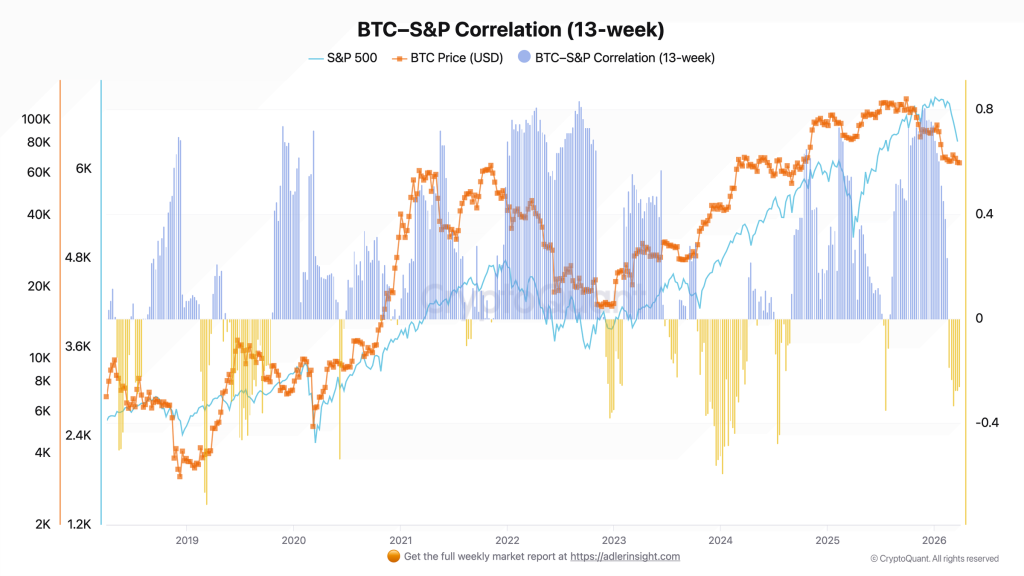
- Though it has outperformed since the outbreak of the Iran war, bitcoin has trailed U.S. equities for nearly six months, its longest recorded stretch of underperformance versus the S&P 500.
- Analyst Mark Connors says bitcoin’s extended lag and earlier deleveraging could set up a rebound, though he argues that the timing will hinge largely on how geopolitical risks and energy markets evolve.
Bitcoin’s first-quarter slump capped an unusual run: nearly six months of underperformance against U.S. equities, a stretch that has no precedent.
“That’s never happened,” said Mark Connors, founder of Risk Dimensions, pointing to data showing bitcoin lagging stocks consistently since early October. The trend has raised fresh questions about whether the asset is behaving more like a risk trade than a hedge.
Bitcoin fell roughly 22% in the first quarter of 2026, following a 25% decline during the final three months of 2025. Over a similar period, the S&P 500 declined far less, leaving a wide performance gap. Connors said the duration of that gap, not just the size, stands out. Previous pullbacks have been sharper but shorter.
The weakness came amid broader market struggles. U.S. equities logged their worst quarter in four years, with the Nasdaq down more than 10% from recent highs. The combined decline across stocks and crypto erased much of the rally that followed the 2024 election.
Policy progress has been uneven. A new SEC chair has helped clear a path for more crypto ETFs, and lawmakers have advanced measures such as the GENIUS Act. Trump also signed an executive order in August that would make it easier for 401(k) plans to include alternative assets such as cryptocurrencies, private equity and real estate, which the Labor Department proposed a rule in response to on Monday.
March Shows Signs of Stability
Despite the weak quarter, bitcoin held up better in March than many expected.
The early March escalation between the U.S. and Iran sent shockwaves through global markets, driving oil prices and the U.S. dollar higher as investors reacted to supply risks and rising costs.
The volatility triggered sharp moves across asset classes. Gold, often treated as a safe haven, saw extreme swings as margin calls and urgent liquidity needs forced selling by both institutional investors and sovereign entities. The scale of the move ranked among the most severe short-term dislocations in decades.
Bitcoin, however, did not experience the same level of forced unwinding. The crypto rose about 1% in March, while gold fell 11% over the same period. “It really hung in there,” Connors said.

He attributes that stability in part to earlier liquidations that cleared out leveraged positions. Bitcoin’s ability to move quickly across borders may also limit forced selling compared with physical assets.
Outlook: A “Coiled Spring”?
Looking ahead, Connors pointed to bitcoin’s extended stretch of underperformance relative to equities as a factor that could shape what comes next. Rolling 63-day data shows the asset has lagged the S&P 500 since October — the longest such period on record — an imbalance that has historically preceded reversals.
If that pattern holds, bitcoin could be entering a phase where relative weakness gives way to renewed demand, particularly as macro pressures tied to debt and currency expansion continue to build in the background.
The timing, however, may depend less on market structure and more on geopolitics. The trajectory of the Iran conflict and its impact on energy markets, liquidity and global risk appetite could determine how quickly sentiment shifts.
“It’s either two months or two years,” Connors said.
Bitcoin NewsMore For You
Encryption Supremacy: Zcash and Privacy in the Age of Scale
By CoinDesk Research5 hours ago Commissioned byGenZcash
Most crypto privacy models weaken as blockchain data grows. Encryption-based models like Zcash strengthen. CoinDesk Research maps the five privacy approaches and examines the widening gap.
Why it matters:
As blockchain adoption scales, the metadata available to machine learning models scales with it. Obfuscation-based privacy approaches are structurally degrading as a result. This report provides a comprehensive comparison of all five major crypto privacy architectures and a framework for evaluating which models remain durable as AI capabilities improve.
View Full ReportMore For You
Bitcoin, stocks rise, oil slides, after report of Iran's willingness to end conflict
By Helene Braun|Edited by Stephen Alpher4 hours ago
Iran's President Masoud Pezeshkian said the country is prepared to end the conflict if it receives security guarantees.
What to know:
- Bitcoin rose to $67,800, in tandem with 3% gains for U.S. stocks, after reports of comments by Iran’s President Masoud Pezeshkian hinted at eased geopolitical tensions.
- Pezeshkian reportedly signaled Iran would be willing to end the conflict in exchange for security guarantees, raising hopes for a diplomatic off-ramp and reducing...

Clarity Act ‘not a gatekeeper’ for crypto innovation, WisdomTree exec says
1 hour ago
The post-quantum transition can’t be postponed any longer
2 hours ago
Bitcoin, stocks rise, oil slides, after report of Iran's willingness to end conflict
4 hours ago
Charles Hoskinson not a fan of CLARITY Act, warns of 'weaponization' by future lawmakers
4 hours ago
Why 12 European banks are teaming up to save the euro from digital dollarization
5 hours ago
The time for clear financial privacy rules is now
5 hours agoTop Stories
Google warns five quantum attack paths could put $100 billion on Ethereum at risk
8 hours ago
Bitcoin bulls scramble for post-quantum protection as Google drops bombshell paper
9 hours ago
Downside risk remains as bitcoin nears record-tying six-month losing streak
8 hours ago
Coinbase’s Base to focus on tokenized markets, stablecoins, developers this year
8 hours ago
Breaking Bitcoin with quantum may be easier than thought, with Taproot partly to blame, Google says
16 hours ago