What would make this account healthier tomorrow? Part 1
 Raell Dottin5 min read·Just now
--
Read the full article on Medium: https://medium.com/@raell.dottin/998d8cc58fdf?source=friends_link&sk=206076c35203dbd9a1740373d0b4e3f3
My new favorite pastime is gambling with ChatGPT.
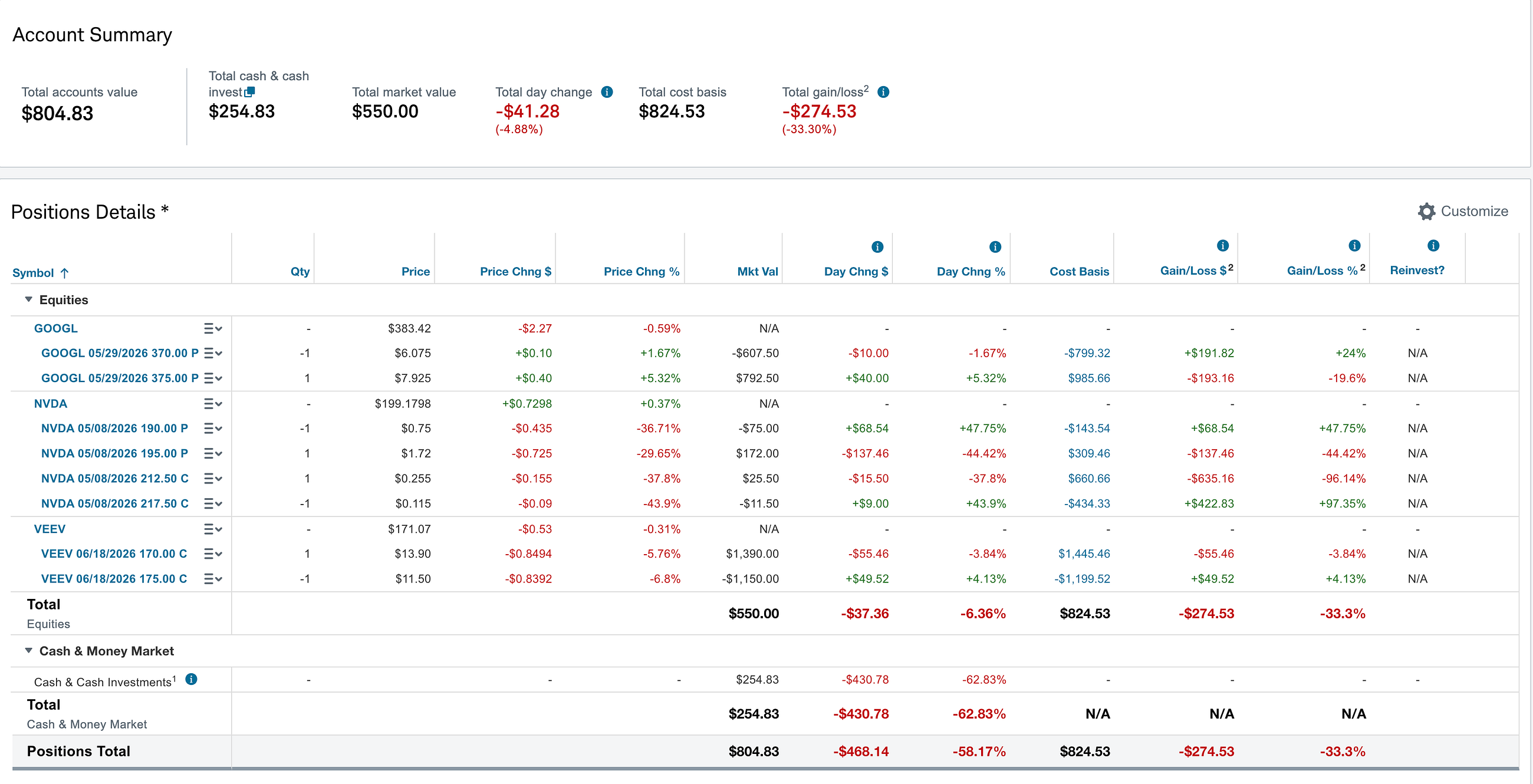
I don’t mean that as a cute metaphor. I mean the account balance is right there on the screen, in red, with numbers too specific to pretend they’re theoretical. Total account value: $804.83. Total market value: $550.00. Cash and cash investments: $254.83. Total cost basis: $824.53. Total gain/loss: -$274.53, or -33.30%.
That isn’t a paper-trading lesson. That’s tuition.
The funny part is that none of the trades felt random when I placed them. They had reasons. Veeva had a conference coming up. Nvidia had momentum, volatility, and drama around big tech earnings. Google looked like it had enough movement to make a spread worth touching. Each position had a story attached to it, and ChatGPT was useful in shaping those stories into trades that sounded more disciplined than they probably were.
That’s where the danger starts.
A bad trade that feels dumb is easy to distrust. A bad trade wrapped in structure is harder to see clearly. Once a spread has defined risk, a thesis, an expiration date, and a few Greeks attached to it, it starts to look like process. It starts to feel more mature than gambling. I’m not just buying calls. I’m choosing a debit spread. I’m not just betting on a stock. I’m expressing a view with capped downside and capped upside.
Then the market opens, and the account still bleeds.
In the screenshot, the damage is scattered across a few names. The GOOGL put spread has one leg up and the other leg down, with the net position still sitting at a loss. The NVDA position is messier because it includes multiple legs with ugly percentage swings. One short put leg is up nicely, but the other long legs are down hard enough to make the whole thing feel unstable. The VEEV call spread is small, but it’s already red, down $5.94 overall across the two legs at that moment.
None of this is catastrophic in dollar terms. That matters. The account is small enough that the losses are survivable. But percentage-wise, the account is getting punched in the face. A 33% total loss isn’t a minor fluctuation. It suggests the strategy is too concentrated, too short-dated, too thesis-heavy, or some unpleasant mix of all three.
That’s the part ChatGPT can make worse if I let it.
ChatGPT is good at helping me think through a trade. It can explain what sell-to-open means. It can compare a debit spread with a credit spread. It can remind me that low option volume may make exiting harder. It can calculate max loss, max profit, breakeven, and expiration risk. It can even challenge a weak thesis if I ask the question cleanly enough.
But it can’t feel the position for me.
It doesn’t feel that small panic when a short-dated Nvidia spread moves against me in the first hour. It doesn’t feel the annoyance of watching one leg print green while the net position is still wrong. It doesn’t feel the temptation to “fix” a position by adding another spread in the same stock. It doesn’t know whether I’m trading from a plan or trying to win back the last mistake.
A trade can be mechanically defined and still be emotionally sloppy. I can know my max loss and still size too aggressively. I can understand the expiration date and still choose one that gives the thesis almost no time to be right. I can say “defined risk” while stacking several defined-risk trades until the whole account behaves like one large unstable bet.
That’s what this screenshot shows me. It doesn’t show one insane trade. It shows a pattern forming.
The account has positions in GOOGL, NVDA, and VEEV. These aren’t obscure penny stocks. The underlying companies are real. The problem isn’t that the names are garbage. The problem is that the trades are built around short-term movement, and short-term movement doesn’t care how reasonable the story sounds. A stock can have good earnings, a strong business, and a compelling event calendar, then still move the wrong way before expiration. Worse, it can move the right way too late.
Options punish timing mistakes efficiently. That’s part of why gambling with ChatGPT feels so seductive. It gives language to the impulse. Instead of saying, “I think Nvidia will drop this week,” I can say, “I’m considering a defined-risk bearish position into near-term volatility, with an exit plan before expiration.”
That sentence sounds responsible. It may even describe a responsible trade in the right context. But if the position size is too large for the account, the sentence doesn’t save me.
The screenshot is useful because it removes the fantasy. There’s no elegant trading philosophy in a line that says Positions Total: -$274.53. There’s no deep market insight in a -58.17% day change across the positions and cash movement shown. There is only the question I should’ve asked before entering the trades:
What would make this account healthier tomorrow?
Not what trade has the best story. Not what stock has the best catalyst. Not what spread has the most attractive max profit. What makes the account healthier?
For an account this size, the answer is probably boring. Fewer positions. Smaller sizing. More cash. Longer expirations. No revenge adjustments. No stacking correlated tech bets because the first idea didn’t work fast enough. No pretending that a thesis is a risk-management plan.
ChatGPT can still help, but I have to use it differently. It shouldn’t be the voice that helps me justify another trade. It should be the annoying risk clerk asking what happens if I’m wrong. It should force me to write the exit before the entry. It should ask whether the option has enough liquidity to exit cleanly. It should calculate the loss as a percentage of account value, not only as a dollar amount. It should tell me when a trade isn’t worth taking because the account can’t absorb another bad week.
That’s less fun than gambling with it. It’s also probably the only way the tool becomes useful instead of expensive.
The honest version is this: I like trading with ChatGPT because it makes me feel less alone while making decisions I don’t fully trust yet. It helps me slow down, but it can also help me dress up impatience as analysis. The tool isn’t the problem by itself. The problem is what I ask it to do. If I ask it to help me find a trade, it’ll help me find one. If I ask it to protect the account, the conversation changes.
Right now, the screenshot says the account needs protection more than excitement. That’s the part I need to sit with. Not because the losses are huge. They aren’t. But because small accounts teach fast. A small account can become a lab, or it can become a slot machine with better vocabulary.