🧱 What Makes a DeFi Strategy Actually Sustainable?
--
DeFi is full of yield.
New strategies launch every week.
APYs spike.
Capital rushes in.
And then — almost predictably — everything fades.
Yields compress.
Liquidity exits.
Opportunities disappear.
This cycle has become one of the most recognizable patterns in DeFi. Which raises a more important question than “what’s the highest APY?”:
What actually lasts?
1️⃣ The Pattern: The Rise and Fall of Yield
We’ve all seen it:
A new protocol launches with aggressive incentives.
Early users pile in to capture high returns.
Liquidity surges, pushing yields down.
Incentives taper off.
Capital rotates to the next opportunity.
This loop repeats across DeFi ecosystems.
The issue isn’t a lack of innovation — it’s that most strategies are designed for short-term attraction, not long-term durability.
So why do they fade so quickly?
Because most yields are not built on sustainable foundations.
2️⃣ Defining “Sustainable” in DeFi
A sustainable DeFi strategy isn’t the one with the highest short-term returns — it’s the one that continues to perform over time.
True sustainability means:
- Consistent returns across cycles
- Low dependence on external incentives
- Adaptability to changing market conditions
This is about durability, not hype.
Sustainable yield is not about maximizing upside in a week — it’s about maintaining performance across months or years.
3️⃣ Real Yield vs Temporary Yield
Not all yield is created equal.
There are two primary sources:
Temporary Yield
- Driven by token emissions or incentives
- Designed to attract liquidity quickly
- Declines as rewards reduce
Real Yield
- Generated from actual economic activity
- Trading fees, lending interest, arbitrage
- Backed by genuine demand
Temporary yield is often unsustainable by design.
Real yield, on the other hand, is tied to market usage, making it inherently more stable.
This distinction is critical when evaluating any DeFi strategy.
4️⃣ The Role of Liquidity & Market Conditions
Sustainability is deeply tied to the environment a strategy operates in.
Key factors include:
- Liquidity depth — Shallow liquidity leads to instability
- User activity — More usage = more real yield
- Market volatility — Some strategies thrive in volatility, others don’t
- Demand — Without demand, yield collapses
Some strategies only work under ideal conditions.
Others are designed to adapt across cycles — these are the ones that last.
5️⃣ Risk & Cost Awareness
Many DeFi strategies look strong on paper — but degrade in practice.
Why?
Because hidden costs are often ignored:
- Execution costs
- Slippage
- Rebalancing frequency
- Changing correlations between assets
A strategy showing high APY might actually deliver lower net returns once these factors are included.
This is where risk-adjusted yield becomes essential.
Sustainable strategies don’t just chase returns — they manage costs and risks effectively.
6️⃣ Designing Better DeFi Strategies
Long-term strategies are not built on single opportunities — they are built as systems.
Key principles include:
- Diversification across multiple strategies
- Continuous monitoring and adjustment
- Adapting to market changes
- Focusing on net yield, not headline APY
This is where DeFi begins to evolve into managed DeFi — moving from manual yield farming to structured capital allocation.
7️⃣ The Role of DeFi Vaults
This is exactly where DeFi vaults come in.
Instead of users manually chasing opportunities, vaults:
- Allocate capital across strategies
- Optimize for sustainable yield
- Adjust positions dynamically
- Reduce reliance on incentives
Concrete vaults are designed with this philosophy:
Prioritizing durability over short-term peaks.
They treat onchain capital not as something to chase yield — but something to manage intelligently over time.
8️⃣ A Real Example: Concrete DeFi USDT
A practical example of this approach is Concrete DeFi USDT.
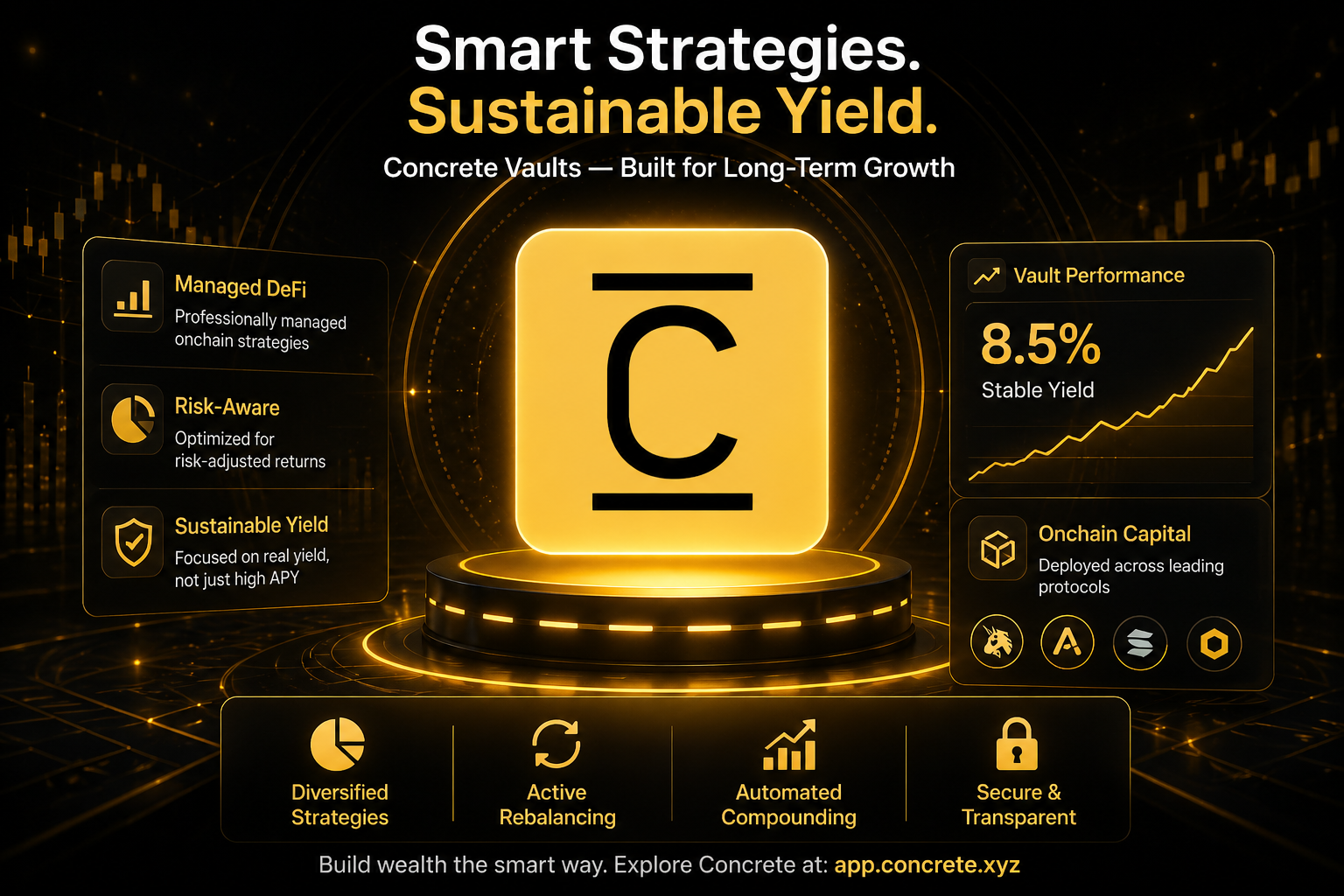
- Offers up to ~8.5% stable yield
- Focuses on consistency over volatility
- Attracts long-term, stability-focused capital
At first glance, this may seem less exciting than triple-digit APYs.
But over time:
- Stable returns compound
- Risks are reduced
- Capital stays instead of rotating
This is the essence of sustainable yield — less noise, more reliability.
9️⃣ The Bigger Shift in DeFi
DeFi is evolving.
From:
- Short-term yield chasing
- Incentive-driven strategies
- Constant capital rotation
To:
- Long-term capital efficiency
- Risk-adjusted yield
- Managed, system-based strategies
The future of DeFi will not be defined by the highest APY.
It will be defined by:
The strategies that survive.
Because in the long run,
infrastructure outlasts incentives.
🚨 Explore Concrete: https://app.concrete.xyz/earn 🚨