What Makes a DeFi Strategy Actually Sustainable?
 I SODL4 min read·1 hour ago
--
DeFi is full of yield.
New strategies launch every week.
APYs spike.
Capital flows in.
And then, almost like clockwork:
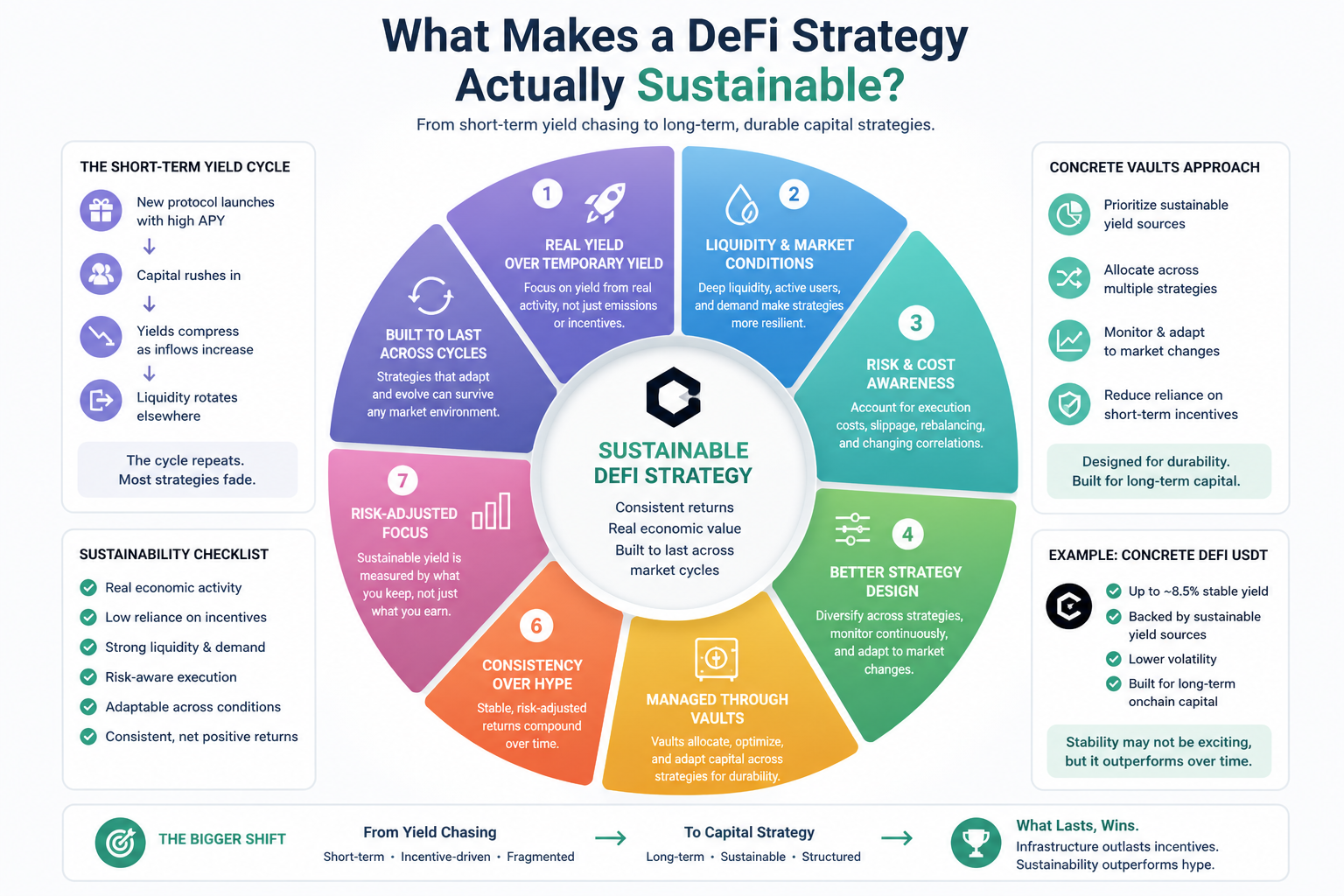
Yields compress.
Liquidity exits.
Attention shifts somewhere new.
If you’ve spent any time in DeFi, this pattern is familiar. It’s not an exception, it’s the cycle.
So the real question isn’t:
“What has the highest yield?”
It’s:
“What actually lasts?”
The Pattern Behind DeFi Yield
At first glance, DeFi feels like a constant stream of opportunity. New protocols promise double- or triple-digit returns, attracting waves of capital almost overnight.
But these opportunities rarely persist.
Why?
Because most are built on temporary conditions:
- Early-stage incentives
- Limited liquidity
- Short-lived inefficiencies
- Speculative demand
As capital floods in, the very thing that made the opportunity attractive begins to disappear. Yields normalize. Risk increases. Participants move on.
This raises a deeper question:
Why do most DeFi strategies fade so quickly and what makes some endure?
Defining “Sustainable” in DeFi
A sustainable DeFi strategy isn’t just one that performs well today. It’s one that continues to function across time and changing conditions.
At a minimum, sustainable yield should:
- Generate consistent returns over time
- Avoid dependence on short-term incentives or emissions
- Remain viable across different market environments
This is about durability, not just performance.
In other words, sustainability is less about how high a strategy can go and more about how long it can survive.
Real Yield vs Temporary Yield
Not all yield is created equal.
One of the most important distinctions in DeFi strategies is the source of returns:
Temporary Yield
- Driven by token emissions or incentives
- Designed to bootstrap liquidity
- Declines as incentives taper off
Real Yield
- Generated from actual economic activity
- Includes trading fees, lending interest, arbitrage
- Tends to be more stable and repeatable
Emission-driven strategies often look attractive upfront, but they rely on continuous external input. Once incentives dry up, so does the yield.
Real yield, on the other hand, is tied to underlying demand. As long as users are trading, borrowing, or hedging, the strategy has a reason to exist.
This is the foundation of sustainable yield.
Liquidity, Activity, and Market Conditions
Even strong strategies don’t operate in isolation. Their sustainability depends heavily on the environment around them.
Key factors include:
- Liquidity depth — Shallow markets increase slippage and fragility
- User activity — Without participation, yield disappears
- Market volatility — Some strategies thrive on it, others break
- Demand for the strategy — If no one needs it, it won’t last
Some DeFi strategies are highly conditional they only work in bull markets, or only during periods of high volatility.
Others are more adaptable.
The difference often determines whether a strategy is temporary or durable.
The Hidden Layer: Risk and Cost
One of the biggest mistakes in evaluating DeFi strategies is focusing only on headline APY.
Because yield is never the full story.
Over time, performance is shaped by:
- Execution costs
- Rebalancing frequency
- Slippage in low-liquidity environments
- Changing correlations between assets
A strategy that looks strong on paper can degrade quickly once these factors are accounted for.
This is where risk-adjusted yield becomes critical.
Sustainable strategies aren’t just profitable, they are efficient, resilient, and mindful of hidden costs.
Designing for Sustainability
As DeFi matures, strategy design is evolving.
The focus is shifting from isolated opportunities to systems that can adapt and persist.
Sustainable approaches often include:
- Diversification across multiple strategies
- Continuous monitoring and adjustment
- Dynamic allocation based on market conditions
- Prioritizing net returns over headline APY
This is the foundation of managed DeFi where capital is actively positioned rather than passively exposed.
Instead of chasing yield, the goal becomes maintaining it.
From Opportunities to Infrastructure
This shift is where DeFi starts to resemble traditional finance — not in structure, but in mindset.
Capital begins to behave differently:
- Less reactive
- More strategic
- Focused on long-term outcomes
And this is exactly where DeFi vaults come in.
Vaults are designed to:
- Aggregate and manage capital
- Allocate across multiple strategies
- Adjust to changing conditions
- Reduce reliance on short-term incentives
In essence, they transform fragmented opportunities into cohesive systems.
A Concrete Approach to Sustainability
Concrete vaults are built around this idea of durability.
Rather than optimizing for peak yield at a single moment, they aim to:
- Prioritize sustainable yield sources
- Manage capital across evolving strategies
- Adapt to market shifts
- Deliver more stable, risk-aware returns
This is what institutional DeFi starts to look like structured, disciplined, and focused on longevity.
Why Stability Wins Over Time
Take Concrete DeFi USDT as an example.
With yields of up to ~8.5%, it may not compete with the most aggressive opportunities in DeFi.
But that’s the point.
Because over time:
- Stable returns often outperform volatile ones
- Lower drawdowns preserve capital
- Consistency attracts long-term participants
For onchain capital, reliability matters more than spikes.
What looks “less exciting” in the short term often proves more powerful across cycles.
The Bigger Shift
DeFi is evolving.
We’re moving away from:
- Short-term yield chasing
- Incentive-driven participation
- Fragmented strategies
And toward:
- Long-term capital allocation
- Sustainable, risk-adjusted yield
- Structured and managed systems
The next phase of DeFi won’t be defined by the highest APY.
It will be defined by the strategies that endure.
Because in the end:
Infrastructure outlasts incentives.
And sustainability outperforms hype.
Explore Concrete at: https://app.concrete.xyz/earn