What Makes a DeFi Strategy Actually Sustainable?
 Jalakdewata4 min read·Just now
--
DeFi is full of yield.
You’ve seen it.
I’ve seen it.
A new protocol launches.
APYs look insane.
Capital floods in.
For a moment, it feels like free money.
Then reality kicks in.
Yields compress.
Liquidity rotates out.
The “opportunity” disappears almost as fast as it came.
And a week later, everyone is chasing the next thing.
So maybe the real question isn’t:
“Where’s the highest yield right now?”
But something way more uncomfortable:
“What actually lasts?”
---
The Pattern We Keep Repeating
If you’ve spent even a few months in DeFi, the cycle becomes obvious.
1. New protocol launches with high APY
2. Early capital rushes in
3. Rewards get diluted
4. Yield drops
5. Liquidity moves elsewhere
Rinse and repeat.
It’s basically musical chairs, but with capital.
And here’s the thing most people don’t want to admit:
This isn’t a bug. It’s the default behavior of short-term incentives.
Which leads to a deeper question:
Why do most DeFi strategies fade so quickly?
---
What Does “Sustainable” Even Mean?
Let’s simplify it.
A sustainable strategy isn’t the one that looks best this week.
It’s the one that still works months later.
In practical terms, a sustainable yield strategy should:
Generate consistent returns over time
Not rely entirely on token incentives
Still function across different market conditions
This is about durability, not hype.
Think of it like this:
High APY is like fireworks — bright, loud, and gone fast.
Sustainable yield is more like a steady engine — not flashy, but it keeps running.
---
Real Yield vs Temporary Yield
Not all yield is created equal. And this is where things get real.
There are basically two sources of yield in DeFi:
1. Real Yield
Comes from actual economic activity:
Trading fees
Lending interest
Arbitrage opportunities
This type of yield exists because users are doing something valuable.
2. Incentive-Driven Yield
Comes from emissions:
Token rewards
Liquidity mining programs
This type of yield exists because protocols are paying you to stay.
And here’s the uncomfortable truth:
Incentives decay.
Protocols can’t emit forever without consequences.
Once emissions drop, yield drops.
Meanwhile, real economic activity tends to be more stable — because it’s tied to actual demand.
So when people talk about sustainable yield, what they’re really pointing at is:
Yield that doesn’t disappear when incentives do.
---
Liquidity, Market Conditions, and Reality
Even solid strategies aren’t immune to context.
Sustainability depends heavily on things like:
Liquidity depth
User activity
Market volatility
Demand for the strategy itself
Some strategies only work in bull markets.
Others only work when volatility is high.
Very few are truly adaptable.
And that’s the difference:
Fragile strategies need perfect conditions.
Sustainable ones survive imperfect ones.
---
The Hidden Costs Everyone Ignores
This is where most “high yield” strategies quietly break down.
On paper, everything looks great.
In reality?
You’re dealing with:
Execution costs
Slippage
Rebalancing overhead
Changing correlations
That 20% APY?
After costs and inefficiencies, it might look very different.
This is why risk-adjusted yield matters more than headline numbers.
Because what you keep is what actually counts.
---
Designing Better DeFi Strategies
Once you zoom out, you start seeing DeFi less as isolated plays…
and more like systems.
Sustainable strategies tend to share a few traits:
Diversification across multiple sources of yield
Continuous monitoring and adjustment
Adaptability to market changes
Focus on net returns, not just APY
At this point, DeFi starts to resemble something closer to managed DeFi, not just farming.
And that shift matters.
Because it moves capital from reactive → intentional.
---
Where Concrete Vaults Fit In
This is exactly the space where vault-based systems come in.
Instead of chasing one strategy, vaults aim to:
Allocate capital across multiple strategies
Prioritize sustainable yield sources
Adapt as conditions change
Reduce reliance on short-term incentives
In other words:
They treat DeFi like a portfolio problem, not a single bet.
That’s the idea behind Concrete vaults — focusing on durability rather than peak performance.
---
A Simple Example: Concrete DeFi USDT
Let’s make this real.
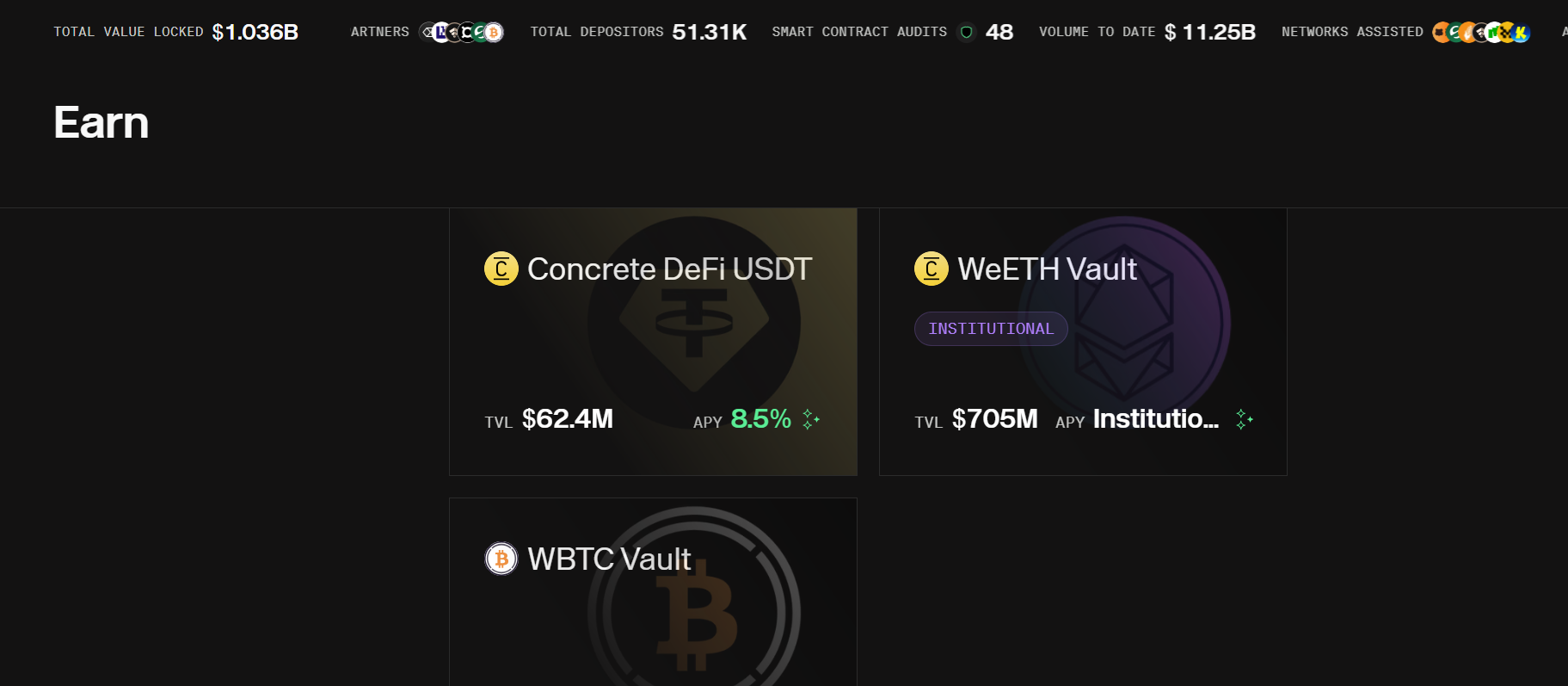
Concrete’s USDT vault offers around ~8.5% yield.
At first glance, that might not sound exciting compared to 20%+ farms.
But zoom out.
It’s stable
It’s consistent
It’s built around sustainable mechanisms
And over time?
Consistency tends to beat volatility.
Because long-term capital doesn’t chase spikes — it prefers reliability.
This is how institutional DeFi starts to think:
Not “What’s highest today?”
But “What can I trust over time?”
---
The Bigger Shift Happening in DeFi
We’re slowly moving from:
Yield chasing → Strategy building
From:
Short-term gains → Long-term capital allocation
And that shift changes everything.
Because in the long run:
Sustainability matters more than peak returns
Systems outperform isolated opportunities
Infrastructure outlasts incentives
The future of DeFi won’t be defined by the highest APY.
It will be defined by the strategies that don’t break.
---
If you want to explore how this approach looks in practice:
👉 Explore Concrete at: https://app.concrete.xyz/earn
---
If you read this carefully, the takeaway is simple but uncomfortable:
Most yield isn’t designed to last.
So the real edge isn’t finding the highest number.
It’s recognizing which ones won’t disappear when the music stops.