 SYED MINHAJUL ISLAM4 min read·Just now
--
🧱 What Makes a DeFi Strategy Actually Sustainable?
Every cycle in DeFi seems to follow the same script.
A new protocol launches with eye-catching returns.
Liquidity rushes in.
APYs spike.
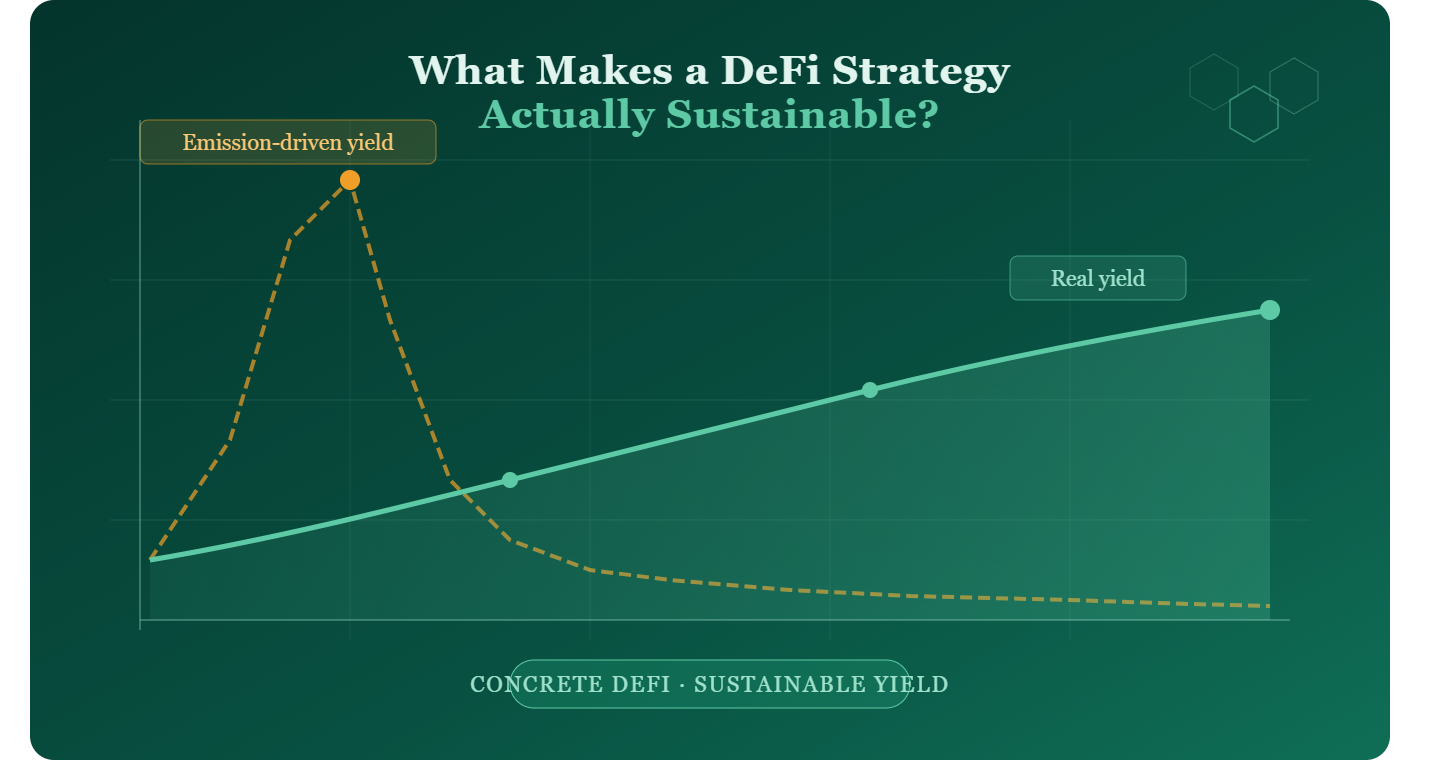
Then, almost as quickly, yields decline and capital moves on.
This pattern isn’t accidental — it’s structural.
And it leads to a more important question for anyone deploying onchain capital:
What actually makes a DeFi strategy sustainable?
The Cycle of Short-Term Yield
Most DeFi strategies begin with momentum, not durability.
High APYs are often driven by incentives designed to bootstrap liquidity. These rewards create temporary opportunities, but they rarely translate into long-term value. As emissions slow or token prices fluctuate, returns compress and liquidity rotates elsewhere.
This creates a constant cycle of capital chasing performance rather than building it.
Sustainable yield, however, requires a different foundation — one that doesn’t rely on short-term attention.
Defining Sustainable Yield
At its core, sustainable yield is about consistency over time, not peak returns.
A sustainable strategy should:
- produce reliable, risk-adjusted yield
- function across different market conditions
- rely on real economic activity
- remain efficient after accounting for costs
This is where DeFi strategies begin to resemble traditional financial systems — focused less on hype, and more on durability.
Real Yield vs Incentivized Yield
One of the clearest distinctions in DeFi is the difference between real yield and incentivized yield.
Real yield comes from:
- trading fees
- borrowing demand
- market-making activity
These sources are tied directly to user behavior and tend to persist as long as the market remains active.
In contrast, incentivized yield comes from:
- token emissions
- liquidity mining rewards
These mechanisms are effective for growth, but they are inherently temporary.
Over time, sustainable yield almost always aligns with real usage, not artificial incentives.
Market Conditions and Liquidity Dynamics
No strategy exists in isolation.
Liquidity depth, volatility, and demand all shape performance. Some DeFi strategies perform exceptionally well in bullish, high-volume environments but struggle during periods of low activity.
Others are more adaptive, maintaining steady returns regardless of market direction.
Sustainability depends on this adaptability — the ability to generate yield without relying on a single set of conditions.
The Reality of Costs and Risks
A major flaw in many DeFi strategies is the focus on headline returns without considering underlying costs.
In practice, performance is affected by:
- transaction fees
- slippage
- rebalancing frequency
- changing asset correlations
When these factors are included, many high-APY strategies reveal significantly lower net returns.
This is why risk-adjusted yield is far more meaningful than raw APY. It reflects what investors actually keep — not just what is advertised.
From Strategies to Systems
As DeFi matures, the focus is shifting from isolated opportunities to integrated systems.
Managed DeFi introduces a more disciplined approach:
- diversifying across multiple strategies
- continuously monitoring performance
- reallocating capital dynamically
- optimizing for long-term efficiency
This transforms DeFi from a reactive environment into a structured capital allocation system.
The Role of DeFi Vaults
DeFi vaults are central to this evolution.
Instead of requiring users to manually chase yield, vaults automate strategy execution and capital allocation. They adapt to market changes, manage risk, and aim to deliver consistent returns.
Concrete vaults are designed with this philosophy in mind. By focusing on sustainable yield and minimizing reliance on incentives, they represent a more advanced model of managed DeFi.
They bridge the gap between retail participation and institutional DeFi — where stability, efficiency, and scalability are essential.
Stability as a Competitive Advantage
One of the most overlooked insights in DeFi is that lower but stable returns often outperform volatile ones over time.
Strategies that deliver consistent yield allow capital to compound efficiently, without exposure to sudden drawdowns or liquidity shocks.
For institutional DeFi participants, this stability is not a drawback — it’s a requirement.
It aligns with how long-term capital evaluates performance: through risk-adjusted yield, not short-term spikes.
The Future of Onchain Capital
DeFi is entering a new phase.
The early era was defined by experimentation and rapid growth. The next phase will be defined by sustainability and structure.
Onchain capital is becoming more sophisticated. Participants are no longer just chasing yield — they are evaluating strategy design, risk exposure, and long-term viability.
This shift is driving the rise of:
- sustainable yield models
- managed DeFi platforms
- adaptive DeFi vaults
- institutional-grade infrastructure
Concrete vaults sit at the center of this transformation, offering a framework built for durability rather than temporary performance.
Conclusion
The future of DeFi won’t be determined by the highest APY.
It will be shaped by the strategies that can endure — across cycles, across conditions, and across time.
Sustainable yield, risk-adjusted thinking, and structured capital management are no longer optional. They are the foundation of the next generation of DeFi strategies.
Because in the long run, the strategies that last will always outperform the ones that don’t.
More details :app.concrete.xyz