What Makes a DeFi Strategy Actually Sustainable?
--
DeFi has created no shortage of opportunities for capital. New protocols launch constantly, APYs surge, liquidity rushes in, and narratives form around “the next big strategy.” Yet the pattern is familiar: incentives fade, yields compress, capital rotates, and many opportunities disappear as quickly as they arrived.
This cycle has repeated across DeFi for years.
Which raises a deeper question:
Why do most strategies fade, while some persist?
The answer often comes down to one idea — sustainability.
Because the strongest DeFi strategies are not necessarily the ones producing the highest returns this week. They are the ones designed to survive changing market conditions and continue generating value across cycles.
Sustainable Yield Is About Durability, Not Hype
A sustainable strategy is not simply one with attractive returns.
It is one that can deliver consistent, risk-adjusted yield over time while remaining resilient under different conditions.
That means a sustainable strategy should:
- Generate returns beyond a single market phase
- Function without depending entirely on token incentives
- Adapt when volatility, liquidity, or correlations shift
- Preserve viability even when easy opportunities disappear
This is where durability matters more than headline performance.
In both traditional finance and onchain capital markets, long-term success often comes from repeatability, not temporary outperformance.
Real Yield vs Temporary Yield
One of the biggest distinctions in DeFi is where yield comes from.
Some yield is generated through real economic activity, such as:
- Trading fees
- Lending demand
- Arbitrage inefficiencies
- Productive capital deployment
This kind of yield tends to have stronger foundations because it comes from actual usage.
Other yield is largely driven by emissions and incentives.
These strategies can attract capital quickly, but they often struggle once rewards decline. As emissions fall, liquidity can leave, and the strategy weakens.
That is why many high-APY opportunities prove temporary.
The yield was subsidized, not sustainable.
Not all yield is created equal.
And sustainable yield often starts with real activity.
Liquidity and Market Conditions Define Longevity
Even a strong strategy can fail if market structure does not support it.
Sustainability depends heavily on:
Liquidity Depth
Without deep liquidity, execution deteriorates, slippage increases, and strategies become harder to scale.
User Activity
Strategies tied to genuine demand tend to have stronger long-term foundations.
Volatility Conditions
Some opportunities only work in narrow environments. Durable strategies perform across multiple regimes.
Adaptive Demand
The best DeFi strategies evolve as conditions change.
That adaptability often separates fragile systems from lasting ones.
Risk and Costs Are Part of Yield
This is where many investors make mistakes.
They focus on gross yield.
But ignore net yield.
A strategy can show strong returns on paper and still degrade materially once real-world frictions are considered.
Those frictions include:
- Execution costs
- Rebalancing overhead
- Slippage
- Correlation shifts
- Drawdown risk
Once these are included, the true return can look very different.
This is why risk-adjusted yield often matters more than raw APY.
A lower but stable return may outperform a higher but fragile strategy over time.
That is a capital allocation lesson, not just a DeFi lesson.
Sustainable Strategies Are Built Like Systems
Long-term strategies are usually designed, not chased.
They tend to rely on:
Diversification
Reducing dependence on a single opportunity.
Continuous Monitoring
Adjusting when market conditions evolve.
Dynamic Capital Allocation
Moving capital where sustainable returns remain.
Net Return Optimization
Focusing on what remains after risk and costs.
This is where DeFi begins looking less like isolated trades and more like managed systems.
And that shift matters.
Because sustainable finance is usually built as infrastructure.
Not as opportunism.
Why Concrete Vaults Fit This Model
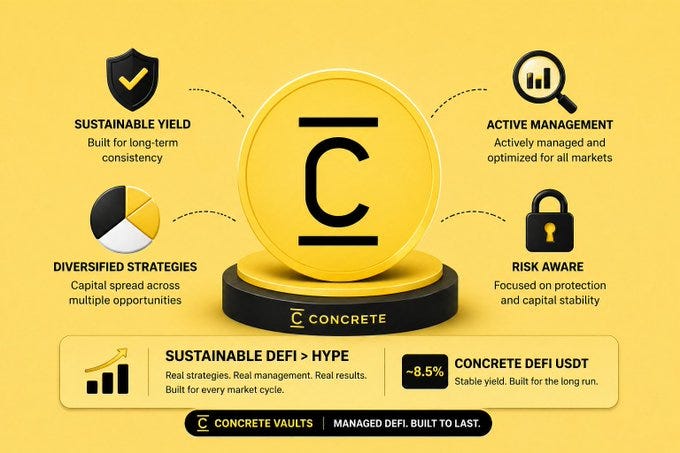
This is where Concrete vaults offer an important framework.
Rather than relying on short-term incentives alone, DeFi vaults can be designed to:
- Prioritize sustainable yield sources
- Manage capital across multiple strategies
- Adapt to changing market conditions
- Reduce reliance on emissions-driven returns
That approach aligns with how managed DeFi may evolve as more sophisticated participants enter the space.
For long-term onchain capital, durability often matters more than chasing temporary spikes.
And that is exactly where strategy design becomes critical.
Concrete DeFi USDT as a Practical Example
Consider Concrete DeFi USDT, offering up to ~8.5% stable yield.
Compared to highly volatile triple-digit APYs, that may seem modest.
But sustainable opportunities often look less dramatic.
And more durable.
Why can consistency matter?
Because:
- Stable returns can compound reliably
- Lower volatility can preserve capital
- Risk-adjusted outcomes may be stronger
- Long-term capital often prefers predictability
This is especially relevant in institutional DeFi, where sustainability often matters more than speculative upside.
Sometimes the less exciting opportunity produces the stronger long-term result.
That is the difference between chasing yield and managing capital.
Explore Concrete at: https://app.concrete.xyz/earn
The Bigger Shift Ahead
DeFi is maturing.
And with maturity comes a shift:
From short-term yield chasing
Toward long-term capital strategies.
From incentive-driven growth
Toward durable infrastructure.
From peak APY obsession
Toward sustainable yield.
That shift may define the next phase of onchain markets.
Because ultimately, the future of DeFi may not belong to the strategies offering the highest returns today.
It may belong to the strategies that continue working tomorrow.
Because infrastructure outlasts incentives.
And in the long run, the strongest opportunities are rarely the ones that spike the hardest —
They are the ones that last. 🚀