What Makes a DeFi Strategy Actually Sustainable?
 ho jame3 min read·Just now
--
I’ll start with a confession: I lost money farming.
Not in some “oh I underperformed BTC” way. In a “watched the APY drop from 1,400% to 12% in three weeks while my LP token bled out” way. The protocol shall remain nameless because I’m still embarrassed.
If you’ve farmed at all, you know the cycle. New project drops. Front page screams 800% APY. Telegram fills with screenshots. You ape in because what if this is the one. Three weeks later the rewards are gone, the token’s down 70%, impermanent loss has eaten whatever you made, and the circus rotates to the next shiny number.
I did this for over a year. I want most of it back.
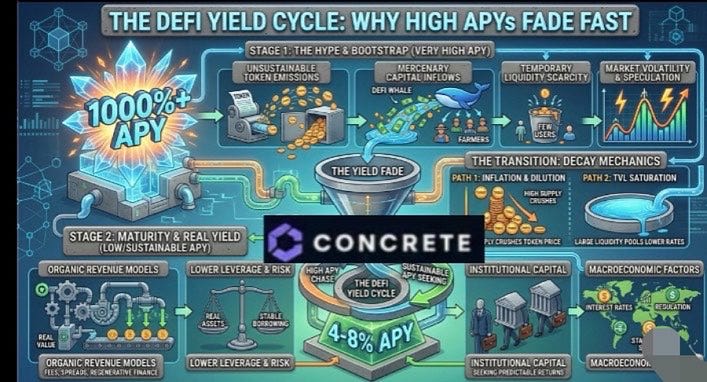
The thing nobody tells you is that the headline APY almost never reflects the actual APY. It’s two different things mashed into one number.
Real yield comes from something — lending interest, trading fees, arbitrage spreads, restaking rewards. Money that exists because someone actually paid for something. Incentive yield is just newly printed tokens used to bribe liquidity into showing up. A marketing budget with a clock on it.
When the budget runs out the APY collapses. When the reward token tanks (and it always tanks), it collapses faster. You end up holding a bag and a Discord channel that’s gone silent.
The right question isn’t “what’s the highest APY today.” It’s “will this still be working in six months?” Most things won’t.
What lasts is the boring stuff. Real lending demand. Trading fees from DEXs with actual volume. Restaking that secures something. None of it pays 800%. It pays maybe 4–12%. Sounds like nothing if you’ve been brain-damaged by farm screenshots, but 8% that lasts beats 800% that doesn’t.
I underestimated cost for embarrassingly long. Gas. Slippage moving in and out of pools. Rebalancing fees when yields rotate. And time — hours every week staring at dashboards. When I added it up, I’d been working a part-time job for negative wages.
Sustainable yield, if I had to define it, is yield that survives all that. A real source. Liquidity you can actually exit. Risk that’s been thought about. And the ability to rotate when the venue paying the most this month stops paying next month — because they always do.
Which brings me to vaults, specifically Concrete, which I’ve been testing the last few months after deciding I was done chasing manually.
You deposit one asset. The vault deploys it across multiple strategies — lending on Aave, liquidity on Pendle, Curve pools, restaking — and an Allocator rebalances between them as conditions shift. You get back a yield-bearing token (ctUSDT, ctWBTC) that’s composable elsewhere in DeFi.
What got my attention isn’t the tech. It’s that they openly say they’re not chasing the highest APY. They optimize for risk-adjusted yield. The Concrete DeFi USDT vault currently targets around 8.5% on stablecoins. The WBTC vault sits around 7%.
Not numbers that win Twitter. Also not numbers that need a token printer to sustain. My first reaction was “8.5%? that’s it?” Then I remembered the year I spent chasing 200% headlines and ending up underwater on most of them.
The next era of DeFi looks like this. Less farming, more allocating. Less “biggest number on the screen,” more “what’s the actual strategy and what’s the actual risk.” The strategies that survive won’t be the loudest ones. They’ll be the boring ones quietly compounding while the dashboard chasers rotate to whatever launches Tuesday.
If you’re tired of being the exit liquidity, Concrete is worth a look.
Explore Concrete at: https://app.concrete.xyz/earn
Side note — I’m not a native English speaker. I wrote this in Korean and translated it over, so apologies if some parts feel clunky or the phrasing is a bit off. Tried my best. Thanks for reading.
Not financial advice. Yields aren’t guaranteed. DeFi has smart contract risk, market risk, and the always-entertaining risk of teams doing something stupid. The vault target numbers are current and will change.
I’m not a native English speaker. Wrote this in Korean
and translated it over, so apologies if some parts feel clunky or
the phrasing is a bit off. Tried my best. Thanks for reading to the end.