What Makes a DeFi Strategy Actually Sustainable?
--
DeFi is a playground of ever‑changing yields. Protocols launch with eye‑popping APYs, capital rushes in, the numbers compress, and liquidity drifts to the next hot idea. Most of these flash‑in‑the‑pan opportunities fade as quickly as they appear. The real question isn’t “what’s the highest yield?” but “what actually lasts.”
1. The Repeating Pattern
Launch → High APY: New protocols announce double‑digit or even triple‑digit yields to attract users.
Capital Surge: Liquidity providers pour in, inflating the pool size and temporary rewards.
Yield Compression: As more capital chases the same incentives, the APY drops.
Liquidity Rotation: When the reward curve flattens, investors move on to the next high‑yield promise.
This cycle repeats across lending, liquidity mining, and yield‑aggregator vaults. The result is a landscape where most strategies survive only a few weeks or months.
2. Defining “Sustainable”
A sustainable DeFi strategy should:
Produce Consistent Returns — earnings that are trackable over weeks, months, and ideally across market cycles.
Be Incentive‑Resilient — not wholly dependent on token emissions or short‑term subsidies.
Endure Market Stress — remain viable when volatility spikes, when asset prices shift, or when liquidity dries up.
In short, sustainability is about durability, not just headline APY.
3. Real Yield vs. Temporary Yield
| Real Yield (Economic Activity) | Temporary Yield (Incentives) |
| — -| — -|
| Comes from genuine trading fees, lending interest, or arbitrage opportunities. | Comes from token emissions, liquidity‑mining rewards, or promotional bonuses. |
| Tied to underlying user demand and transaction volume. | Tied to a protocol’s tokenomics schedule; declines as emissions taper. |
| More stable; adjusts gradually with market fundamentals. | Often spikes, then decays abruptly once the incentive curve flattens. |
Because emissions‑driven yield diminishes by design, strategies that lean heavily on them will see their APY collapse as soon as the reward schedule winds down.
4. Liquidity & Market Conditions
Sustainability hinges on three market‑related pillars:
Liquidity Depth: Deep order books and sizable pools reduce slippage, allowing a strategy to keep operating even when capital inflows stop.
User Activity: Continuous borrowing, trading, or staking creates a “real‑yield” backbone.
Volatility & Correlation: Strategies that only work in low‑volatility environments (e.g., stablecoin lending) may falter when markets swing, while those that can hedge or adapt to volatility tend to persist.
A durable approach either works across a range of conditions or has built‑in mechanisms to rebalance when the market shifts.
5. Risk & Cost Awareness
Even a seemingly lucrative APY can evaporate once hidden costs are accounted for:
Execution Fees: Gas, bridge, and swap fees can eat a significant portion of returns, especially on congested networks.
Rebalancing Overhead: Frequent position adjustments incur transaction costs and may trigger tax events.
Slippage & Market Impact: Large moves in thin markets can drastically reduce realized yield.
Changing Correlations: Strategies that rely on stable relationships (e.g., stable‑coin pairs) can suffer when those correlations break.
A sustainable strategy surfaces net returns after all these frictions are taken into consideration.
6. Building Sustainable Strategies
Diversify Across Engines: Blend lending, fee‑capture, and arbitrage to smooth out cycles.
Continuous Monitoring: Automated alerts for yield decay, liquidity drops, or gas spikes keep the system agile.
Adaptive Allocation: Shift capital toward the strongest real‑yield sources as conditions evolve.
Focus on Net Yield: Prioritize risk‑adjusted, after‑cost returns rather than headline APY.
When these principles are applied, the portfolio begins to look less like a sprint and more like a long‑term fund.
7. Concrete Vaults: A Case Study in Durability
Concrete’s vault architecture embodies the sustainable‑yield philosophy:
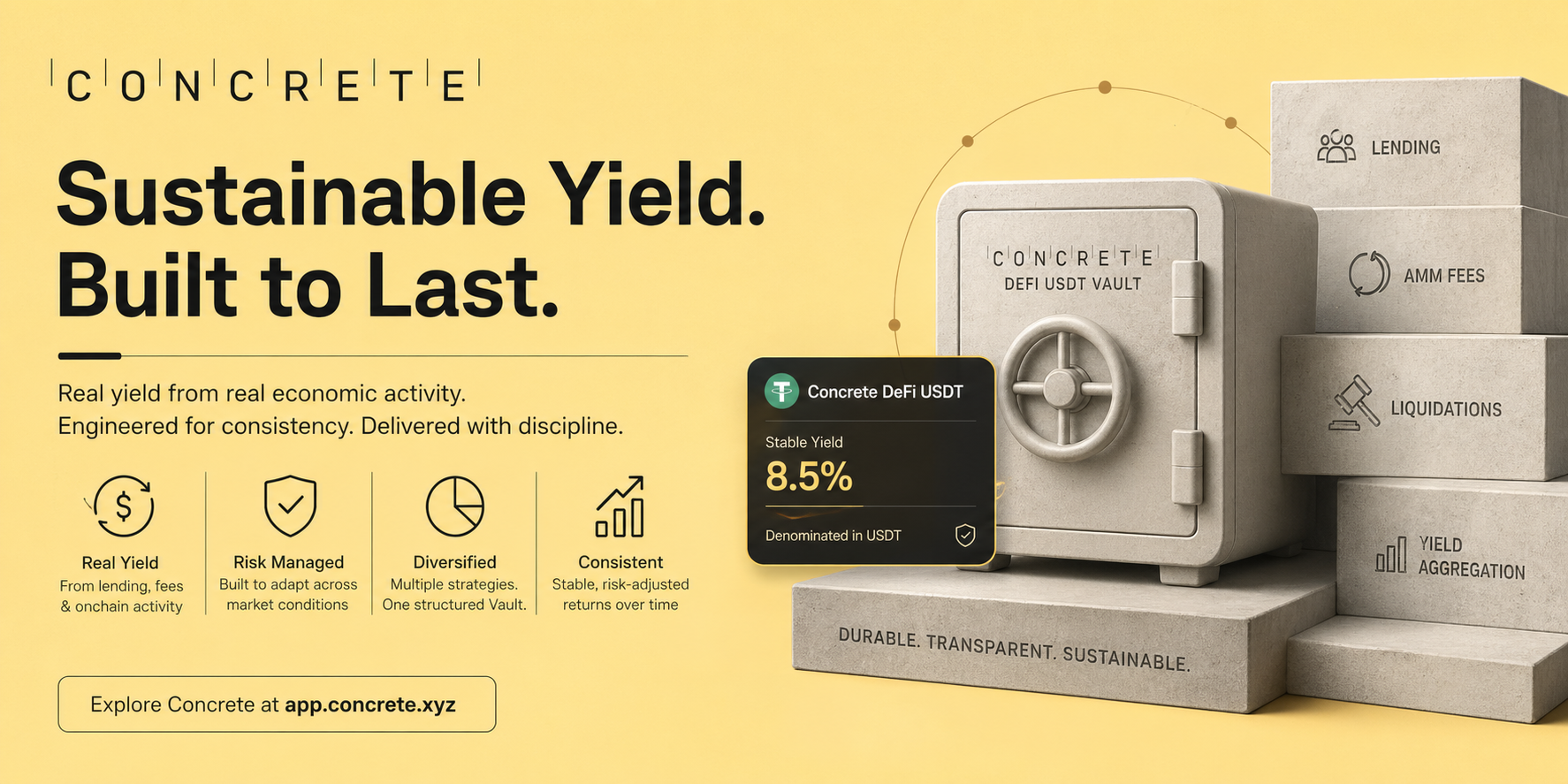
Prioritize Real Yield: Vaults steer capital toward protocols that generate fees from genuine on‑chain activity, limiting exposure to emission‑only rewards.
Dynamic Capital Management: Positions are re‑weighted automatically as liquidity, fee revenue, and market conditions change.
Reduced Incentive Dependence: By capping token‑reward exposure, Concrete vaults avoid the sharp APY drop that follows emission decay.
Risk Controls: Built‑in safeguards monitor gas costs, slippage, and correlation shifts, ensuring that only net‑positive opportunities are executed.
The result is a vault system that aims for steady, risk‑adjusted yield rather than flash‑high APYs.
8. Concrete DeFi USDT — A Concrete Example
Yield Profile: Around 8.5 % stable yield on USDT, driven largely by lending fees and modest incentive overlays.
Stability Over Excitement: While 8.5 % may look modest next to a 200 % “promo” APY, the stability of the return has historically outperformed volatile, incentive‑only offers when measured over multiple quarters.
Capital Attraction: Long‑term investors gravitate toward predictable returns, which also encourages deeper liquidity and lower slippage for the vault.
Concrete DeFi USDT showcases how a lower‑profile, durable yield can be more valuable than a fleeting, high‑risk spike.
9. The Bigger Shift Ahead
DeFi is moving from a yield‑chasing frenzy to a capital‑deployment mindset where longevity matters more than headline numbers. Sustainable strategies will:
Outlast Incentive Schedules: By anchoring returns to real economic activity.
Attract Institutional Capital: Institutions prioritize risk‑adjusted, predictable cash flows.
Shape Infrastructure: Protocols that enable deep liquidity, transparent risk metrics, and composable governance will become the backbone of the ecosystem.
In this emerging paradigm, the winners will be the vaults and protocols that can consistently deliver sustainable yield, not the ones that simply shout the highest APY for a week.
Explore Concrete at app.concrete.xyz to see a live example of a sustainable, managed DeFi approach.
Keywords used naturally: sustainable yield, risk‑adjusted yield, DeFi strategies, DeFi vaults, managed DeFi, Concrete vaults, on‑chain capital deployment, institutional DeFi.