What Makes a DeFi Strategy Actually Sustainable?
 !Solar Smoke4 min read·Just now
--
DeFi moves fast. Too fast, sometimes.
A new protocol launches.
APYs look insane.
Capital rushes in like a tide chasing the moon.
Then, quietly, the same story repeats.
Yields compress. Liquidity fades. Attention shifts elsewhere.
What once looked like an opportunity turns into a memory.
So maybe the real question was never about chasing the highest yield.
It’s about asking what actually stays.
The Pattern We Keep Ignoring
We’ve all seen it.
A farm goes live with triple-digit APY. Early users win. Twitter lights up. Funds rotate in. For a moment, everything feels like momentum.
Then emissions dilute the reward.
Liquidity oversaturates the strategy.
Returns normalize.
And just like that, capital moves on.
This cycle isn’t an exception. It’s the default behavior of most DeFi strategies.
So why do they fade so quickly?
Because most of them were never built to last.
What “Sustainable” Really Means
Sustainability in DeFi isn’t flashy. It doesn’t scream for attention.
A sustainable yield strategy is one that :
- Generates consistent returns over time
- Doesn’t rely entirely on token incentives
- Holds up across different market conditions
It’s not about peak performance. It’s about durability.
In other words, sustainable yield is quiet strength. It compounds slowly, but it survives.
Real Yield vs Temporary Yield
Not all yield is created equal.
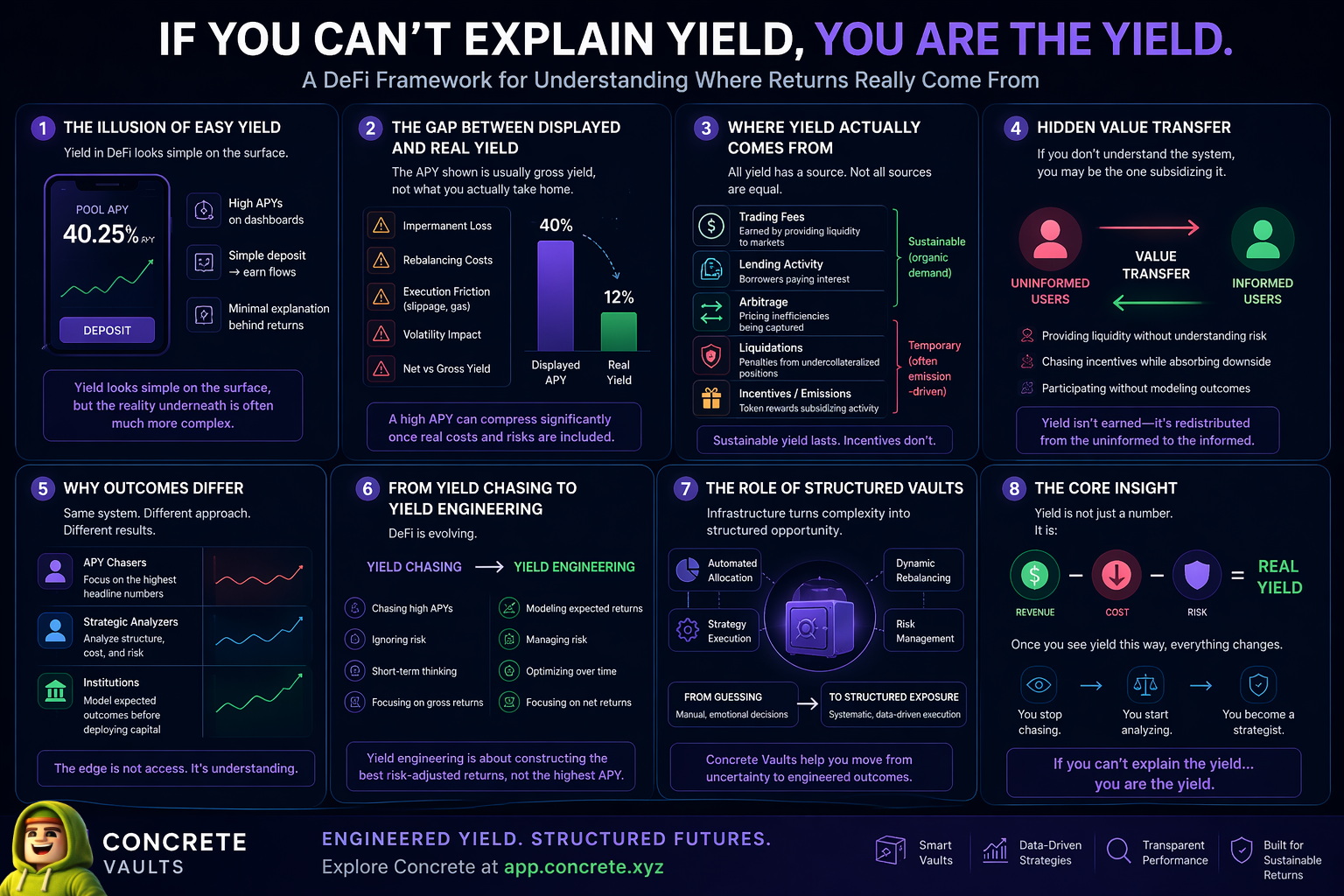
Some yield comes from real economic activity.
Trading fees. Lending interest. Arbitrage inefficiencies.
This is real yield. It exists because users are doing something valuable onchain.
Then there’s another kind.
Yield driven by emissions. Token rewards. Incentive programs designed to bootstrap liquidity.
This is temporary yield.
It works… until it doesn’t.
Emissions decline. Token prices fluctuate. Incentives dry up. And when they do, the yield disappears with them.
Real yield, on the other hand, is tied to actual demand. It may not spike as high, but it tends to persist.
That’s the difference between something that attracts attention and something that retains capital.
Liquidity, Market Conditions, and Adaptability
A strategy doesn’t exist in isolation. It lives inside a market.
Sustainability depends on:
- Depth of liquidity
- Level of user activity
- Market volatility
- Demand for the underlying strategy
Some strategies only perform in very specific conditions. High volatility. Bull markets. Incentive-heavy environments.
Others adapt.
The ones that last are flexible. They respond to changing conditions instead of breaking under them.
That adaptability is what separates fragile yield from resilient systems.
The Hidden Costs That Erode Yield
On paper, many strategies look perfect.
But reality is less forgiving.
Execution costs.
Rebalancing frequency.
Slippage.
Shifting correlations between assets.
All of these quietly eat into returns.
A strategy showing high APY might deliver far less once these factors are accounted for. This is where risk-adjusted yield matters more than headline numbers.
Because what you keep is more important than what you see.
Designing for Durability
Sustainable DeFi strategies aren’t discovered. They’re designed.
They tend to share a few core principles:
- Diversification across multiple strategies
- Continuous monitoring and adjustment
- Adaptation to evolving market conditions
- Focus on net returns, not just APY
At this level, DeFi starts to feel less like yield farming… and more like system design.
This is where managed DeFi begins to take shape.
Where Concrete Fits In
This is the idea behind Concrete vaults.
Instead of chasing short-term spikes, these vaults aim to:
- Prioritize sustainable yield sources
- Actively manage capital across strategies
- Adapt as conditions change
- Reduce reliance on temporary incentives
It’s a shift from reactive to intentional.
From chasing opportunities… to building systems that endure.
If you want to explore how this works in practice:
https://app.concrete.xyz/earn
A Grounded Example: Concrete DeFi USDT
Take Concrete DeFi USDT as a simple example.
It offers up to around 8.5% stable yield.
At first glance, that might not look exciting compared to triple-digit farms.
But over time, stability compounds differently.
Consistent returns reduce uncertainty.
Lower volatility protects capital.
Reliability attracts long-term participants.
This is the essence of institutional DeFi thinking.
Because serious capital doesn’t chase hype. It seeks sustainability.
The Shift That’s Already Happening
DeFi is evolving.
Slowly, but clearly.
From short-term yield chasing
to long-term capital strategy
From isolated opportunities
to interconnected systems
From peak APY
to sustainable, risk-adjusted yield
In the end, the future of DeFi won’t belong to the loudest returns.
It will belong to the strategies that remain when everything else fades.
Because in a market obsessed with speed,
the ones that endure quietly… win completely.