Atubulated4 min read·Just now
--
What Makes a DeFi Strategy Actually Sustainable?
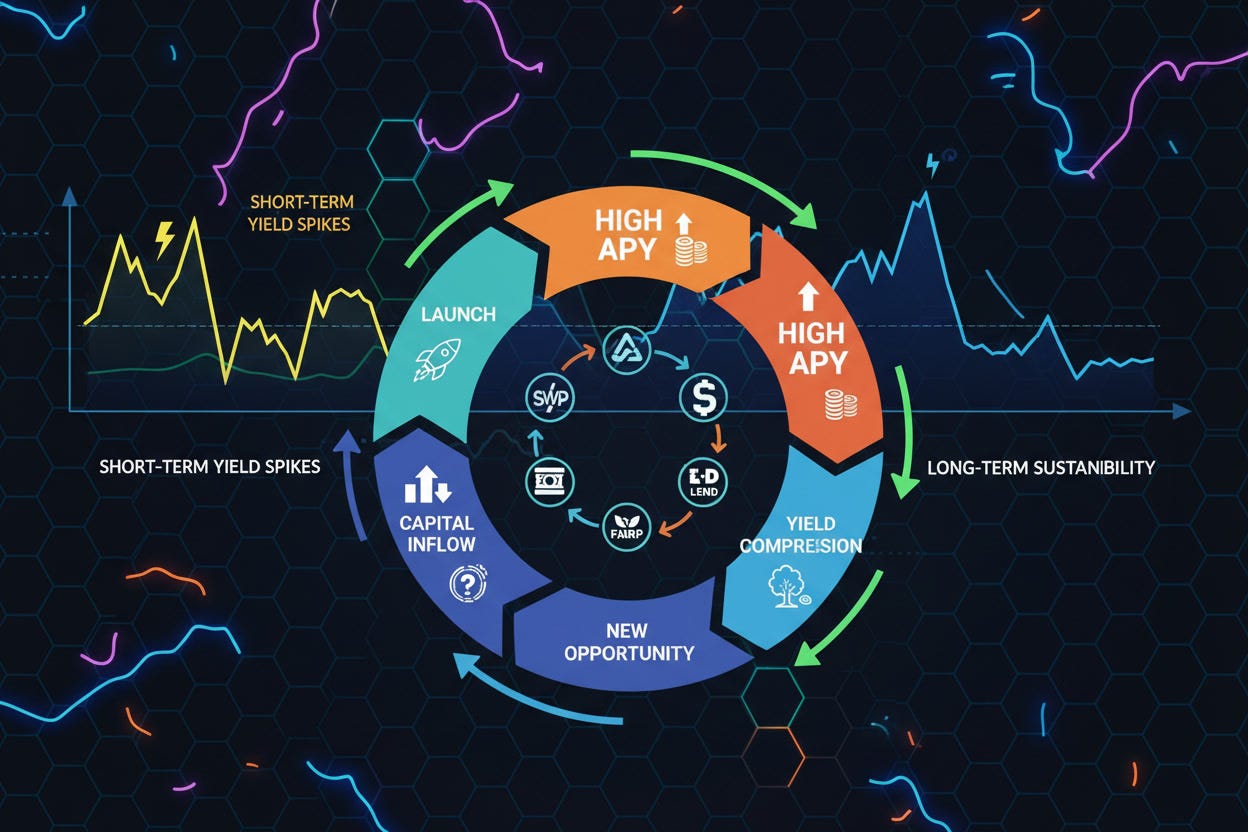
DeFi has a familiar pattern.
A new protocol launches with aggressive APY.
Capital rushes in.
Liquidity explodes overnight.
Social timelines fill with screenshots and dashboards.
Then the cycle begins.
Yields compress.
Liquidity rotates elsewhere.
Activity slows.
The opportunity fades.
We have seen this happen across almost every market cycle in DeFi.
Which raises a more important question:
What actually lasts?
Because in the long run, the strongest strategies may not be the ones that perform for a week. They may be the ones that survive across changing market conditions.
What Does “Sustainable” Actually Mean?
A sustainable DeFi strategy is not simply one that produces high returns.
It is one that can continue producing returns over time without collapsing under pressure.
That usually means a strategy should:
Generate relatively consistent returns
Avoid depending entirely on token incentives
Remain viable across different market conditions
Adapt as liquidity and volatility change
Sustainability is ultimately about durability, not temporary performance.
The goal is not to maximize excitement for a short period. The goal is to create systems that can continue functioning through multiple market environments.
Real Yield vs Temporary Yield
Not all yield is created equal.
Some yield comes from real economic activity within the market.
Trading fees generated by active liquidity
Lending demand from borrowers
Arbitrage opportunities created by inefficiencies
These sources are tied to actual usage.
Other forms of yield come primarily from emissions and incentives.
Protocols distribute tokens to attract liquidity. APYs spike temporarily as rewards flow into the system. But once emissions slow or token prices decline, the yield often collapses with it.
This is why many strategies struggle to maintain returns over time.
Temporary incentives can attract capital quickly. Sustainable revenue tends to keep it.
Liquidity and Market Conditions Matter
The sustainability of a strategy also depends heavily on market structure.
Liquidity depth matters because shallow liquidity increases slippage and instability.
User activity matters because inactive markets generate fewer fees and opportunities.
Volatility matters because some strategies only perform well in calm environments.
Certain DeFi strategies are highly dependent on specific market conditions. They work well during bull markets but break down during periods of stress or reduced liquidity.
More durable strategies are designed to adapt rather than rely on perfect conditions.
That adaptability becomes increasingly important as DeFi grows more competitive and interconnected.
The Hidden Role of Risk and Costs
A strategy can look extremely attractive on paper while degrading significantly in practice.
Execution costs reduce realized returns over time.
Frequent rebalancing creates additional friction.
Slippage increases during volatile periods.
Changing asset correlations can introduce unexpected downside.
This is where the idea of risk adjusted yield becomes important.
Headline APY may show potential upside, but it rarely captures the operational and structural risks involved in maintaining that yield over time.
Sustainable strategies focus on net outcomes, not just theoretical returns.
Better Strategy Design Creates Better Outcomes
As DeFi matures, strategy design is becoming more sophisticated.
Instead of relying on a single opportunity, sustainable systems often diversify across multiple strategies. They continuously monitor market conditions, adjust allocation when necessary, and prioritize long-term efficiency over short-term spikes.
This is where DeFi begins to resemble financial infrastructure rather than isolated opportunities.
The focus shifts toward:
Diversification across strategies
Continuous monitoring and adaptation
Efficient capital deployment
Net returns after costs and risk
The result is a more structured approach to managing capital.
How Concrete Vaults Approach Sustainability
This philosophy is reflected in Concrete vaults.
Rather than optimizing purely for peak APY, the system is designed around sustainable yield generation and structured onchain capital deployment.
Concrete vaults aim to:
Prioritize durable yield sources
Manage capital dynamically across strategies
Adapt allocation as market conditions change
Reduce dependence on short-term incentives
This creates a form of managed DeFi where capital is actively positioned for long-term efficiency instead of reactive yield chasing.
The emphasis is not simply on generating yield. It is on maintaining sustainable performance through changing environments.
Concrete DeFi USDT as a Real Example
The difference between temporary and sustainable yield becomes clearer with practical examples.
Concrete DeFi USDT offers up to approximately 8.5 percent stable yield.
Compared to highly volatile opportunities advertising much larger APYs, this may appear less aggressive. But sustainability changes the equation.
Stable yield strategies can outperform fragile opportunities over longer periods because they avoid sharp collapses, excessive volatility, and constant repositioning.
Consistency tends to attract long-term capital because predictability matters.
In many cases, sustainable yield appears less exciting in the short term while proving far more reliable over time.
The Bigger Shift Happening in DeFi
DeFi is gradually moving beyond pure yield speculation.
The ecosystem is becoming more focused on long-term capital strategies, structured systems, and infrastructure that can survive multiple cycles.
Sustainability is likely to matter more than peak returns.
Durable systems will matter more than temporary incentives.
Infrastructure will outlast emissions.
The future of DeFi may not be defined by who offers the highest APY.
It may be defined by which strategies continue working long after the hype fades.
Built by Concrete, Concrete vaults represent a move toward sustainable DeFi strategies, structured DeFi vaults, and scalable infrastructure designed for long term institutional DeFi adoption.
Explore Concrete at app.concrete.xyz