--
What Makes a DeFi Strategy Actually Sustainable?
I’ve seen this movie before.
A new protocol launches.
The APY is insane—200%, 500%, sometimes more.
Crypto Twitter lights up.
Discords get louder.
Everyone rushes in.
You tell yourself:
“This one feels different.”
So you deposit.
For a few days, maybe weeks… it works.
Your dashboard is green.
Rewards are flowing.
Then slowly—almost quietly—things change.
The APY drops.
Liquidity starts leaving.
The hype fades.
And just like that…
the opportunity disappears.
---
The Pattern We Don’t Talk About
If you’ve been in DeFi long enough, you’ve lived this cycle more than once:
High APY launches
Capital floods in
Yields compress
Liquidity rotates out
Then the next “opportunity” shows up—and the cycle repeats.
At some point, a question starts to form:
> Why does this keep happening?
And more importantly:
> What actually lasts?
---
Redefining What “Good” Looks Like
Early on, I judged strategies by one thing:
APY.
Higher meant better.
But over time, that definition started to break.
Because the best-performing strategies weren’t the ones with the highest returns…
They were the ones that kept returning.
That’s when I started thinking differently about sustainability.
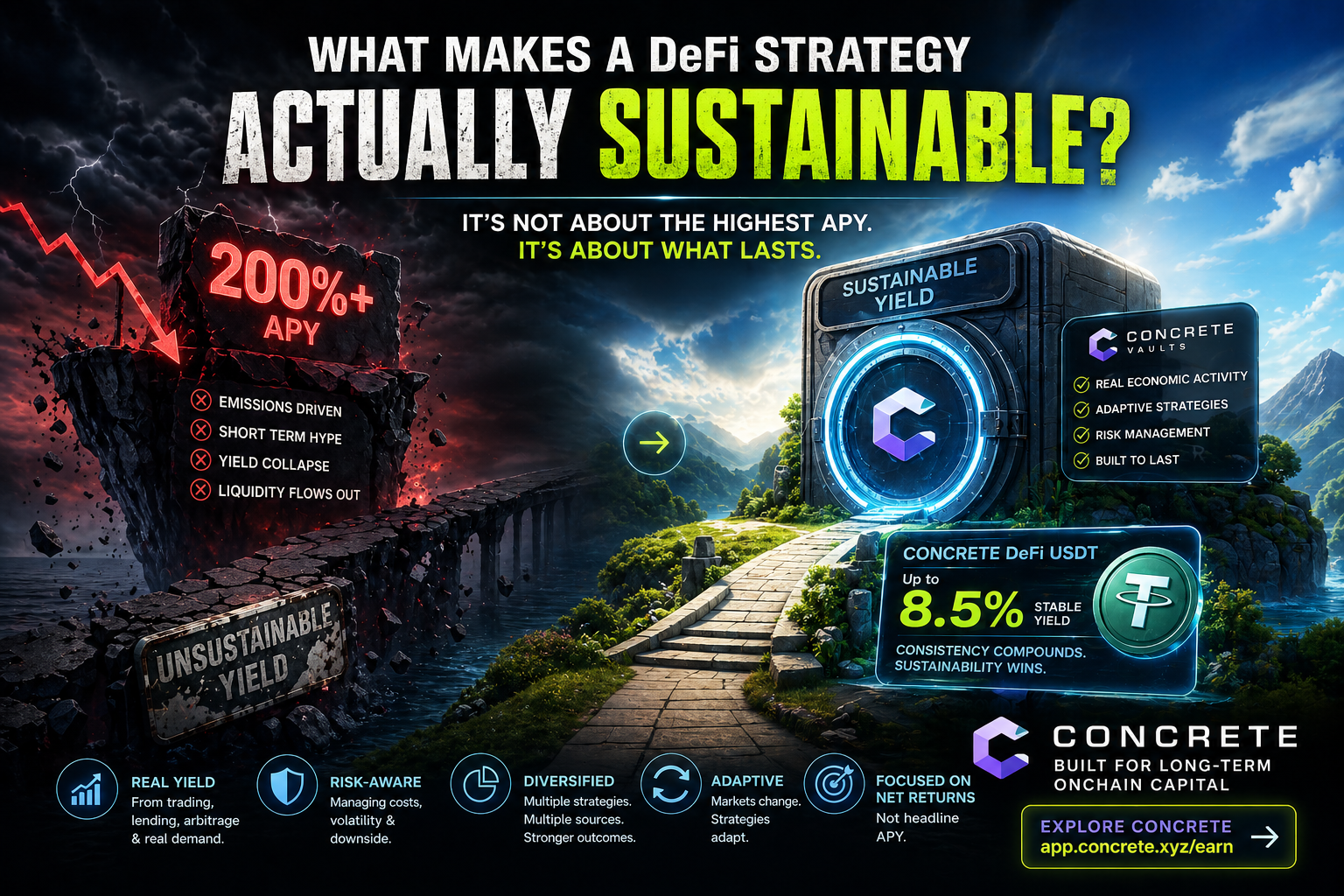
A sustainable DeFi strategy isn’t just profitable.
It is:
Consistent over time
Less dependent on hype
Able to survive different market conditions
It’s not about how fast you earn.
It’s about how long you can keep earning.
---
Two Types of Yield (Only One Lasts)
At some point, I began separating yield into two categories:
1. Temporary Yield
This is the exciting kind.
Driven by token incentives
Boosted by emissions
Designed to attract liquidity quickly
It looks great at the start.
But it fades—because incentives don’t last forever.
---
2. Real Yield
This is the quieter kind.
Generated from trading fees
Borrowing demand
Arbitrage activity
It doesn’t spike dramatically.
But it doesn’t disappear overnight either.
That’s the difference:
> Temporary yield attracts attention.
Real yield builds longevity.
---
Why Some Strategies Break
Not every strategy is designed to survive.
Some only work under perfect conditions:
High volatility
Strong user demand
Deep liquidity
Once those conditions change… the strategy weakens.
Others are more flexible.
They adapt to:
Changing liquidity
Market shifts
Different risk environments
This is where sustainability starts to separate itself.
Because the question is no longer:
> “Does it work right now?”
But:
> “Does it still work when things change?”
---
The Hidden Cost of “High Yield”
Here’s something I learned the hard way:
A strategy can look perfect on paper… and still fail in reality.
Why?
Because of what’s not immediately visible:
Execution costs
Slippage
Rebalancing inefficiencies
Changing correlations between assets
These are the silent killers of returns.
They don’t show up in the APY.
But they show up in your balance.
That’s why sustainable yield is really:
> Risk-adjusted yield.
Not what you could earn.
But what you actually keep.
---
From Opportunities to Systems
At some point, I stopped chasing strategies…
And started thinking in systems.
Instead of asking:
> “Where should I farm next?”
I started asking:
> “How is this strategy designed?”
Sustainable DeFi strategies tend to share a few things:
Diversification across multiple sources of yield
Continuous monitoring and adjustment
Adaptability to market conditions
Focus on net returns, not headline APY
This is where DeFi begins to look less like speculation…
And more like engineered capital allocation.
---
Why Managed DeFi Is Gaining Ground
Let’s be honest:
Most users don’t have the time to track all of this manually.
Markets move fast.
Conditions change constantly.
And reacting too late can erase gains.
That’s where managed DeFi comes in.
Instead of relying on guesswork, structured systems—like Concrete vaults—are built to:
Prioritize sustainable yield sources
Allocate capital across strategies
Adapt as conditions evolve
Reduce dependence on short-term incentives
They don’t chase the highest number.
They aim for something harder:
Consistency.
---
A Real Example of Sustainable Yield
Take something like Concrete DeFi USDT.
At first glance, it might not look exciting.
~8.5% yield?
In a space where 100%+ exists?
But that’s exactly the point.
Because over time:
Stability compounds
Volatility doesn’t erase gains
Consistency attracts long-term capital
And in many cases…
That “boring” 8.5% can outperform unstable 80%.
Not in a week.
But across a cycle.
---
The Shift That’s Already Happening
DeFi is maturing.
Slowly, but clearly.
We’re moving from:
Yield chasing
→ to
Sustainable, risk-aware strategies
From:
Short-term hype
→ to
Long-term capital thinking
From:
Individual guesswork
→ to
structured, managed systems
Because in the end…
The future of DeFi won’t be defined by the highest APY.
It will be defined by the strategies that survive.
---
Final Thought
The best strategy isn’t the one that wins today.
It’s the one that’s still working tomorrow.
And next month.
And next cycle.
Because in a market full of noise…
Sustainability is the real edge.
🚨 Explore Concrete at: https://app.concrete.xyz/earn 🚨