What Makes a DeFi Strategy Actually Sustainable?
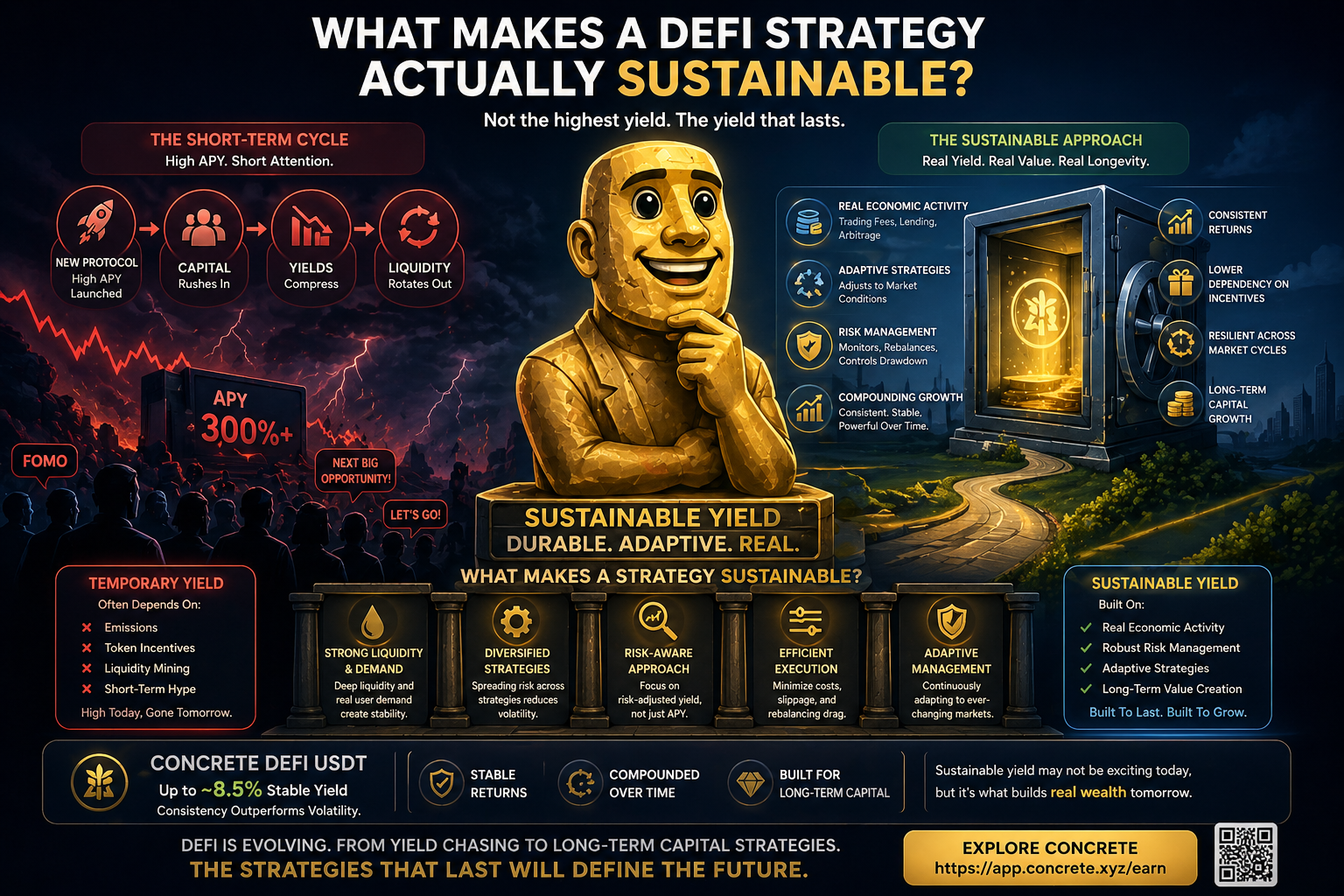
DeFi is full of yield. New protocols launch every week with sky-high APY. Capital rushes in, yields compress, and liquidity quickly rotates elsewhere. This cycle repeats across DeFi: hype builds, incentives flow, then most strategies fade as quickly as they appeared.
So the real question isn’t “What has the highest yield?”
It’s: “What actually lasts?”
1. Start With the Pattern
We’ve all seen it:
New protocols launch with eye-watering APY
Capital floods in
Yields compress rapidly
Liquidity rotates to the next hot opportunity
This boom-bust pattern repeats because most DeFi strategies are built on temporary incentives rather than durable fundamentals. The key question is: Why do most strategies fade so quickly?
2. Define What “Sustainable” Means
A sustainable DeFi strategy is not about chasing the highest headline APY. It is about durability.
A truly sustainable strategy should:
Generate consistent returns over time (not just in bull markets)
Not depend entirely on token emissions or short-term incentives
Remain viable across different market conditions — bull, bear, or sideways
Sustainability is about durability, not just short-term performance. It focuses on risk-adjusted yield that can compound reliably for months and years.
3. Compare Real Yield vs Temporary Yield
Not all yield is created equal.
Yield from real economic activity: Comes from trading fees, lending interest, arbitrage, or genuine protocol revenue. This type tends to be more stable because it reflects actual usage and value creation.
Yield from emissions or incentives: Often looks extremely attractive at first but declines sharply once the reward program ends or token value drops.
Emissions-driven yield frequently collapses because it relies on continuous token printing or finite incentive budgets. In contrast, real yield backed by economic activity is more resilient — it doesn’t disappear when the marketing budget runs out.
4. Highlight the Role of Liquidity & Market Conditions
Sustainability heavily depends on:
Liquidity depth (to minimize slippage)
Genuine user activity (real demand, not just farmed TVL)
Market volatility tolerance
Ongoing demand for the underlying strategy
Many high-yield opportunities only work in specific conditions (low volatility, high incentive phases). When those conditions change, the strategy breaks. Sustainable ones adapt or are designed to withstand cycles.
5. Introduce Risk & Cost Awareness
Even strategies that look strong on paper can degrade over time due to hidden frictions:
Execution costs and gas fees
Rebalancing expenses
Slippage on large positions
Changing correlations between assets
A good DeFi strategy must account for net returns after all costs and risks, not just gross APY. Without proper risk management and onchain capital deployment discipline, even promising setups erode.
6. Connect This to Better Strategy Design
Sustainable DeFi strategies are built like robust systems, not one-off opportunities. Key elements include:
Diversification across multiple yield sources and strategies
Continuous monitoring and automated rebalancing
Adaptation to changing market conditions
Focus on net returns and risk-adjusted yield rather than headline APY
This is where DeFi starts looking more like mature financial infrastructure instead of pure speculation. Managed DeFi and automated vault architectures solve many of these problems by handling complexity professionally.
7. Connect to Concrete Vaults
DeFi vaults (especially institutional-grade ones) represent a major step forward in building sustainable yield.
Vaults aim to:
Prioritize sustainable yield sources over short-term incentives
Manage capital dynamically across strategies (onchain capital deployment)
Adapt automatically to changing conditions
Reduce reliance on fleeting emissions
They turn fragmented manual yield farming into structured, repeatable processes suitable for both retail and institutional DeFi.
8. Use Concrete DeFi USDT as an Example
A clear real-world example is the Concrete DeFi USDT vault.
While many protocols chase 50%+ APY with heavy incentives, Concrete DeFi USDT targets a more modest but stable yield of up to ~8.5%. This yield comes from carefully managed, delta-neutral and other real-yield strategies rather than pure emissions.
Why does this matter?
Stability often outperforms volatile high-yield opportunities over time (fewer large drawdowns).
Consistency attracts long-term capital instead of mercenary liquidity.
It demonstrates how sustainable yield can look less exciting in the short term but delivers superior risk-adjusted yield and reliability in the long run.
Concrete vaults focus on durability, transparent risk management, and automated optimization — exactly what turns good ideas into lasting infrastructure.6b8688
9. Close With the Bigger Shift
DeFi is maturing. It is moving away from short-term yield chasing toward long-term capital strategies.
In the future:
Sustainability will matter more than peak returns
Infrastructure and robust DeFi vaults will outlast incentives
The winners won’t be defined by the highest APY, but by the strategies that actually last
The next phase of DeFi belongs to protocols and users who prioritize risk-adjusted yield, capital efficiency, and durable economic activity.
If you want to move beyond chasing the next hype cycle and explore sustainable yield in practice, check out Concrete at app.concrete.xyz — a strong example of institutional-grade yield infrastructure in action.
Keywords naturally used: sustainable yield, risk-adjusted yield, DeFi strategies, DeFi vaults, managed DeFi, Concrete vaults, onchain capital deployment, institutional DeFi.
--