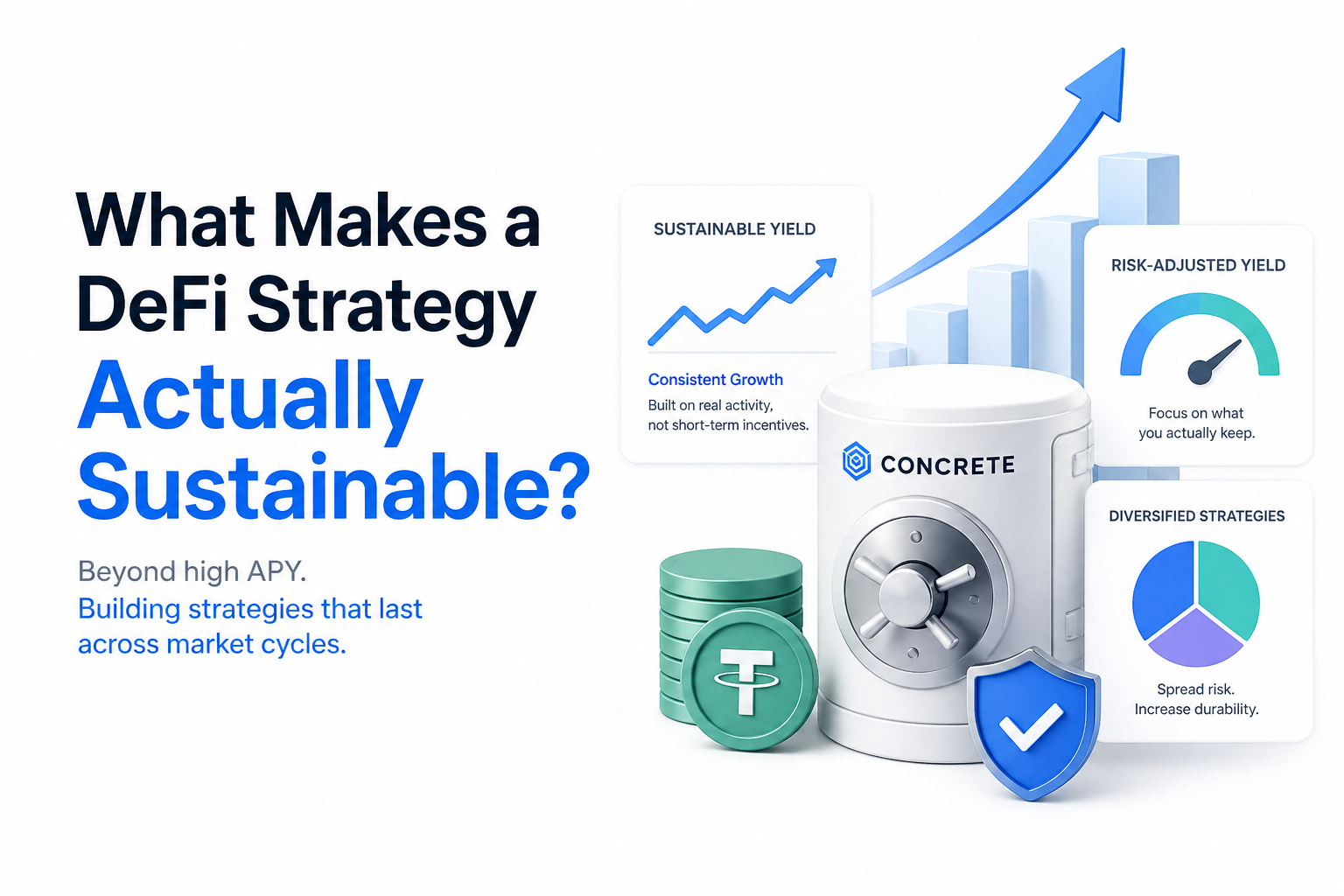
What Makes a DeFi Strategy Actually Sustainable?
--
DeFi has never had a shortage of yield.
Every week, new protocols launch with eye-catching APYs. Capital floods in almost instantly, chasing the next high-return opportunity. For a moment, everything looks promising — returns are high, liquidity is deep, and the strategy appears to work.
Then the cycle repeats.
Yields compress. Liquidity rotates out. The opportunity fades.
This pattern has played out across countless DeFi strategies. And it raises a more important question — one that goes beyond short-term performance:
What actually lasts?
The Pattern Behind DeFi Yield Cycles
If you’ve spent any time in DeFi, the pattern is familiar.
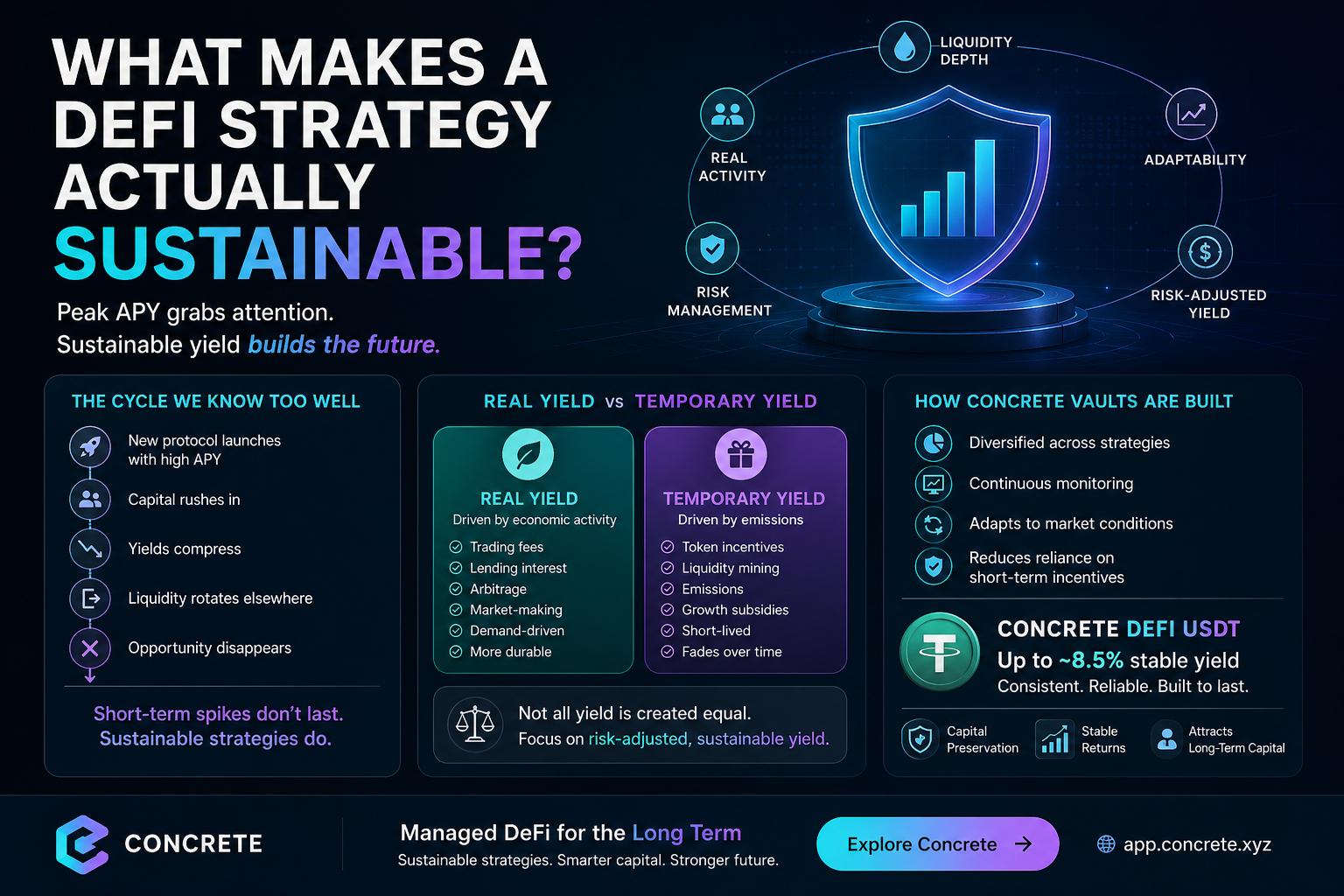
A new protocol introduces aggressive incentives. Early participants benefit from elevated yields, often driven by token emissions. As awareness spreads, capital flows in quickly, diluting returns. Over time, emissions decline, and so does the yield.
Eventually, participants move on.
This cycle isn’t random — it’s structural. Many DeFi strategies are designed to bootstrap liquidity, not sustain it. The result is a system optimized for growth bursts, not durability.
So why do most strategies fade so quickly?
Because they were never built to last in the first place.
Defining Sustainability in DeFi
A sustainable yield strategy isn’t defined by how high it performs in a short window — but by how well it holds up over time.
At its core, sustainability in DeFi means:
- Generating consistent returns across different market conditions
- Minimizing reliance on temporary incentives
- Maintaining viability through market cycles
This shifts the focus from peak APY to risk-adjusted yield — what you actually keep after accounting for volatility, cost, and time.
In other words, durability matters more than spikes.
Real Yield vs Temporary Yield
Not all yield is created equal.
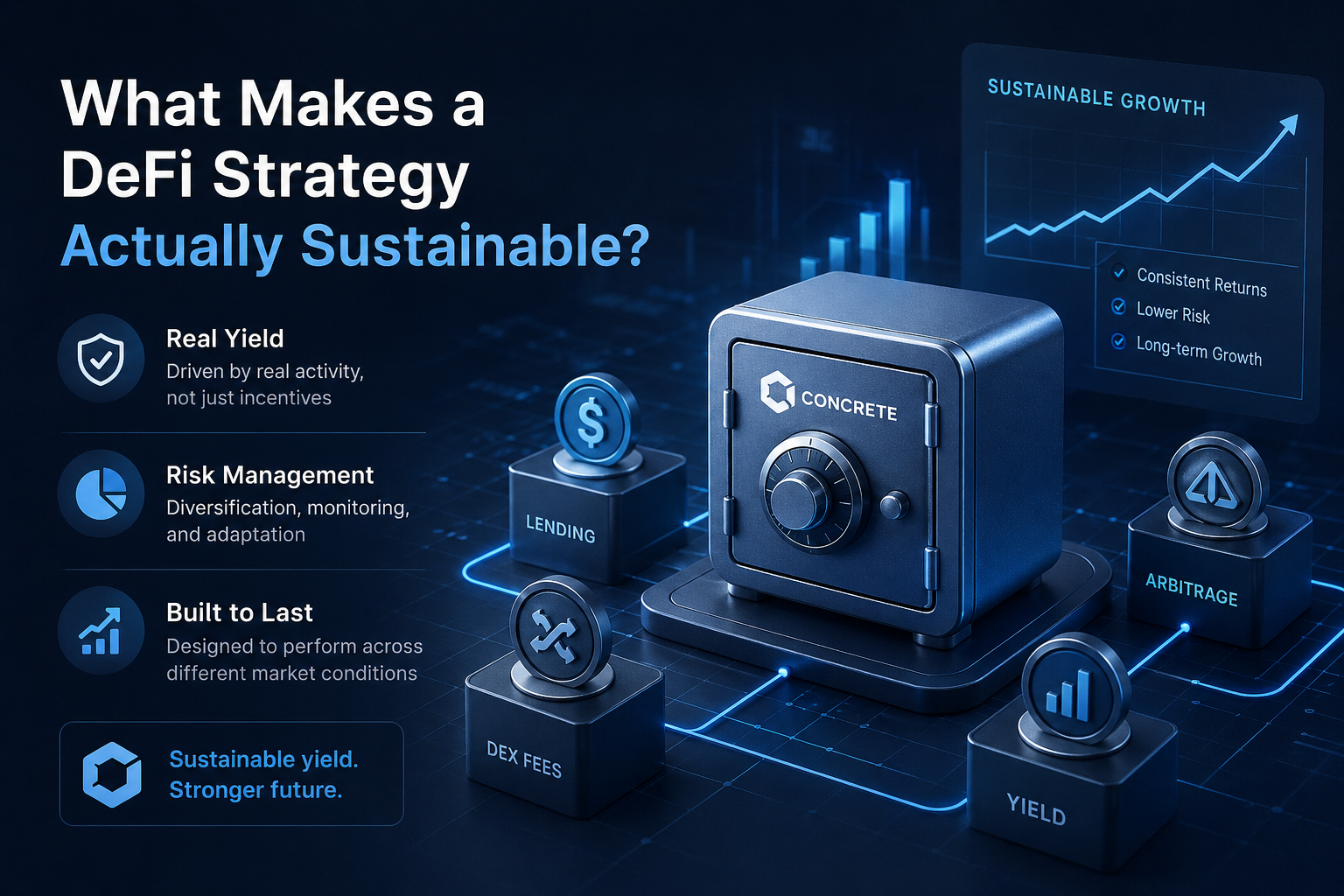
Some returns are driven by real economic activity — trading fees, lending demand, arbitrage inefficiencies. These are tied to actual usage within the ecosystem.
Others rely heavily on emissions and incentives.
The difference is critical.
Emission-driven yield often declines as token distribution slows and price pressure increases. What looks attractive at launch tends to normalize quickly.
Real yield, on the other hand, is anchored in ongoing activity. As long as users trade, borrow, or interact with protocols, value continues to be generated.
This is the foundation of sustainable yield.
The Role of Liquidity and Market Conditions
Sustainability is also shaped by the environment a strategy operates in.
Liquidity depth determines whether positions can scale without excessive slippage. User activity influences fee generation. Market volatility can either enhance or erode returns depending on the strategy.
Some DeFi strategies only perform under very specific conditions — high volatility, strong incentives, or rapid market expansion.
Others are more adaptive.
The difference lies in design. Strategies built around narrow assumptions tend to break when conditions change. More resilient approaches evolve alongside the market.
The Hidden Layer: Risk and Cost
One of the most overlooked aspects of DeFi yield is cost.
On paper, many strategies look highly profitable. But once you factor in execution costs, rebalancing, slippage, and shifting correlations, the picture changes.
Returns degrade.
A strategy that advertises double-digit APY might deliver significantly less in practice. This is why focusing solely on headline numbers can be misleading.
True risk-adjusted yield accounts for everything — not just what’s earned, but what’s lost along the way.
Designing for Long-Term Performance
As DeFi matures, strategy design is evolving.
Instead of chasing isolated opportunities, there’s a growing shift toward systems thinking — approaches that combine multiple strategies, adapt to changing conditions, and optimize for net returns.
This includes:
- Diversification across yield sources
- Continuous monitoring and adjustment
- Dynamic allocation of capital
- Prioritizing sustainability over short-term gains
This is where managed DeFi begins to stand out — bringing structure and discipline to an otherwise fragmented landscape.
From Opportunities to Infrastructure
This shift is especially visible in the rise of DeFi vaults.
Rather than relying on users to manually chase yield, vaults handle onchain capital deployment in a more systematic way. Capital is allocated, rebalanced, and optimized based on evolving conditions.
Within this model, Concrete vaults represent a move toward sustainability-first design.
Instead of maximizing peak returns, they aim to:
- Prioritize durable yield sources
- Manage capital across multiple strategies
- Adapt dynamically to market changes
- Reduce dependence on short-term incentives
The goal isn’t just performance — it’s longevity.
A Practical Example: Stability Over Hype
Consider a product like Concrete DeFi USDT.
With yields of up to ~8.5%, it may not compete with the highest APYs seen during peak incentive cycles. But that’s precisely the point.
Stability often outperforms volatility over time.
Consistent returns attract long-term capital because they reduce uncertainty. They allow strategies to compound more effectively and withstand market fluctuations.
In the context of institutional DeFi, this matters even more. Larger pools of capital prioritize predictability and risk management over short-term upside.
Sustainable yield may look less exciting — but it’s far more reliable.
The Bigger Shift in DeFi
DeFi is evolving.
What began as a landscape driven by rapid experimentation and incentive-driven growth is gradually maturing into a more structured financial system.
The focus is shifting:
- From short-term yield chasing
- Toward long-term capital strategies
- From peak APY
- To sustainability and durability
In this next phase, infrastructure will outlast incentives.
The strategies that define the future of DeFi won’t be the ones with the highest returns in a single week — but the ones that continue to perform across cycles.
Because in the end, sustainability isn’t just a feature.
It’s the strategy.
Explore Concrete at app.concrete.xyz 🚀