What Makes a DeFi Strategy Actually Sustainable?
 Adeboye Opeyemi Esther6 min read·Just now
--
If you’ve spent any time in DeFi (Decentralized Finance), you’ve likely seen the same cycle play out again and again.
A new protocol launches, offering extremely high APY—sometimes 50%, 100%, or even higher. The excitement spreads quickly across social media. Investors rush in, hoping to take advantage of these attractive returns.
For a short time, everything looks promising.
Then reality sets in.
The yields begin to drop. Liquidity starts to leave. Users move their funds to the next trending opportunity. And just like that, the cycle repeats itself.
This pattern is very common in DeFi.
But instead of constantly asking, “Which platform is offering the highest yield right now?”, a more important and smarter question you should be asking is:
🔸 What makes a DeFi strategy actually sustainable?
In traditional finance, the most successful strategies are not the ones that perform well briefly, they are the ones that survive different market conditions over time. DeFi is gradually moving in that same direction.
In this article, I will be breaking things down in a simple and beginner-friendly way to help you understand the difference between short-term yield chasing and long-term, sustainable DeFi strategies.
🔸 What “Sustainable” Really Means in DeFi
Let’s start with the basics.
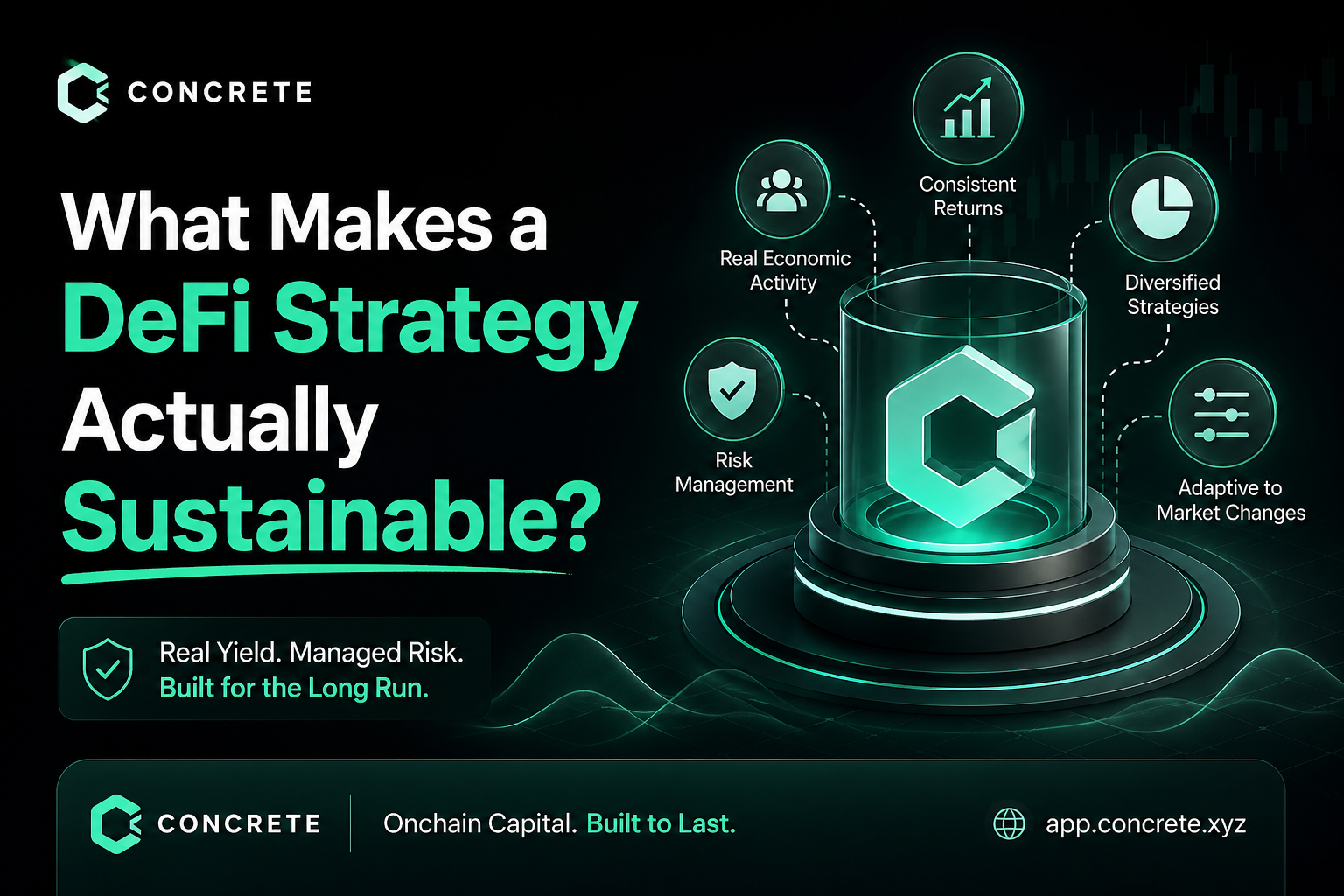
A sustainable DeFi strategy is one that can generate consistent returns over a long period of time, this can be months or even years, not just a few days or weeks. This strategy does not collapse when market conditions change.
Here are the key characteristics:
▪️ Consistent Returns Over Time: A sustainable strategy delivers relatively stable returns without extreme fluctuations or sudden drops.
▪️ Low Dependence on Temporary Incentives: It does not rely heavily on token rewards (also known as emissions) that can be reduced or stopped at any time.
▪️ Ability to Perform Across Market Conditions: Whether the market is bullish, bearish, or moving sideways, the strategy should still work, even if returns are slightly lower.
At its core, sustainability is about durability, and not hype.
Think of it like building a house. A sustainable strategy is like a strong, well-built structure that can withstand storms and not just a temporary setup that collapses under pressure.
🔸 Real Yield vs. Temporary Yield: Not All Yield Is Equal
One of the most important lessons in DeFi is understanding where your yield is coming from.
▪️ Real Yield
Real yield is generated from actual economic activity within the ecosystem. Examples include:
* Interest paid by borrowers in lending protocols
* Trading fees from decentralized exchanges
* Arbitrage opportunities and other productive on-chain activities
Because this type of yield is tied to real usage and demand, it tends to be more stable over time.
▪️ Temporary Yield (Incentives and Emissions)
Temporary yield, on the other hand, often comes from token incentives or emissions.
Protocols distribute newly minted tokens to attract liquidity and users. This can create a very high APYs at the beginning, but it usually doesn’t last.
▪️ Why?
* Incentives can be reduced or removed
* Liquidity providers leave once rewards drop
* Token prices often decline, reducing actual returns
So while emissions-driven strategies may look exciting, they are often short-lived.
📍 Important key takeaway:
Not all yields are created equal. Real yield builds long-term value, while temporary yield often fades quickly.
🔸 The Role of Liquidity and Market Conditions
A DeFi strategy does not exist in isolation, it is influenced by its environment.
▪️ Liquidity Depth: More liquidity means smoother transactions and lower slippage (extra costs from price changes).
▪️ User Activity: Active users, traders, borrowers, and investors help sustain yield generation.
▪️ Market Volatility: Some strategies perform well only under certain conditions, while others are more adaptable.
▪️ Underlying Demand: The best strategies solve real problems that exist regardless of market trends.
Many high-yield strategies only thrive during bull markets. When conditions change, they struggle or fail.
Sustainable strategies are designed to adapt and remain functional, even in challenging environments.
🔸 Risk and Cost Awareness: The Hidden Reality
One of the biggest mistakes beginners make is focusing only on headline APY.
Experienced investors focus on something more important:
Risk-adjusted yield: the return you get after considering risks and costs.
Here are some factors that can reduce your actual profits:
▪️ Gas Fees and Execution Costs: Frequent transactions can significantly eat into your returns.
▪️ Rebalancing Costs: Moving funds between strategies is not free.
▪️ Slippage: Large trades can push prices against you, reducing gains.
▪️ Changing Market Behavior: Assets that once behaved differently may move together during market stress, increasing risk.
A strategy might look profitable on paper, but once these factors are included, your net returns (what you actually keep) can be much lower.
Sustainable strategies are designed with these realities in mind.
🔸 Building Better DeFi Strategies for the Long Term
Understanding sustainability helps you make smarter investment decisions.
Instead of chasing trends, better strategies focus on:
▪️ Diversification: Spreading capital across multiple opportunities reduces risk.
▪️ Continuous Monitoring and Adaptation: Markets evolve, and strategies must adjust accordingly.
▪️ Focus on Net Returns: What matters is what you keep after all costs not just the advertised APY.
▪️ Automation: Automated systems help manage rebalancing and compounding efficiently.
At this stage, DeFi begins to feel less like speculation and more like a structured financial system.
🔸 How Concrete Vaults Prioritize Durability
Platforms like Concrete are designed to focus on long-term sustainability rather than short-term hype.
Concrete vaults aim to:
* Prioritize yield from real economic activity
* Dynamically allocate capital across strategies
* Automatically adapt to changing market conditions
* Reduce risk through structured management
Instead of requiring users to constantly monitor opportunities and move funds manually, these vaults handle the complexity behind the scenes.
This approach is especially appealing to users who value consistency, efficiency, and risk management.
🔸 Concrete DeFi USDT: A Real-World Example
A great example of this approach is the Concrete DeFi USDT vault.
This vault targets approximately ~8.5% stable yield on USDT, using strategies like delta-neutral arbitrage, which aim to generate returns while minimizing exposure to market direction.
Recent performance shows yield around 7–8% over 7- and 30-day periods, highlighting consistency.
For beginners, this is an important lesson.
An 8.5% return may not sound as exciting as a 100% APY farm but over time, stable and predictable returns often outperform volatile ones, especially when you factor in losses, fees, and the stress of constant monitoring.
Sustainable yield may appear less attractive on the surface, but it offers something more valuable: reliability.
▪️ Explore Concrete: https://app.concrete.xyz/earn
🔸 The Bigger Shift Happening in DeFi
DeFi is maturing.
The industry is gradually shifting away from short-term yield chasing toward long-term, sustainable financial strategies.
Looking ahead:
* Sustainability will matter more than high APY
* Risk-adjusted returns will become the standard
* Strong, reliable infrastructure will outlast hype-driven projects
The strategies that succeed will not only survive market cycles, they will help shape the future of finance.
Conclusion: Why Sustainability Wins in the Long Run
DeFi is no longer just about chasing the highest returns, it is about making smart and more informed decisions.
Sustainable strategies focus on consistency, real economic activity, and careful risk management. They may not always offer the highest APY, but they provide something far more valuable: long-term growth and stability.
With the rise of managed solutions like vaults, participating in DeFi is becoming more accessible even for beginners.
You don’t need to constantly jump from one opportunity to another or spend hours tracking the market.
Instead, you can focus on strategies built to last.
Because in the end:
The future of DeFi belongs to those who build and invest in what is sustainable.