What Makes a DeFi Strategy Actually Sustainable?
 eswar8 min read·Just now
--
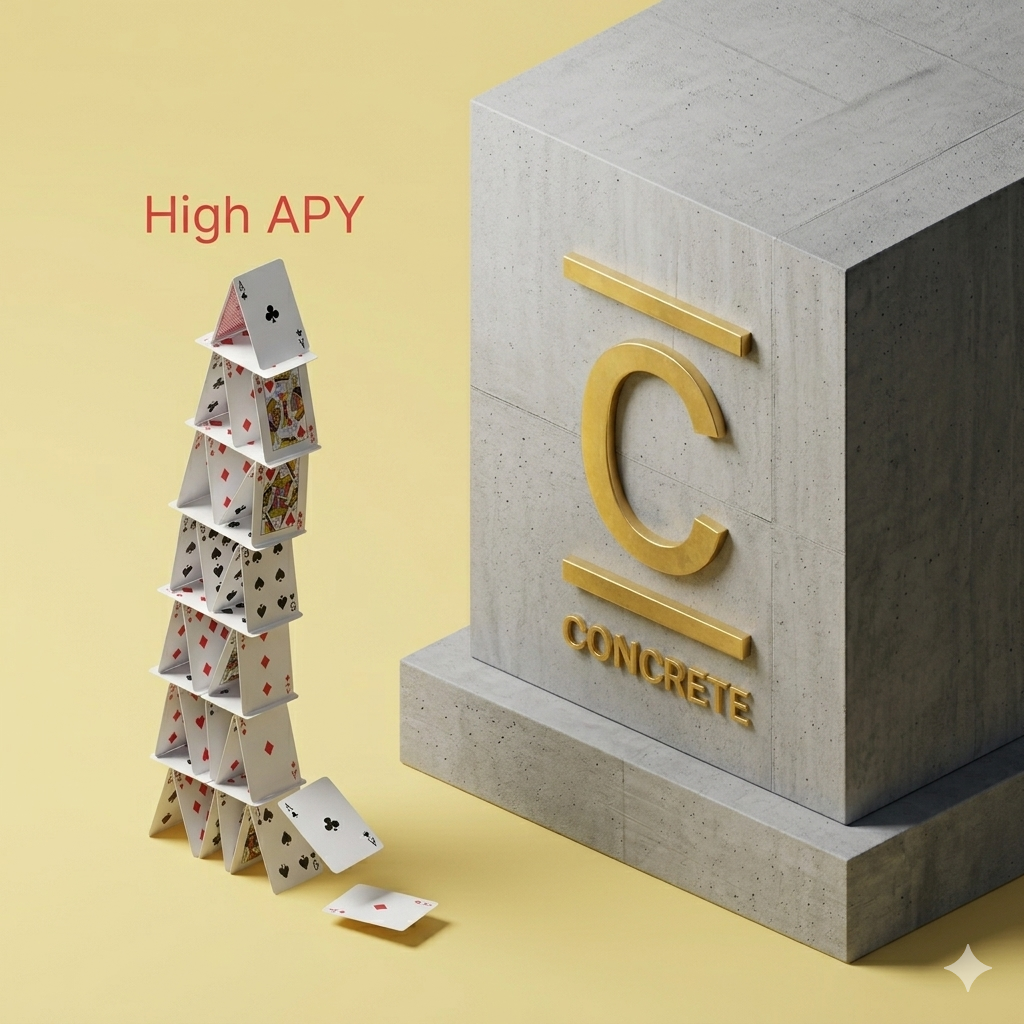
I remember the first time I watched a DeFi pool go from 300% APY to single digits in less than two weeks.
It wasn’t because the protocol was a scam. The team was legitimate. The code was audited. The idea was sound. But the yield wasn’t real in any meaningful, durable sense — it was bait. And the moment the bait ran out, everyone left.
That experience stuck with me, because it perfectly captures what’s broken about how most people think about DeFi strategies. We walk in asking “what’s the APY?” when we should be asking “where does this yield actually come from — and how long can it keep coming?”
Those are very different questions. And the gap between them is where a lot of capital gets quietly destroyed.
The Cycle We’ve All Seen (And Probably Fallen For)
Here’s the pattern, repeated across hundreds of protocols over the past few years:
A new protocol launches. It offers token emissions to bootstrap liquidity — sometimes 200%, sometimes 500%, sometimes numbers that look almost satirical. Capital pours in because, well, yield is yield. TVL climbs. The protocol gets written up everywhere. More capital flows in.
Then reality kicks in.
Token prices drop as early farmers sell. Yields compress because there’s now more liquidity chasing the same pool of incentives. The math stops working. The farmers rotate out to the next shiny thing, and the protocol is left holding a fraction of its peak TVL with an APY that’s now in the neighborhood of… 4%. Which, honestly, might be perfectly fine — but it’s not what anyone signed up for.
This cycle repeats constantly across DeFi. It’s not random. It’s structural. And understanding why it happens is the first step toward building a strategy that actually survives it.
What “Sustainable” Actually Means (It’s Simpler Than People Make It Sound)
Let’s get plain about this. A sustainable DeFi strategy is one that:
Generates returns from real economic activity. Not from a protocol bribing you to stay. Not from token inflation. From actual fees, actual interest, actual arbitrage — work that the market pays for because it creates value.
Survives multiple market conditions. Not just the bull run, not just when volatility is high, not just when liquidity is deep. A strategy that only works in perfect conditions isn’t a strategy — it’s a bet on those conditions persisting.
Doesn’t eat itself. This is a subtle one. Some strategies look profitable until you factor in the cost of maintaining them — gas fees, rebalancing, slippage, and the compounding drag of impermanent loss. A truly sustainable strategy is profitable net of all those friction points.
That’s really it. Durable, adaptable, net-positive. It sounds obvious when you say it out loud, but chasing headline APY makes people forget all three of those requirements almost immediately.
Real Yield vs. Emissions Yield: The Distinction That Matters Most
Not all yield is created equal. This is probably the most important concept in this entire piece, so I want to spend some real time on it.
Emissions-driven yield is essentially a subsidy. The protocol is paying you — often in its own token — to use it. This is a legitimate way to bootstrap liquidity and grow a user base. But it has a ceiling. The protocol can only emit so many tokens before dilution makes those emissions worthless. And the moment incentives slow down, so does the capital.
Real yield comes from economic activity that would happen regardless of incentives. Think:
- Trading fees on a DEX that has genuine volume because traders actually want to use it
- Interest on lending markets where borrowers are paying because they need leverage or liquidity
- Arbitrage profits from market inefficiencies that are naturally replenished by price movement
- Liquidation fees from protocols maintaining collateral ratios
This kind of yield doesn’t disappear when the token emissions end. It persists as long as the underlying activity persists. It grows when markets are active and shrinks when they’re not — which is just… how financial systems work. Predictably. Manageably.
The irony is that real yield strategies often look boring compared to emissions farming. An 8% stablecoin yield doesn’t get the same Twitter attention as a 400% APY farm. But the 8% is still there six months later. The 400% usually isn’t.
Liquidity Depth, Market Conditions, and Why Context Is Everything
One thing experienced DeFi strategists understand that newer participants often don’t: a strategy doesn’t exist in a vacuum. Its performance is deeply tied to market conditions, and a strategy that works beautifully in one environment can become actively harmful in another.
Consider a volatility-harvesting strategy in an options protocol. In a choppy, high-volatility market, that strategy can print. In a prolonged low-volatility period, it bleeds slowly. Neither outcome reflects a “broken” strategy — it reflects the strategy operating in conditions it wasn’t optimized for.
The same goes for liquidity. A strategy that earns excellent returns in a deep, liquid market might suffer significantly from slippage in thinner conditions. The math on paper doesn’t account for the reality of execution.
Sustainable DeFi strategies are ones that either:
- Are explicitly designed for specific conditions and are managed actively when those conditions change, or
- Are diversified across enough strategies that the underperformers in any given environment are offset by the outperformers.
This is where managed DeFi starts to look a lot less like speculation and a lot more like actual portfolio management.
The Costs Nobody Talks About (Until They’re Eating Your Returns)
Let me be honest about something the yield calculators don’t show you.
Running a DeFi strategy actively — especially one that rebalances across multiple positions — is expensive. Gas costs on Ethereum mainnet during busy periods can turn a profitable rebalance into a net-negative one. Slippage on larger positions in thinner pools compounds over time. Impermanent loss in correlated-but-not-perfectly-correlated pairs accumulates quietly.
There’s also the correlation risk that changes over time. Two assets that moved together historically might decouple during a market shock. A strategy built on historical correlation assumptions can fail suddenly and dramatically when those assumptions stop holding.
None of this makes DeFi bad. It just means that a strategy that looks strong on gross APY might look very different on a net, risk-adjusted basis. And sustainable strategies are the ones built around net returns — what you actually keep — not headline numbers.
Monitoring execution costs, watching for slippage degradation as liquidity shifts, and being willing to exit a strategy when conditions change aren’t sexy activities. But they’re what separate strategies that work from strategies that looked like they worked.
What Actually Good Strategy Design Looks Like
Okay, so what do you do with all of this?
The answer, honestly, is to stop treating DeFi like a treasure hunt and start treating it like a system. Here’s what that shift looks like in practice:
Diversify across strategies, not just assets. Holding multiple tokens doesn’t protect you if they’re all exposed to the same underlying conditions. Spreading capital across strategies with different yield sources — lending, trading fees, real-world asset yield — gives you resilience.
Monitor continuously, not periodically. DeFi conditions change fast. A strategy that was optimal a month ago might be mediocre today and actively bad next week. This requires either significant time investment or trusting infrastructure that does it for you.
Focus on sustainable yield sources first. Start with yield from real economic activity. Layer in incentive-based yield as a bonus, not a foundation.
Net returns over gross APY. Always. Without exception.
Be willing to be boring. Consistent 8–12% net returns, sustained over 18 months, beat a 400% APY that lasts three weeks and then drags you through a long recovery. Compounding only works if you actually keep the gains.
This is where DeFi starts to look less like a casino and more like a thoughtfully managed portfolio. And that shift — toward onchain capital management with real infrastructure underneath it — is where the space is actually heading.
This Is Exactly What Concrete Vaults Are Built For
I want to talk about Concrete specifically here, because it’s one of the more thoughtful implementations of these ideas I’ve come across.
The philosophy behind Concrete vaults is straightforwardly aligned with everything above: prioritize sustainable yield sources, manage capital actively across strategies, adapt to changing conditions, and reduce dependence on short-term incentive farming.
Instead of chasing peak APY, the vaults are designed around durability. That means real economic activity backing the yield, continuous monitoring of how strategies are performing, and the flexibility to shift allocations when conditions change. It’s managed DeFi in the genuine sense — not just a smart contract sitting there passively, but actual capital management logic running underneath.
You can explore the vaults directly at https://app.concrete.xyz/earn and see what’s currently running.
Concrete DeFi USDT: A Real-World Example Worth Looking At
If you want a concrete example of what sustainable yield actually looks like in practice, Concrete DeFi USDT is worth your attention.
It offers up to approximately 8.5% stable yield on USDT. Which — in a world where people are used to seeing triple-digit numbers — might not sound impressive at first. But let me reframe that.
8.5% stable yield, compounded over 24 months, significantly outperforms most volatility-chasing strategies when you account for the drawdowns, the capital locked during recovery periods, and the psychological cost of watching a position collapse and waiting for it to come back.
More practically: stable yield attracts stable capital. Long-term capital. Institutional-grade capital. Because the people managing serious money — whether that’s a fund, a treasury, or an individual with real savings at stake — aren’t optimizing for the best week. They’re optimizing for the best year. The best three years.
Sustainable yield looks less exciting. That’s sort of the point. Boring and reliable is exactly what long-term capital wants.
Where DeFi Is Actually Going
Here’s my honest take on the direction this space is heading.
The infrastructure era of DeFi is coming. Not the wild-west incentive farming era, not the “ape into anything with three digits of APY” era — the era where the strategies that last are the ones that matter.
We’re starting to see institutional DeFi become a real category. Entities with serious capital are looking at onchain strategies, but they’re not going to allocate to something that requires them to check a dashboard every four hours and pray the correlation assumptions hold. They need managed infrastructure. Audited logic. Proven durability across cycles.
The protocols that survive the next five years won’t necessarily be the ones that offered the highest peak yields. They’ll be the ones that offered real yield, maintained through real conditions, with the infrastructure to keep performing as the market evolves.
That’s the shift. From short-term yield chasing to long-term capital strategy. From headline APY to risk-adjusted yield that compounds cleanly over time. From fragile, incentive-dependent farms to durable systems designed to adapt.
The future of DeFi isn’t going to be defined by the highest number on a farming dashboard.
It’s going to be defined by the strategies that are still running — and still delivering — when everything else has already rotated away.
Explore Concrete at: https://app.concrete.xyz/earn