What Makes a DeFi Strategy Actually Sustainable?
--
DeFi loves a good number.
A new protocol launches, the APY looks absurdly high, Crypto Twitter lights up, dashboards start circulating, and capital moves fast. For a moment, the opportunity feels obvious.
Then the pattern begins.
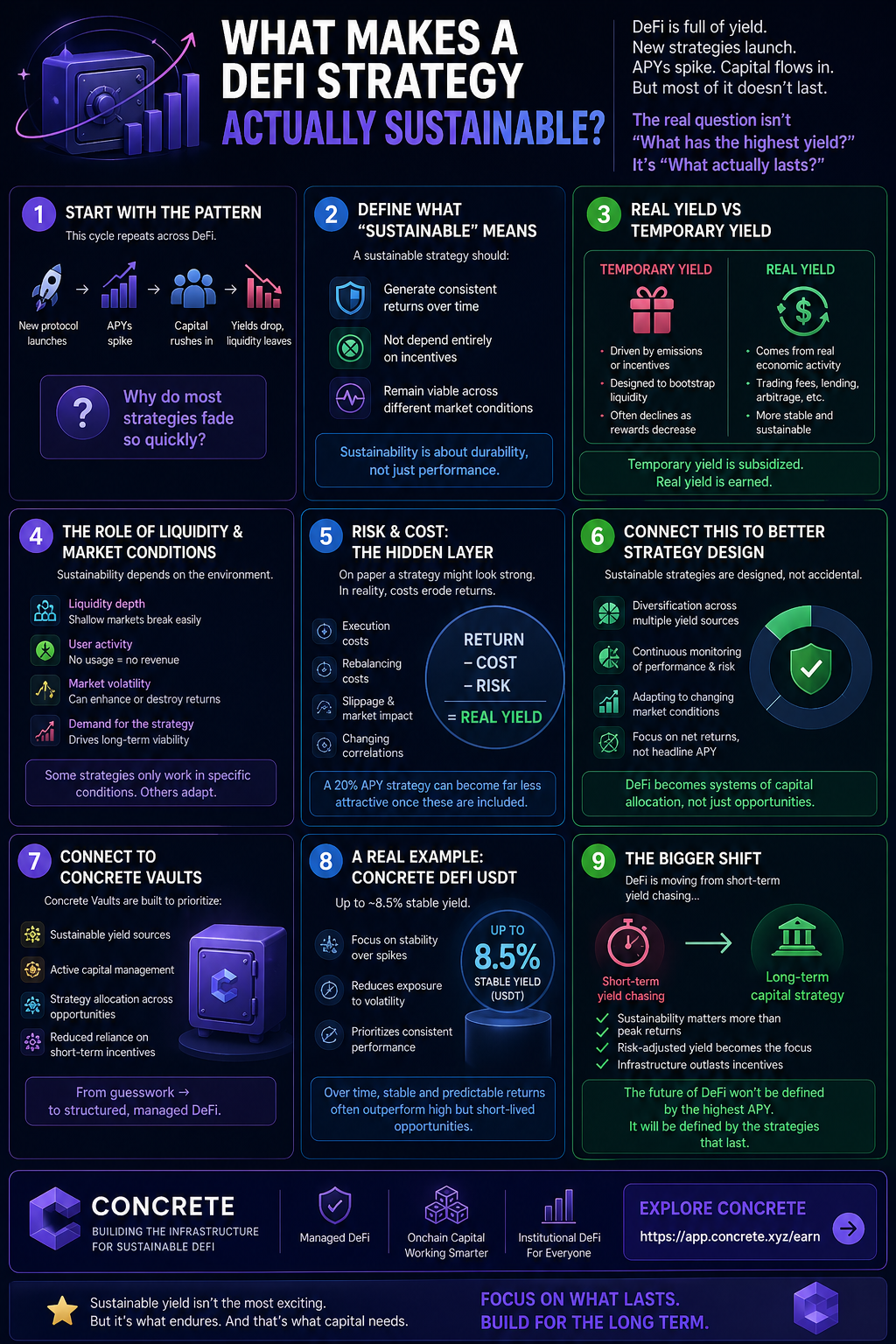
More liquidity enters. Yields compress. Incentives get diluted. Early participants take profits. Capital rotates elsewhere.
We’ve seen this cycle play out repeatedly — from early liquidity mining waves to more recent farm rotations. What looks exceptional in week one often becomes average by week three, and irrelevant shortly after.
That repetition reveals something important.
The hardest question in DeFi is not:
“Where is the highest APY right now?”
It’s:
“What actually lasts?”
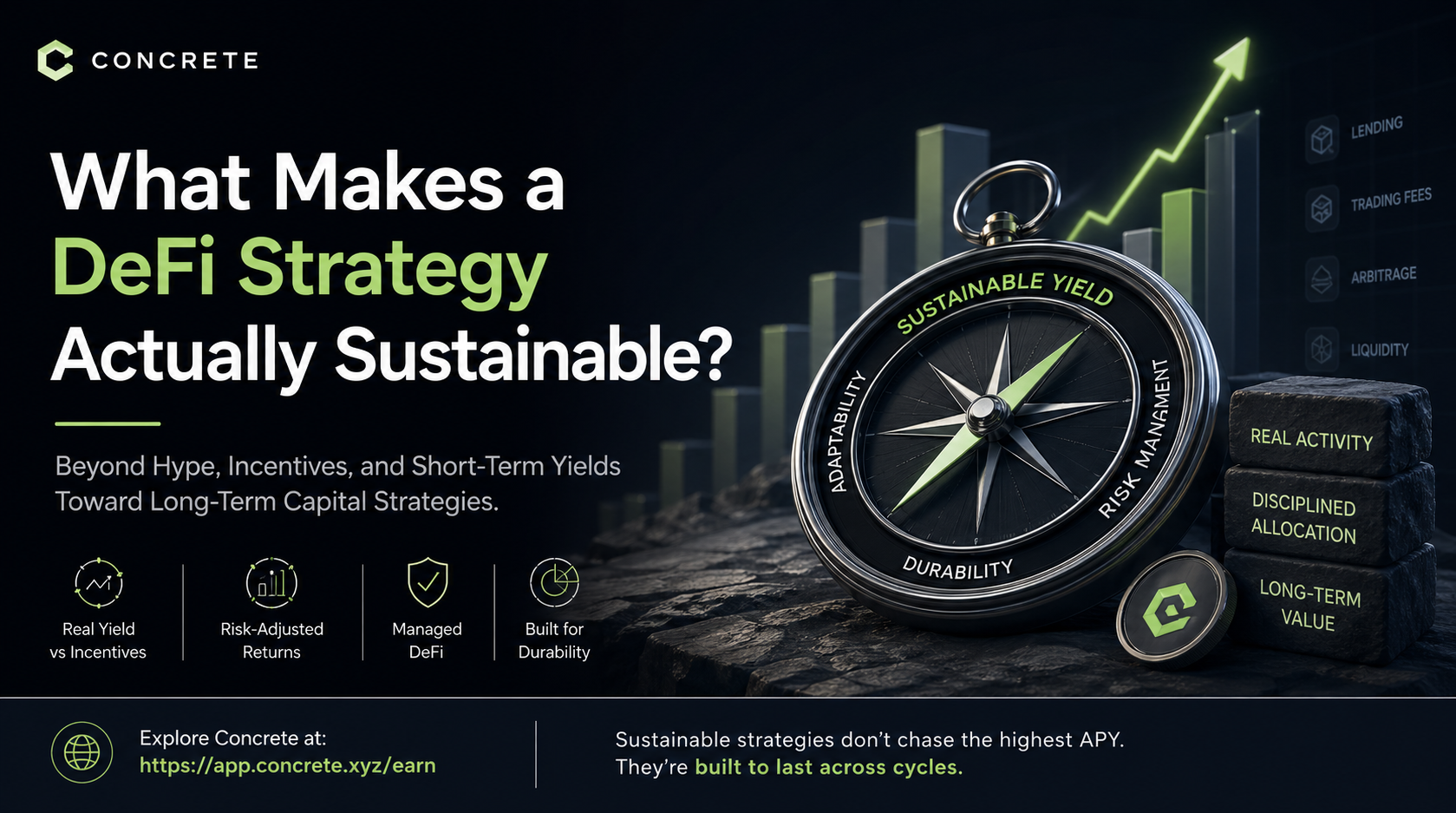
Because as any financial system matures, durability begins to matter more than short-term performance. The most valuable strategies are not the ones that spike briefly — but the ones that continue working when conditions change.
Sustainability Is About Durability, Not Just Safety
“Sustainable yield” is often misunderstood as simply “lower but safer.”
In reality, it is something more specific.
A sustainable strategy:
- generates returns without relying entirely on temporary incentives
- continues to function across different market regimes
- remains profitable after costs, competition, and scaling effects
Most importantly, it is supported by a mechanism that still works tomorrow — not just today.
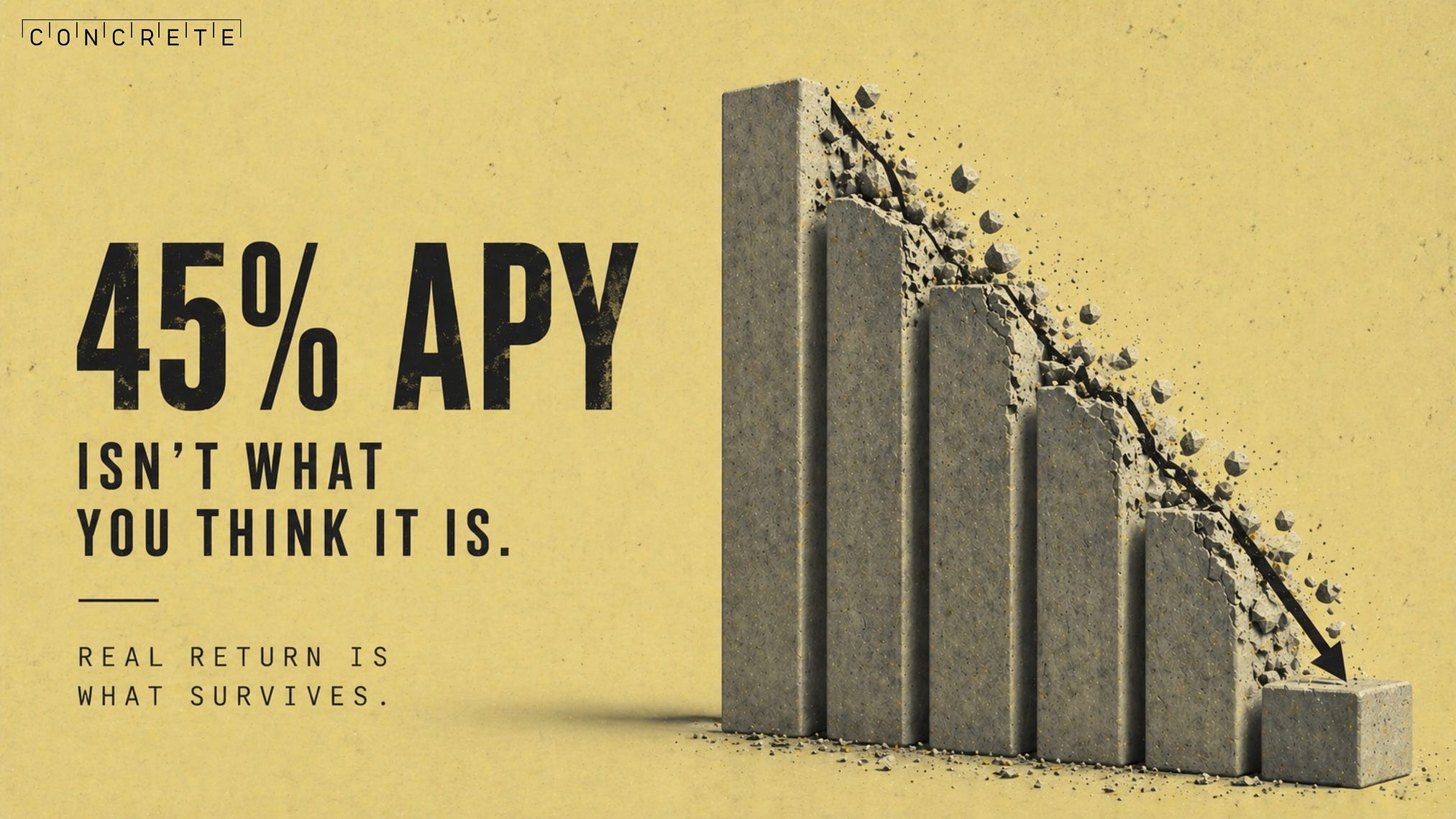
This distinction matters because many DeFi strategies look strong in isolation. A dashboard might show a 40% APY. Incentives might boost returns to attractive levels. But if those returns disappear as soon as emissions slow down, the strategy was never truly durable.
It was conditional.
And conditional yield is where a lot of capital gets misallocated.
Not All Yield Is Created Equal
A useful way to evaluate sustainability is to separate real yield from temporary yield.
Real yield is generated by actual market activity:
- trading fees
- borrowing demand
- arbitrage opportunities
- liquidation flows
- basis spreads
These returns exist because users interact with the market for a reason.
Temporary yield, on the other hand, is often driven by token emissions or incentive programs. These are effective for bootstrapping liquidity — but rarely stable on their own.
When emissions decrease, two things usually happen:
- sell pressure increases
- liquidity exits
The result is predictable: yields fall, and the strategy weakens.
This does not make incentives “bad.” It makes them incomplete.
A strategy that depends entirely on subsidies has not yet proven it can stand on its own economics.
By contrast, strategies rooted in recurring activity tend to degrade more slowly. They may not offer triple-digit APY, but they are more likely to produce risk-adjusted yield over time.
And for serious onchain capital, that difference matters.
Market Conditions Decide What Survives
Even well-designed strategies are not universally effective.
They are conditional on:
- liquidity depth
- volatility
- user demand
- capital scale
- timing
For example:
- a basis trade may perform well in high volatility but compress in calm markets
- a lending strategy may depend on sustained borrowing demand
- a market-neutral setup may break when correlations shift
This is where many DeFi strategies fail — not because the logic is flawed, but because the environment changes.
Sustainable strategies behave differently.
They are not optimized for a single “perfect” condition. Instead, they:
- adapt to changing regimes
- degrade gradually instead of collapsing
- remain viable under less favorable conditions
Scale is also a critical test.
A strategy that works at $1M may not work at $50M. If returns collapse as capital increases, the edge was never durable — it was capacity-limited.
Understanding that difference is key to evaluating long-term viability.
The Hidden Reality: Net Yield vs Headline Yield
One of the most common mistakes in DeFi is confusing visible yield with realized yield.
A strategy may show a 20% APY on a dashboard. But after accounting for:
- rebalancing costs
- slippage
- gas and bridging fees
- hedging costs
- changing correlations
…the actual return can be significantly lower.
In some cases, a “20% strategy” becomes a 9–11% net outcome.
These frictions are easy to ignore individually. Together, they define the real performance.
This is why sustainable yield must be evaluated on a net basis, not a headline basis.
The more complex a strategy is, the more sensitive it becomes to execution.
And in practice, the strategies that survive are not the ones with the highest theoretical return — but the ones with the most reliable realized return.
Sustainable Strategies Look Like Systems
As DeFi evolves, strategy design is shifting from isolated opportunities to integrated systems.
A sustainable approach typically includes:
- diversification across multiple yield sources
- continuous monitoring and adjustment
- dynamic capital allocation
- focus on net, risk-adjusted returns
This introduces a more disciplined framework for evaluating yield:
- Where does the yield actually come from?
- How sensitive is it to market conditions?
- What remains after costs?
- How scalable is the opportunity?
- What happens when incentives decline?
- How does it behave under stress?
The ability to answer these questions consistently is what separates short-term strategies from durable ones.
This is also where DeFi begins to resemble traditional capital allocation — but with onchain transparency.
Why This Matters for Concrete Vaults
This shift toward sustainability is exactly where vault-based infrastructure becomes relevant.
Rather than treating yield as a static number, Concrete vaults are designed to:
- allocate capital across multiple strategies
- prioritize yield sources tied to real activity
- adapt exposure as conditions change
- reduce dependence on short-term incentives
In practice, this means moving away from “single-opportunity farming” toward managed DeFi systems.
The goal is not to capture the highest possible APY in a short window, but to maintain a more consistent return profile over time.
That requires:
- selection discipline
- ongoing monitoring
- risk awareness
- flexibility in allocation
As DeFi matures, this type of structure becomes increasingly important — especially for larger pools of capital that cannot rely on constant rotation.
A Practical Example: Concrete DeFi USDT
A useful way to understand sustainability is to look at a strategy that does not compete for attention through extreme APY.
Concrete DeFi USDT offers up to approximately 8.5% yield — and its significance lies not in how high the number is, but in how it is positioned.
Rather than relying purely on incentives, such a strategy typically draws from a mix of:
- lending demand
- stable yield opportunities
- market-neutral positioning
- diversified allocation across sources
The result is not the highest possible return in any single moment — but a more stable and repeatable one.
This highlights an important trade-off in DeFi:
High volatility strategies may outperform briefly.
Consistent strategies tend to outperform over time.
For long-term capital, consistency is often more valuable than short-term spikes.
Because in practice, capital compounds more effectively in environments where it does not need to constantly move.
And capital that stays is more powerful than capital that briefly visits.
The Direction DeFi Is Moving Toward
The deeper shift in DeFi is not just technological — it is conceptual.
Early on, the ecosystem was driven by rapid experimentation:
- chase the highest APY
- rotate quickly
- repeat
That model worked when infrastructure was new and incentives were abundant.
But sustainable systems cannot rely on temporary rewards forever.
As DeFi matures, the focus is shifting toward:
- long-term capital strategies
- risk-adjusted yield
- infrastructure that supports durability
- disciplined capital management
In that environment:
- sustainability matters more than peak returns
- process matters more than hype
- net yield matters more than headline APY
The protocols and strategies that align with this shift are more likely to attract long-term, serious capital.
Explore Concrete at: app.concrete.xyz/earn
Final Thought
The future of DeFi will not be defined by the highest APY.
It will be defined by the strategies that continue to work — across cycles, across conditions, and across time.