Chijioke John4 min read·Just now
--
What Makes a DeFi Strategy Actually Sustainable?
DeFi is full of yield.
New strategies launch every week.
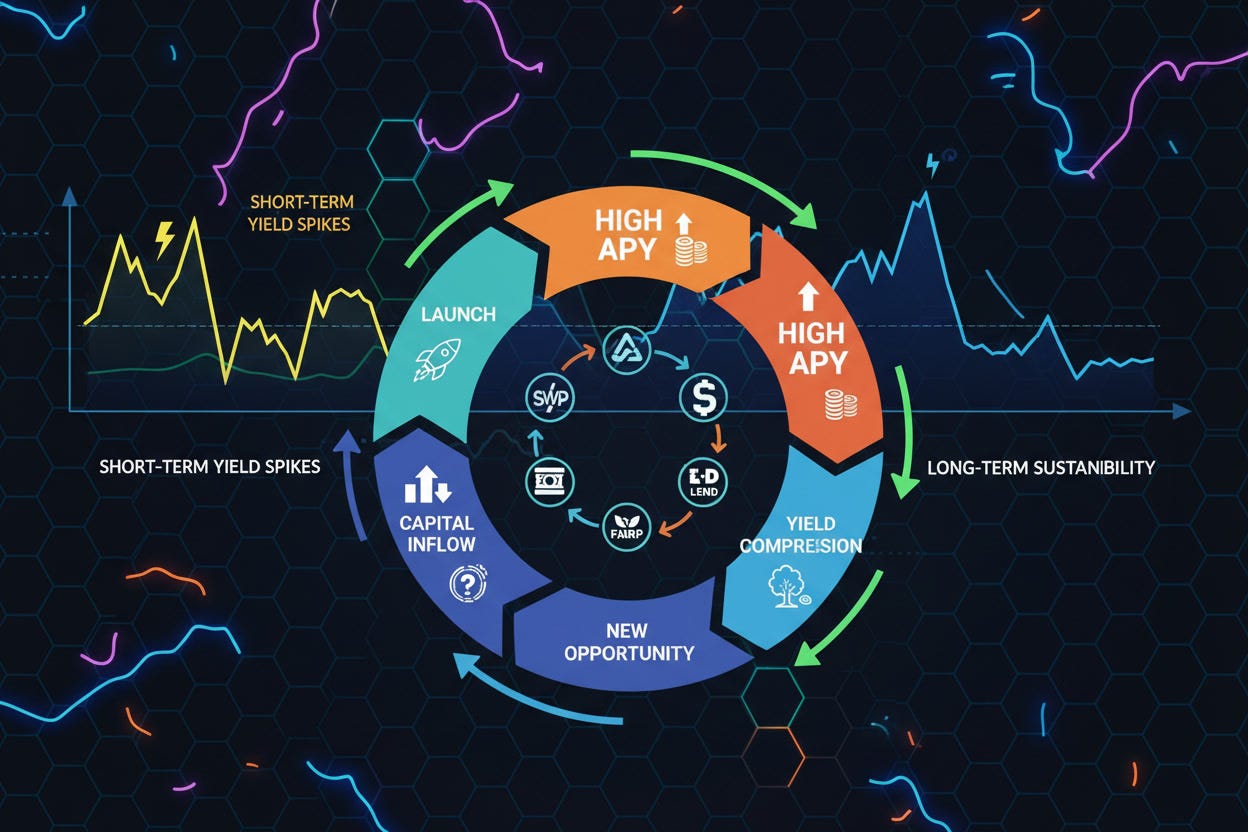
APYs spike.
Capital flows in.
But most of these strategies don’t last.
Yields drop.
Liquidity leaves.
Opportunities disappear.
So the real question isn’t: “What has the highest yield?”
It’s: “What actually lasts?”
1️⃣ Start With the Pattern
We’ve all seen the cycle:
A new protocol launches with triple-digit APY. Twitter lights up. Capital rushes in chasing the headline number. For a few days or weeks, it works.
Then yields compress. Mercenary liquidity rotates to the next farm. The APY chart goes vertical, then flatlines.
This isn’t a bug in DeFi. It’s been the default playbook since 2020.
Which forces the key question: Why do most strategies fade so quickly?
2️⃣ Define What “Sustainable” Means
In mature markets, performance without durability is noise.
A sustainable DeFi strategy should do three things:
-Generate consistent returns over time, not just for a week
-Not depend entirely on incentives to stay profitable
-Remain viable across different market conditions— bull, bear, sideways
This is about durability, not just performance. A strategy that prints 100% APY for 10 days and then blows up is less useful than one that does 8% for 5 years.
3️⃣ Compare Real Yield vs Temporary Yield
Not all yield is created equal.
Real yield comes from economic activity: trading fees from DEX volume, interest from lending markets, arbitrage spreads, MEV, liquidations. Someone pays, you earn. It’s backed by real demand.
Temporary yield comes from emissions. Tokens printed to bootstrap TVL. It works until the incentives end or the token price collapses.
Emissions-driven yield almost always declines. It has to — no protocol can subsidize forever. Real economic activity is more stable because it’s tied to actual usage, not tokenomics.
4️⃣ Highlight the Role of Liquidity & Market Conditions
Sustainability isn’t just about the source. It’s about the environment.
A strategy’s durability depends on:
-Liquidity depth — can you enter and exit without moving the market?
-User activity— is there organic demand for the underlying asset or service?
-Market volatility — does your strategy break when volatility spikes?
-Demand for the strategy itself — are you the only one doing it, or will 100 vaults copy you next week?
Some DeFi strategies only work in bull markets with endless risk appetite. Others adapt. The ones that adapt are the ones that survive cycles.
5️⃣ Introduce Risk & Cost Awareness
This is the part dashboards hide.
A strategy might show 25% APY, but degrade fast once you account for:
-Execution costs — gas, bridge fees, swap fees on every rebalance
- Slippage — especially when you’re moving size
-Rebalancing drag — LPs and delta-neutral strategies bleed value over time
- *Changing correlations* — the hedge that worked last month fails this month
Risk-adjusted yield is what matters. Gross APY is marketing. Net yield after all costs and risks is reality.
6️⃣ Connect This to Better Strategy Design
So how do you build for sustainability? You stop chasing opportunities and start building systems.
Durable DeFi strategies typically involve:
-Diversification across strategies — no single point of failure
-Continuous monitoring — onchain capital deployment that reacts to data, not narratives
-Adapting to market changes— rotating from directional to delta-neutral when volatility shifts
- *Focusing on net returns* — optimizing for what you keep, not the headline APY
This is where institutional DeFi starts to separate from retail DeFi. It’s less about APY screenshots and more about managed DeFi infrastructure.
7️⃣ Connect to Concrete Vaults
This is the problem Concrete vaults are designed to solve.
Instead of manual yield chasing, vaults aim to:
-Prioritize sustainable yield sources over short-term emissions
-Manage capital across strategies to reduce single-strategy risk
-Adapt to changing conditions with automated rebalancing
- Reduce reliance on incentives by focusing on real economic activity
Concrete vaults are built for durability, not just peak yield. The goal isn’t to win the week. It’s to survive the cycle.
8️⃣ Use Concrete DeFi USDT as an Example
Let’s ground this.
Concrete DeFi USDT- offers up to ∼8.5% stable yield. On paper, that looks “boring” compared to a 150% APY farm.
But over 12–24 months, stability often outperforms volatility. Why?
- No impermanent loss blowups
- No token emissions dumping 80%
- No strategy decay when the market shifts
Consistency attracts long-term capital. Institutions don’t allocate to 150% APY. They allocate to predictable, risk-adjusted yield. Sustainable yield often looks less exciting. It’s also more reliable.
9️⃣ Close With the Bigger Shift
DeFi is maturing.
We’re moving from short-term yield chasing toward long-term capital strategies. As the space grows, sustainability will matter more than peak returns.
Infrastructure will outlast incentives. Managed DeFi will outlast manual farming. Systems will outlast screenshots.
The future of DeFi won’t be defined by the highest APY.
It will be defined by the strategies that last.
Explore Concrete at http://app.concrete.xyz