What Makes a DeFi Strategy Actually Sustainable?
--
DeFi is full of yield. Every week, new protocols launch with eye-catching APYs, capital rushes in, and timelines fill with screenshots of massive returns. For a moment, everything looks unstoppable.
Then the pattern repeats.
Yields compress. Liquidity rotates elsewhere. Incentives dry up. The strategy that looked unbeatable a week ago becomes irrelevant a month later.
This cycle has defined much of DeFi’s early growth. But it also raises the real question smart capital should be asking:
Not “What has the highest yield today?”
But “What strategy can still generate returns across market cycles?”
The future belongs to sustainable yield.
The Difference Between Yield and Sustainable Yield
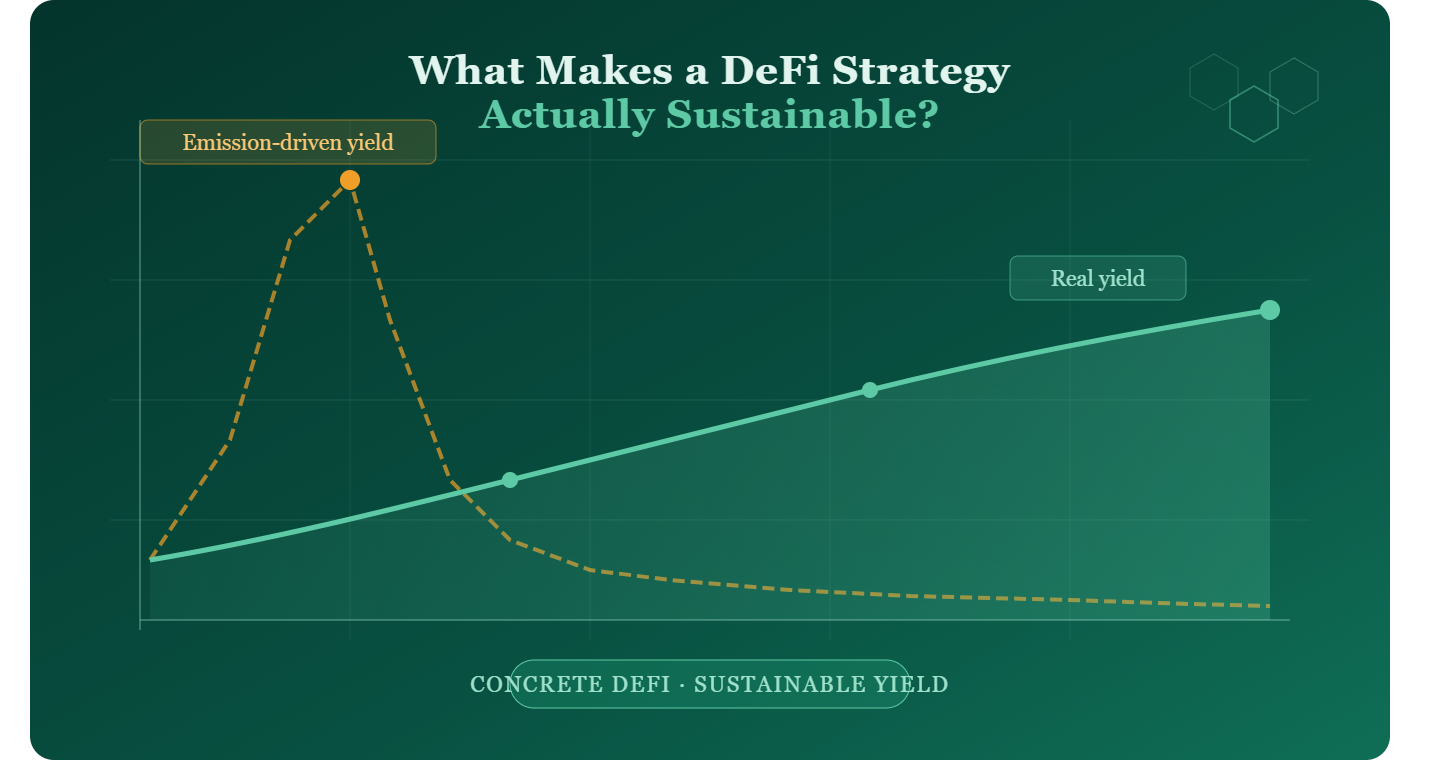
Many investors confuse temporary performance with durability. A strategy posting 100% APY for two weeks may look attractive, but if it depends entirely on token emissions or short-term speculation, it is not built to last.
A truly sustainable strategy should be able to:
- Generate consistent returns over time
- Operate without relying only on incentives
- Remain viable in bull and bear markets
- Adjust to changing liquidity and volatility
- Deliver attractive net returns after costs
This is the foundation of risk-adjusted yield.
The strongest strategies are not always the loudest. Often, they are the most repeatable.
Real Yield vs Temporary Yield
Not all yield is created equal.
Some yield comes from real economic activity:
- Trading fees
- Lending demand
- Borrowing interest
- Arbitrage inefficiencies
- Productive market making
This type of yield is tied to genuine usage. As long as users trade, borrow, hedge, or move capital onchain, these opportunities can continue.
Other yield comes mainly from incentives:
- Token emissions
- Liquidity mining rewards
- Unsustainable subsidy programs
These mechanisms can attract liquidity quickly, but they often fade once rewards decline.
That is why many headline APYs disappear so fast. They were never returns created by markets — they were returns created by incentives.
Liquidity, Activity, and Market Conditions Matter
Even strong DeFi strategies depend on context.
A strategy may perform well when:
- Liquidity is deep
- Volatility is elevated
- Borrow demand is high
- Trading volume is active
But conditions change.
When markets slow down, spreads tighten, or users leave, returns can compress. Sustainable strategies are those that can adapt rather than collapse.
This is where managed DeFi becomes important. Instead of treating yield as static, capital must respond dynamically to changing conditions.
The Hidden Costs Most Investors Ignore
Many strategies look incredible on dashboards because dashboards rarely show the full picture.
Real performance can be reduced by:
- Execution costs
- Gas fees
- Slippage
- Rebalancing frequency
- Smart allocation delays
- Correlation shifts between assets
A strategy offering 15% gross yield may produce far less after operational friction.
This is why professional capital increasingly focuses on net returns, not headline APY.
Better Strategy Design in DeFi
As DeFi matures, stronger frameworks are emerging.
Sustainable systems often include:
- Diversification across multiple yield sources
- Continuous monitoring and reallocation
- Risk controls
- Cost-efficient execution
- Exposure management across changing cycles
This turns DeFi from a collection of short-term opportunities into capital infrastructure.
The shift is important: DeFi is evolving from speculation toward portfolio construction.
Why Concrete Vaults Matter
This is where Concrete vaults represent a meaningful direction for the market.
Rather than relying on one temporary yield source, vault structures aim to:
- Prioritize sustainable yield sources
- Allocate across opportunities intelligently
- Adapt to market changes
- Reduce dependence on short-term emissions
- Improve consistency over time
That approach reflects what institutional DeFi increasingly demands: reliability, process, and disciplined risk management.
Concrete DeFi USDT as a Real Example
A practical example is Concrete DeFi USDT, offering up to approximately 8.5% stable yield.
At first glance, some users may compare that to higher short-term APYs elsewhere. But over time, consistency often outperforms volatility.
Why?
Because a stable 8.5% with lower churn can be more valuable than chasing 30% yields that disappear, require constant movement, or expose capital to hidden risks.
Long-term investors understand this principle well:
Reliable compounding often beats unstable excitement.
That is why sustainable yield continues to attract serious onchain capital.
The Bigger Shift Ahead
The next era of DeFi will not be defined by whoever posts the highest APY this week.
It will be defined by:
- Durable systems
- Sustainable yield
- Better risk-adjusted yield
- Adaptive vault infrastructure
- Professional capital management
In short, the winners will be the strategies that last.
DeFi is growing up. And as it does, sustainability will matter more than hype.
Explore Concrete at: https://app.concrete.xyz/earn