What Makes a DeFi Strategy Actually Sustainable?
 Jayanta Debnath3 min read·Just now
--
DeFi is booming with yield. Every week, new protocols launch, APYs spike, and capital rushes in. But most of these strategies don’t last. Yields drop, liquidity leaves, and opportunities disappear almost as quickly as they appear.
The real question isn’t “What has the highest yield?” It’s “What actually lasts?”
In mature financial systems, the best strategies might not be the ones performing for a week—they’re the ones that survive across market cycles. Understanding what makes a DeFi strategy sustainable is essential for investors seeking consistent returns.
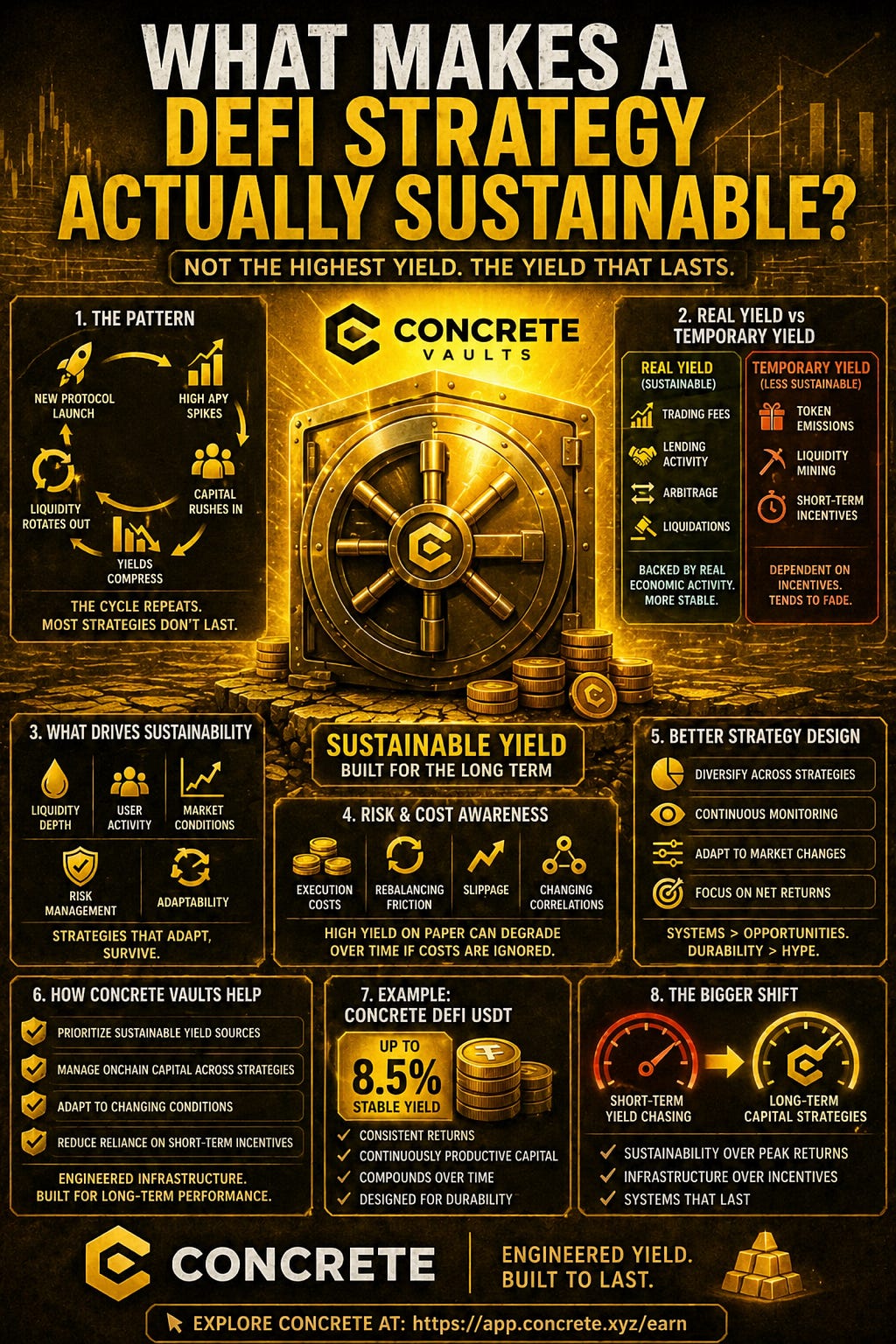
1️⃣ Start With the Pattern:
We’ve all seen the cycle:
>New protocols launch with high APY
>Capital rushes in
>Yields compress
>Liquidity rotates elsewhere
This cycle repeats across DeFi. Most strategies fade because they rely on temporary incentives rather than real, ongoing economic activity.
2️⃣ What Does “Sustainable” Mean?
A sustainable DeFi strategy should:
>Generate consistent returns over time
>Not rely solely on rewards or incentives
>Remain viable in different market conditions
Sustainability is about durability, not just performance.
3️⃣ Real Yield vs Temporary Yield:
There’s a crucial difference:
>Real yield: comes from trading, lending, or arbitrage
>Temporary yield: driven by token emissions or incentives
Emissions-driven yield often declines once incentives end. Real economic activity, on the other hand, tends to be stable and predictable. Not all yield is created equal.
4️⃣ Liquidity & Market Conditions Matter:
Sustainable strategies depend on:
>Liquidity depth
>Active users
>Market volatility
>Demand for the underlying strategy
Some strategies only work in specific conditions. Others adapt and survive.
5️⃣ Risk & Cost Awareness:
Even the strongest strategy on paper can degrade over time. Execution costs, rebalancing, slippage, and changing correlations all impact net returns. Sustainable strategies account for these realities, focusing on real, risk-adjusted yield.
6️⃣Building Better Strategies:
Durable strategies require:
>Diversification across approaches
>Continuous monitoring
>Adaptation to market changes
>Focus on net returns, not headline APY
This is where DeFi starts to resemble a financial system rather than just a series of opportunities.
7️⃣ Concrete Vaults and Sustainability:
Concrete vaults are designed for sustainable yield:
>Prioritizing durable sources of return
>Managing capital across multiple strategies
>Adapting to changing market conditions
>Reducing reliance on short-term incentives
Concrete aims for strategies that survive, not just peak briefly.
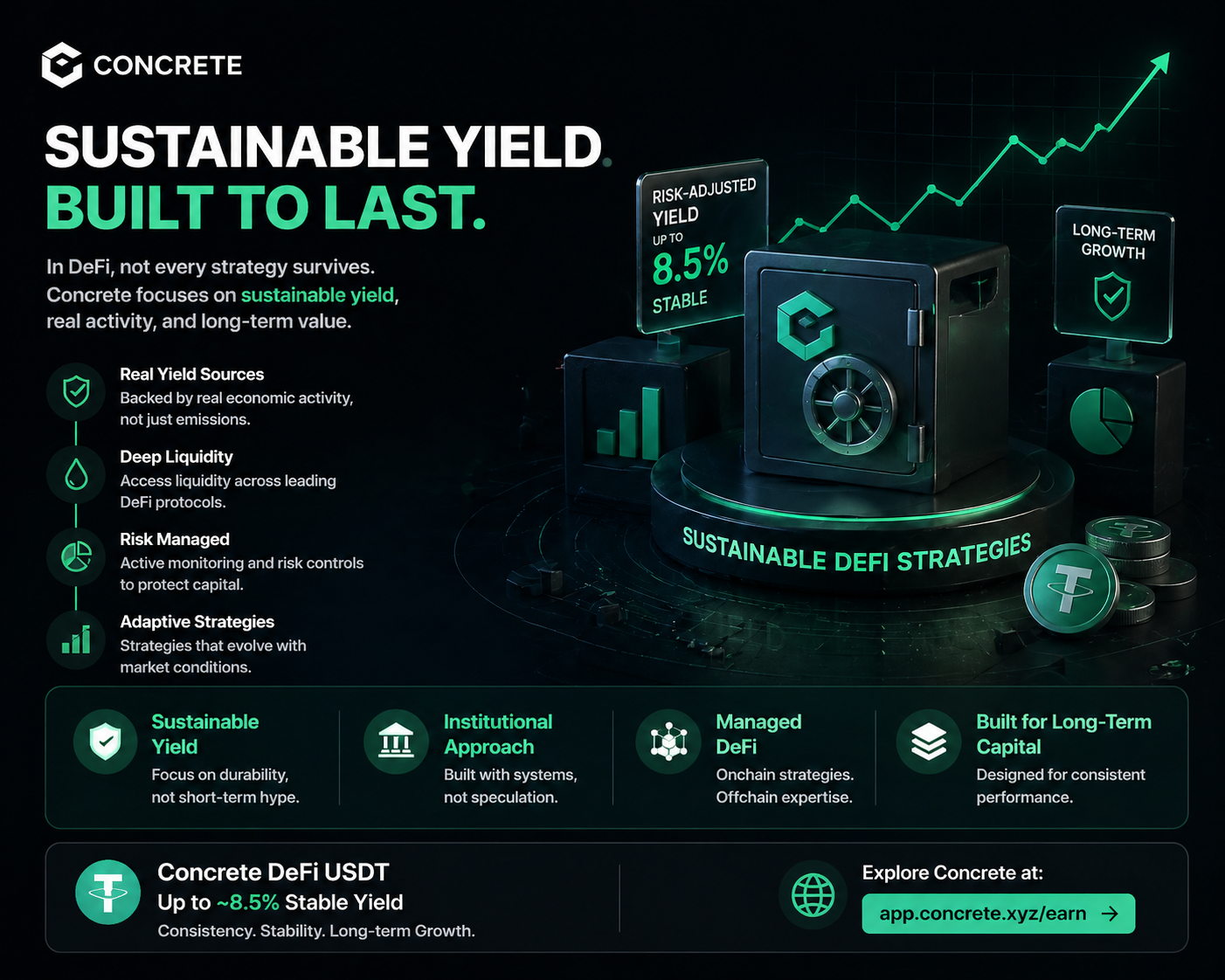
8️⃣ Example: Concrete DeFi USDT:
Consider Concrete DeFi USDT:
>Offers up to ~8.5% stable yield
>Stability outperforms volatile opportunities over time
>Consistency attracts long-term capital
Sustainable yield might look less exciting, but it’s far more reliable.
9️⃣ The Bigger Shift:
DeFi is moving from chasing short-term yield to focusing on long-term capital strategies. The highest APY no longer defines success durability does. Infrastructure and systems that prioritize sustainability will outlast temporary incentives.