What Makes a DeFi Strategy Actually Sustainable?
--
Most DeFi strategies aren’t designed to last — and that’s the point.
Scroll through any DeFi dashboard and you’ll see the same thing:
High APYs.
New opportunities.
Constant rotation of capital.
At first glance, it looks like growth.
But look closer, and a pattern emerges.
A strategy launches.
Capital rushes in.
Returns spike.
Then slowly — or suddenly — it fades.
This isn’t an exception.
It’s the default behavior of DeFi.
So instead of asking:
“What yields the most?”
A better question is:
“What is actually built to survive?”
The Hidden Design of DeFi Strategies
Most DeFi strategies are optimized for attention, not durability.
They are designed to:
- attract liquidity quickly
- generate early momentum
- create competitive APYs
- bootstrap network effects
And they work — temporarily.
But once incentives decline or capital saturates the strategy:
- yields compress
- participants exit
- the opportunity weakens
This creates a system where capital is constantly moving, but rarely staying.
Sustainability is not the priority.
Growth is.
Rethinking What “Sustainable” Means
In this environment, sustainability becomes a different kind of metric.
A sustainable strategy is not defined by peak performance.
It is defined by:
- consistency over time
- independence from temporary incentives
- resilience to changing market conditions
- the ability to function without constant capital inflow
It answers a simple question:
Can this strategy still work tomorrow?
And more importantly:
Will it still work when conditions change?
Real Yield vs Incentivized Yield
At the core of sustainability is the source of yield.
Real yield comes from actual economic activity:
- trading fees generated by volume
- interest paid by borrowers
- arbitrage opportunities between markets
This type of yield is tied to usage.
As long as the system is used, the yield can persist.
Incentivized yield, on the other hand, comes from:
- token emissions
- liquidity mining rewards
- temporary subsidy programs
This yield is designed to attract capital — not sustain it.
Once incentives decrease, so does participation.
And with it, the yield.
Understanding this difference is critical.
Because many high-APY strategies are built on incentives, not fundamentals.
Liquidity Is Not Loyalty
Another factor often overlooked is liquidity behavior.
In DeFi, liquidity is mobile.
It moves quickly toward higher returns and exits just as fast.
This means:
- high TVL does not guarantee stability
- capital inflows can reverse rapidly
- strategies dependent on constant inflow are fragile
Sustainable strategies do not rely on loyalty.
They rely on structure.
They generate value even when capital is not rapidly increasing.
The Cost of Staying Active
There’s also a practical reality:
Maintaining performance in DeFi requires effort.
Users must:
- monitor changing APYs
- move capital frequently
- rebalance positions
- pay gas costs
- manage risk exposure
Over time, this creates friction.
And friction leads to inefficiency.
Capital becomes:
- idle between decisions
- stuck in outdated strategies
- less responsive to better opportunities
Even strong strategies can degrade under operational pressure.
Designing for Durability
Sustainable strategies are not discovered — they are designed.
They require:
- diversification across multiple yield sources
- continuous monitoring and adjustment
- adaptability to different market regimes
- focus on risk-adjusted yield rather than peak returns
This is where DeFi begins to evolve.
From a collection of opportunities
into a system of capital management.
The Role of Concrete Vaults
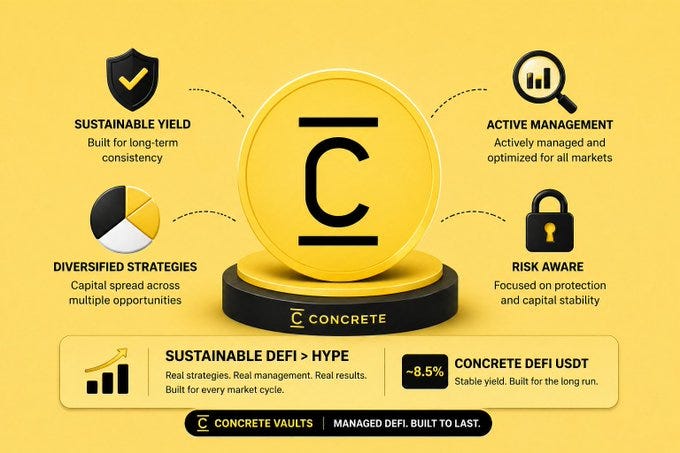
This is exactly the problem Concrete vaults are built to address.
Instead of relying on users to manually manage capital, they introduce structured systems for onchain capital deployment.
Concrete vaults aim to:
- prioritize sustainable yield sources
- manage allocation across strategies
- adapt to changing conditions
- reduce dependence on short-term incentives
- enable automated compounding
This creates a model of managed DeFi, where capital is guided by infrastructure rather than constant user intervention.
The focus shifts from chasing yield
to maintaining efficiency over time.
Concrete DeFi USDT: Stability as a Strategy
A clear example is Concrete DeFi USDT, offering up to ~8.5% stable yield.
At first glance, it may not compete with higher APYs.
But that’s the point.
It is not designed to peak.
It is designed to persist.
Stable yield:
- reduces volatility
- improves predictability
- attracts long-term capital
And over time, consistency compounds more effectively than short-lived spikes.
The Future: From Hype to Durability
DeFi is entering a new phase.
The early era rewarded speed, incentives, and experimentation.
The next phase will reward:
- sustainability
- structure
- disciplined capital allocation
In this environment:
- DeFi strategies will be evaluated over time, not at launch
- DeFi vaults will become standard tools
- institutional DeFi will prioritize reliability over hype
Because in the end, the market doesn’t reward what spikes.
It rewards what survives.
Final Thought
The highest yield in DeFi is often temporary.
The most valuable yield is sustainable.
And the strategies that matter most
won’t be the ones that attract the most attention —
but the ones that continue working long after attention fades.
Explore Concrete at: https://app.concrete.xyz/earn 🚀