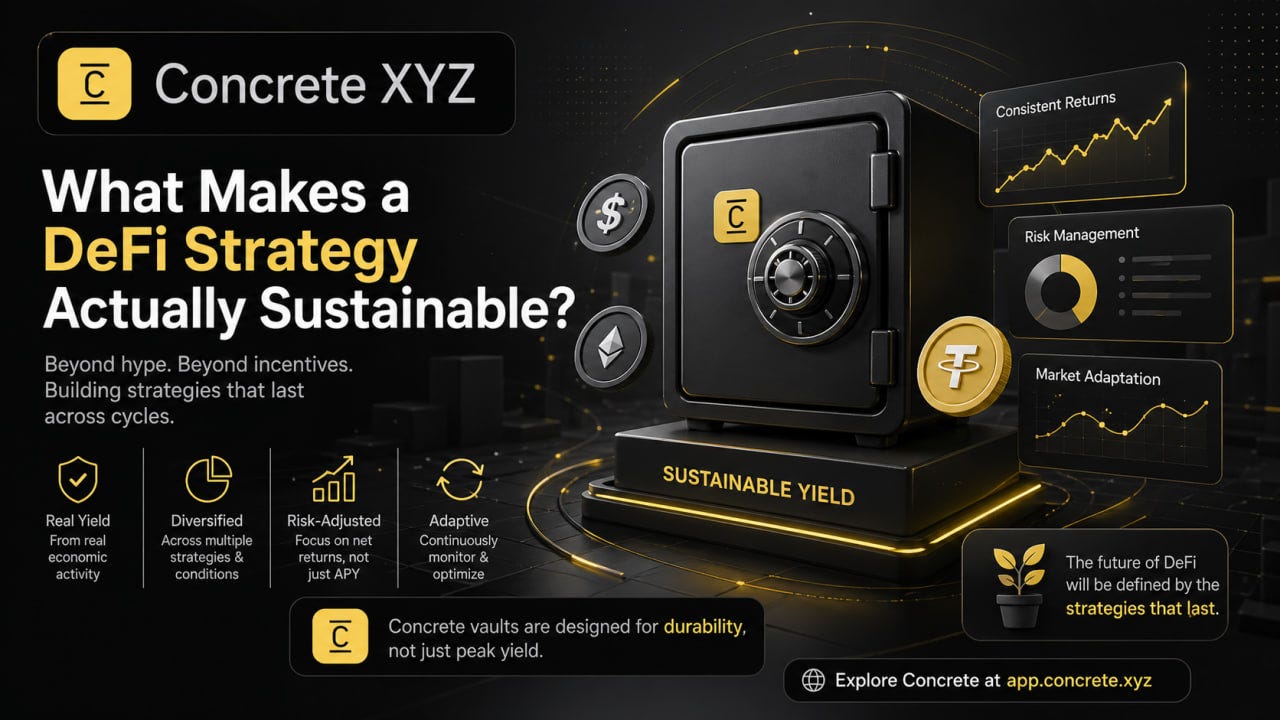
What Makes a DeFi Strategy Actually Sustainable?
--
DeFi is full of yield.
Every week, we see the same pattern:
new protocols launch with high APY, capital rushes in, yields start to compress, and liquidity rotates elsewhere.
This cycle repeats again and again across DeFi strategies.
But the real question is no longer:
“What has the highest yield?”
It’s:
“What actually lasts?”
The Pattern Behind DeFi Yield
Most strategies in DeFi begin with strong incentives. Token emissions attract attention and drive rapid capital inflows.
But over time:
- rewards decrease
- users exit
- yields decline
This is why many opportunities look attractive at the start but quickly fade.
So why do most strategies fail to sustain themselves?
Defining Sustainable Yield
Sustainable yield isn’t about chasing the highest number — it’s about consistency over time.
A sustainable strategy should:
- generate reliable returns
- not rely entirely on incentives
- remain viable across different market conditions
This is where the concept of risk-adjusted yield becomes important.
Because in the long run, stability often outperforms short-term spikes.
Real Yield vs Temporary Yield
Not all yield is created equal.
There are two main types:
- yield from real economic activity (trading, lending, arbitrage)
- yield driven by emissions or incentives
The problem is simple:
emissions-based yield almost always declines.
Meanwhile, yield backed by real activity tends to be more stable.
Understanding this difference is key to identifying durable opportunities in DeFi strategies.
Liquidity & Market Conditions
Sustainability depends heavily on market structure.
Key factors include:
- liquidity depth
- user activity
- volatility
- demand for the strategy
Some strategies only work under specific conditions.
Others are flexible enough to adapt — and those are the ones that tend to last.
The Overlooked Layer: Risk & Cost
One of the biggest mistakes in DeFi is focusing only on APY.
In reality, returns are shaped by:
- execution costs
- slippage
- rebalancing
- shifting correlations
A strategy may look strong on paper but weaken over time once these factors are considered.
This is where managed DeFi becomes critical — moving beyond manual yield farming toward structured capital management.
Designing Better Strategies
Sustainable strategies are built, not found.
They often include:
- diversification across multiple approaches
- continuous monitoring
- adapting to changing conditions
- focusing on net returns instead of headline APY
At this stage, DeFi starts to resemble a system rather than a collection of opportunities.
The Role of DeFi Vaults
This is where DeFi vaults play a key role.
They enable:
- automated strategy execution
- efficient onchain capital deployment
- continuous optimization
- adaptability across market cycles
Vaults are not just tools — they are infrastructure for long-term capital.
How Concrete Vaults Approach Sustainability
Concrete vaults are designed with durability in mind.
Instead of chasing short-term yield, they:
- prioritize sustainable yield sources
- allocate capital across multiple strategies
- adapt dynamically to market conditions
- reduce reliance on temporary incentives
This approach aligns closely with the principles of institutional DeFi, where consistency matters more than hype.
A Real Example: Concrete DeFi USDT
A strong example is Concrete DeFi USDT.
With yields of up to ~8.5%:
- it may not be the highest
- but it is designed to be stable
Over time, this kind of consistency can outperform more volatile opportunities.
And in many cases, predictable returns attract more long-term capital than short-term spikes.
The Bigger Shift
DeFi is evolving.
We are moving from:
- short-term yield chasing
toward:
- structured, long-term capital strategies
In this new phase:
- sustainable yield matters more than peak APY
- risk-adjusted yield becomes the benchmark
- infrastructure outlasts incentives
The future of DeFi will not be defined by the highest returns.
It will be defined by strategies that endure.
🚨 Explore Concrete at app.concrete.xyz 🚨