What Makes a DeFi Strategy Actually Sustainable?
--
I’ve watched it happen maybe twenty times now.
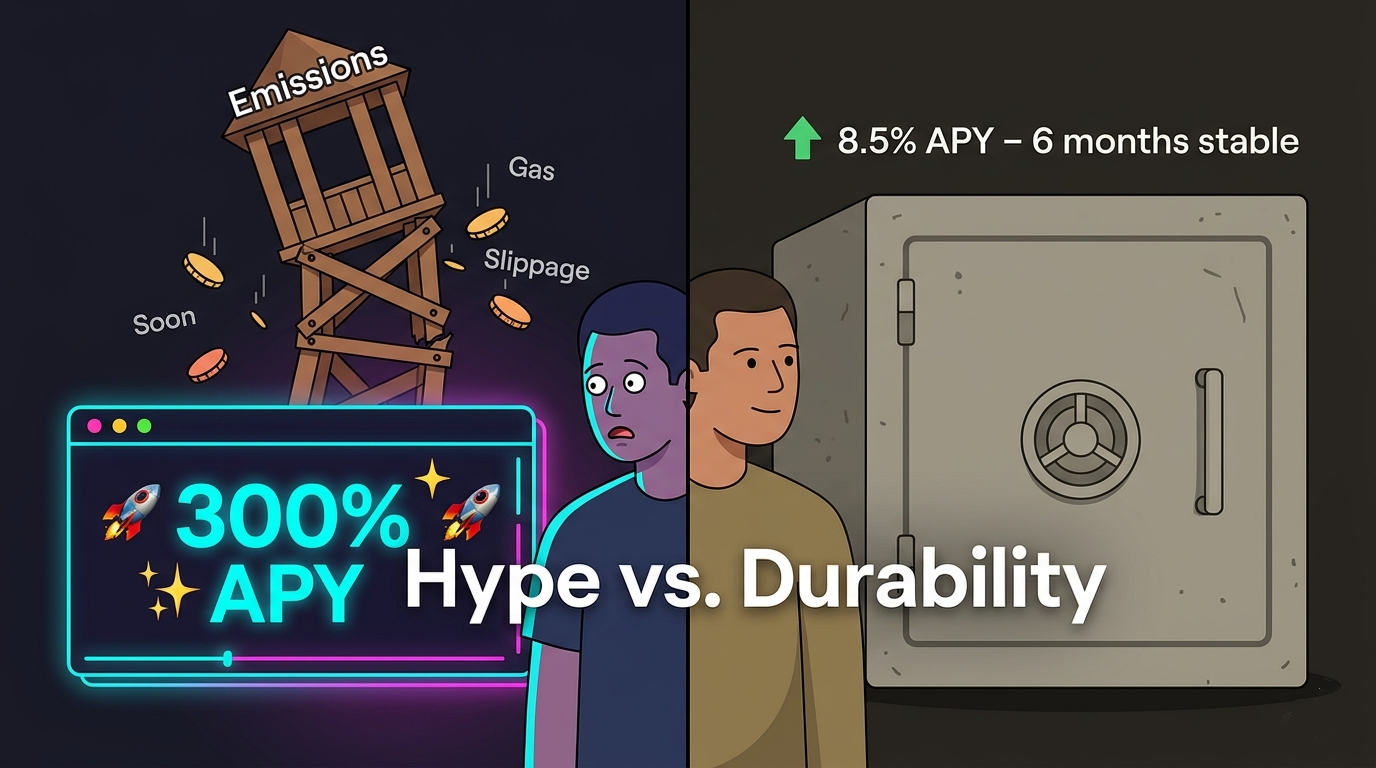
New protocol launches. APY shows 300% on something stupid like a stablecoin-stablecoin pair. Everyone loses their minds. Capital floods in. Discord goes crazy. Then two weeks later, the APY is 8%. Then 4%. Then the TVL drops faster than my motivation on a Monday morning.
The pattern is so predictable it’s almost boring. Yet every time, we convince ourselves “this time is different.” It never is.
So I started asking myself: what actually lasts? Not what has the biggest number right now, but what’s still gonna be there in six months when the hype dies?
What “sustainable” even means
Sustainable doesn’t mean the highest yield. It means the yield doesn’t vanish when the incentives stop. It means the strategy doesn’t break when volatility hits. It means you can sleep at night without checking your position every hour.
A sustainable strategy should generate consistent returns over time, not depend entirely on some treasury printing tokens, and stay viable when markets go up, down, or sideways. Basically, boring stuff that works.
Real yield vs temporary yield
Here’s the thing nobody tells you. Most DeFi “yield” isn’t real. It’s subsidized.
Real yield comes from actual economic activity. Someone pays a trading fee on Uniswap. Someone borrows USDC on Aave and pays interest. Someone gets liquidated and the liquidator captures a profit. Those are real transactions. Real value exchange.
Temporary yield comes from emissions. The protocol prints a governance token and gives it to you for staking. That’s not yield. That’s marketing. The moment they stop printing, your APY collapses.
I’ve been in farms where 80% of the APY was just token emissions. When the token price dumped, my “yield” turned into a loss. Learned that one the hard way.
The security elephant in the room
Even if a strategy offers real yield, none of it matters if the protocol gets hacked.
Look at recent months. April 2026 was brutal. The sector lost over $606 million across multiple exploits, making it the worst month since the Bybit incident. KelpDAO,a major liquid restaking protocol, suffered a $290 million hack on April 18 when attackers compromised a cross-chain bridge. The fallout erased more than $13 billion in total value locked across DeFi within 48 hours.
And it wasn’t just big names. Volo Protocol lost $3.5 million from three specific vaults just days after KelpDAO. Scallop, Sui′s largest lending protocol, got hit for $142,000 through a deprecated rewards contract that was over 17 months old.
What’s scary is that many of these protocols passed audits. KelpDAO had two separate audits before its breach. Scallop completed an audit in February 2025, yet that legacy contract remained exploitable. As one analyst put it, “audited does not mean safe”.
This is why sustainable yield isn’t just about returns. It’s about surviving. A 20% APY means nothing if the vault gets drained.
Why liquidity and market conditions matter
A strategy that works perfectly in calm markets can get destroyed in five minutes of chaos. The KelpDAO hack triggered a cascade effect, with the drained rsETH being used as collateral on platforms like Aave and Compound, creating systemic bad debt.
This is the hidden danger of chasing yield without understanding how strategies behave under stress.
The hidden costs nobody accounts for
A strategy can look amazing on paper then slowly bleed you dry through costs.
Execution costs add up. Every rebalance costs gas. Every harvest costs gas. If you’re manually moving money every week, those fees eat your compounding. I calculated once that my manual harvesting was costing me about 15% of my yield. I was working for free.
Slippage is another killer. If you’re trying to move a decent amount of capital, you move the market against yourself. That 10% arb opportunity becomes 2% after you actually execute.
And correlations shift. Two uncorrelated assets suddenly become correlated during a crash. Your “diversified” portfolio becomes a pile of the same risk. I’ve watched people get wrecked by this.
Better strategy design
So what actually works? The strategies that last usually share a few things.
They diversify across multiple yield sources. Not just one farm. Not just one protocol. If one source dries up, the others keep going.
They monitor continuously. Not checking once a week, but actually watching in real time and adjusting before things break.
They adapt to market conditions. When volatility spikes, they shift from lending to liquidation strategies. When rates compress, they move capital elsewhere.
They focus on net returns. Not the headline APY, but what actually lands in your wallet after gas, slippage, and risk.
And they prioritize security over hype. Because nobody cares about your yield if your funds are gone.
This is where DeFi stops being gambling and starts being actual finance.
How Concrete vaults fit in
Concrete Vaults are designed around this idea of durability, not peak yield. They don’t chase the highest number. They chase the most reliable number.
The vaults prioritize sustainable yield sources — trading fees, lending interest, arbitrage — not just emissions that will vanish. They manage capital across multiple strategies so no single failure kills you. They rebalance automatically when conditions change, so you don’t have to watch charts all day.
The Hook Manager enforces risk boundaries. If a position gets too dangerous, the vault adjusts before you get liquidated. That’s not exciting. But it keeps your money safe.
The Allocator moves capital day-to-day based on real-time data, not some static allocation you set once and forget. When Aave rates go up and Compound rates drop, the vault shifts. No manual intervention needed.
And while Concrete vaults aren’t immune to crypto risks, their infrastructure is built by a team from institutions like Point72 and Morgan Stanley, with security backed by a $250,000 bug bounty program and partnerships with top-tier security firms. That’s not a guarantee, but it’s a far cry from the “audited but still vulnerable” protocols we keep seeing drained.
The Concrete DeFi USDT example
Their USDT vault targets around 8.5% stable yield right now. Not sexy. Not something you screenshot and flex on Twitter.
But here’s why that matters. That yield comes from real sources — mostly delta-neutral funding rate strategies and basis trading. It’s not emissions. It doesn’t collapse when a treasury runs dry. It survives volatility because the underlying strategies are hedged.
Over a year, 8.5% reliably compounded beats a volatile 30% that might lose your principal. I’ve watched people chase 50% farms and end up with less than they started. Meanwhile, boring USDT vaults just keep stacking.
The bigger shift happening
DeFi is growing up. The era of “apy go brrr” is ending. Not because yields are disappearing, but because we’ve realized that chasing spikes is a loser’s game.
The future isn’t about who has the highest number this week. It’s about whose strategies actually last. Who can generate consistent returns across bull and bear markets. Who builds infrastructure that survives when the hype dies.
Sustainability will matter more than peak returns. Infrastructure will outlast incentives. Security will beat marketing.
The highest APY was never the point. The point was always: can this strategy still be here in six months? Can I trust it with my capital?
Concrete vaults won’t make you rich overnight. But they might still be working for you next year. And honestly? That’s worth more than any temporary pump.
🌍 Explore Concrete at: https://app.concrete.xyz/earn