--
🟠 What Makes a DeFi Strategy Actually Sustainable?
Decentralized Finance (DeFi) has seen a recurring pattern: new protocols launch with high Annual Percentage Yields (APYs), attracting a rapid influx of capital. However, as more capital enters, yields compress, and liquidity often shifts to newer, higher-yielding opportunities. This cycle repeats across the DeFi landscape, leading to a critical question: Why do most strategies fade so quickly?
⏺ Defining Sustainable DeFi
A sustainable DeFi strategy is one that generates consistent returns over time, without relying solely on temporary incentives. It remains viable across various market conditions, emphasizing durability rather than just peak performance.
⏺ Real Yield vs. Temporary Yield
It’s crucial to differentiate between real yield and temporary yield. Real yield originates from genuine economic activities such as trading fees, lending interest, or arbitrage opportunities. In contrast, temporary yield often stems from token emissions or other short-term incentives. Emissions-driven yields tend to decline as incentives diminish, while real economic activity provides a more stable and enduring source of returns. Not all yield is created equal.
⏺ The Role of Liquidity and Market Conditions
The sustainability of a DeFi strategy is heavily influenced by factors like liquidity depth, user activity, market volatility, and the inherent demand for the underlying strategy. Some strategies thrive only under specific market conditions, while truly sustainable ones demonstrate adaptability.
⏺ Risk and Cost Awareness
Often overlooked are the hidden costs and risks associated with DeFi strategies. These include execution costs, the need for frequent rebalancing, slippage during large trades, and changing correlations between assets. A strategy that appears robust on paper can degrade significantly over time once these practical considerations are factored in.
⏺ Designing Better Strategies
Building sustainable DeFi strategies involves several key principles: diversification across multiple strategies, continuous monitoring of market dynamics, adapting to evolving conditions, and focusing on net returns rather than just headline APY. This approach shifts DeFi from a series of fleeting opportunities to a more robust, system-oriented financial ecosystem.
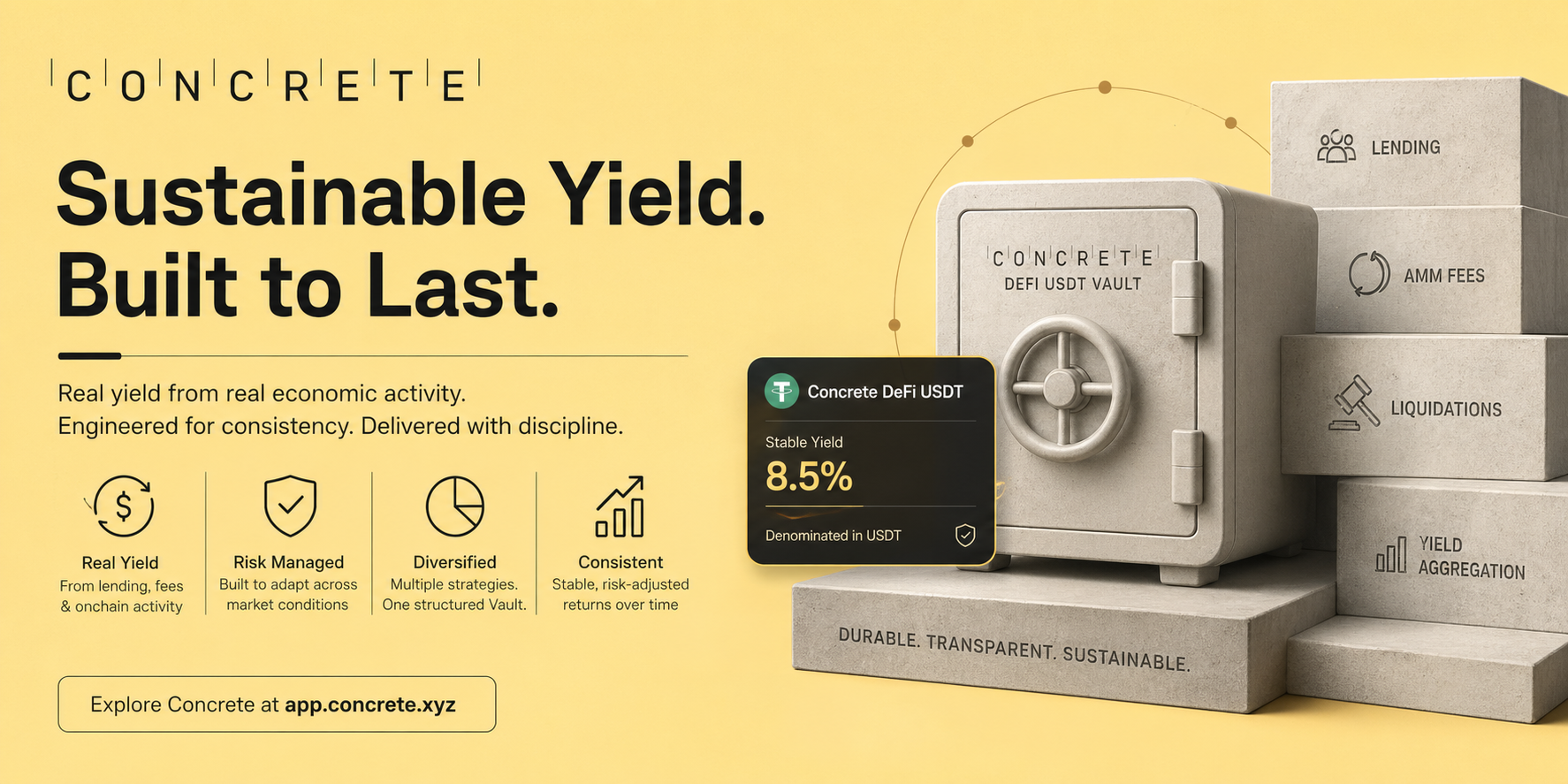
⏺ Concrete Vaults: A Sustainable ApproachPlatforms like Concrete aim to address these challenges by prioritizing sustainable yield sources. Their vaults are designed to manage capital across various strategies, adapt to changing market conditions, and reduce reliance on short-term incentives. The focus is on durability and consistent performance, not merely achieving the highest possible yield.
⏺ Example: Concrete DeFi USDT
Consider the Concrete DeFi USDT offering, which provides up to ~8.5% stable yield. While this might seem less exciting than volatile, high-APY opportunities, its stability can lead to superior long-term performance. Consistency in returns attracts long-term capital, demonstrating that sustainable yield, though less flashy, is ultimately more reliable.
⏺ The Bigger Shift in DeFi
DeFi is undergoing a significant transformation, moving away from short-term yield chasing towards the development of long-term capital strategies. In this evolving landscape, sustainability will increasingly outweigh peak returns, and robust infrastructure will prove more enduring than temporary incentives. The future of DeFi will not be defined by the highest APY, but by the strategies that demonstrate true longevity and resilience.
lets get more information on https://app.concrete.xyz/earn
🔑 Keywords to Use Naturally
-- sustainable yield
-- risk-adjusted yield
-- DeFi strategies
-- DeFi vaults
-- managed DeFi
-- Concrete vaults
-- onchain capital deployment
-- institutional DeFi