What Makes a DeFi Strategy Actually Sustainable?
 Yuga4 min read·Just now
--
DeFi is full of yield. New strategies launch every week with flashy APYs. Capital rushes in. Then, just as quickly, yields compress, liquidity dries up, and everyone rotates to the next hot opportunity.
This cycle repeats endlessly across DeFi. A protocol offers triple-digit returns to bootstrap liquidity, attracts hundreds of millions, and a few months later the incentives fade — leaving frustrated users and collapsing TVL.
So the real question isn’t “What has the highest yield right now?”
It’s: “What actually lasts?”
This week, we explore a deeper idea: In mature financial systems, the best strategies might not be the ones that perform for a week — but the ones that survive across market cycles.
- The Repeating Pattern. We’ve all seen it. A new DeFi strategy launches with eye-watering APY. Twitter lights up. Capital floods in. For a short period, everyone feels like a genius.Then reality hits. Incentives run out. Competition increases. Yields drop sharply. Liquidity providers leave for greener pastures. The strategy that looked unstoppable quietly fades into the background.Why do most DeFi strategies disappear so quickly? Because many are built for short-term attention, not long-term durability.
- What “Sustainable” Actually Means. A truly sustainable DeFi strategy is one that can generate consistent, risk-adjusted returns over time without depending on artificial support.It should deliver:
- Reliable performance across different market conditions (bull, bear, and sideways)
- Returns that don’t collapse when token emissions end
- Durability that attracts long-term capital instead of mercenary liquidity
Sustainability is about durability, not just peak performance.
- Real Yield vs Temporary Yield. Not all yield is created equal.Temporary yield usually comes from heavy token emissions and incentives. Protocols distribute their native tokens to attract TVL, creating artificially high APYs. When the emissions slow or stop, the yield drops dramatically — often to near zero. Real yield, on the other hand, comes from genuine economic activity: trading fees from actual volume, interest paid by borrowers in lending markets, arbitrage opportunities, and other productive use cases. Real yield is more stable because it’s tied to real demand and usage, not inflationary rewards. Emissions-driven strategies often collapse once the subsidies end, while strategies built on real activity tend to persist.
- The Role of Liquidity and Market Conditions. Sustainability also depends heavily on liquidity depth and underlying market dynamics.Some strategies only work well in high-volatility environments or when specific conditions exist (e.g., wide funding rates or abundant incentives). When those conditions change, the strategy breaks. Sustainable strategies adapt. They maintain performance even when volatility shifts, user activity fluctuates, or correlations between assets change. They are built to survive different regimes, not just thrive in one.
- Risk and Cost Awareness. Many strategies look excellent on paper but degrade quickly once real-world frictions are included:
- Gas fees and execution costs
- Slippage during rebalancing
- Impermanent loss or changing asset correlations
- Hidden risks that only appear during market stress
A strategy with a high headline APY can deliver poor net returns after these costs. Sustainable strategies prioritize risk-adjusted yield — focusing on what you actually keep after fees, risks, and drawdowns.
- Building Better DeFi Strategies. Sustainable DeFi strategies are designed like professional portfolios, not one-off opportunities.They incorporate:
- Diversification across multiple yield sources
- Continuous monitoring and automated rebalancing
- Focus on net returns instead of gross APY
- Adaptive mechanisms that respond to changing market conditions
This is where DeFi begins to mature — moving from isolated opportunities toward robust, managed systems.
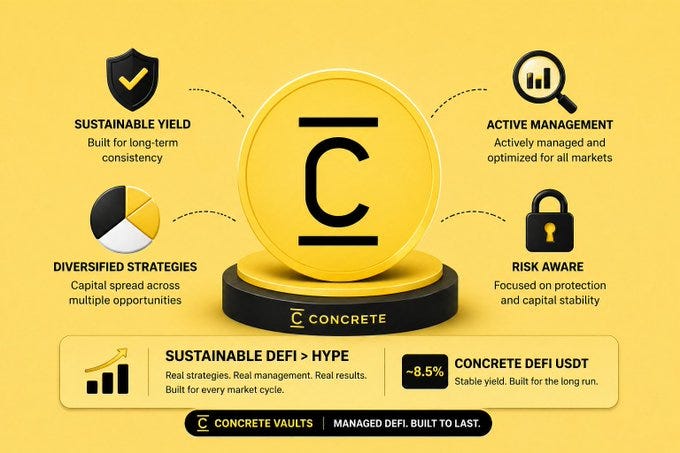
- How Concrete Vaults Approach Sustainability. Concrete vaults are built specifically for this long-term mindset. Instead of chasing short-term spikes, Concrete focuses on sustainable yield through automated, institutional-grade infrastructure. The vaults allocate capital intelligently across strategies, manage rebalancing, reduce execution friction, and prioritize sources of real economic yield over temporary incentives. By handling the complex work behind the scenes, Concrete vaults help users move from short-term yield hunting to structured, durable exposure.
- Concrete DeFi USDT as a Real Example. A clear example is the Concrete DeFi USDT vault. It targets approximately 8.5% stable yield, primarily through delta-neutral arbitrage and optimized lending strategies. Recent realized yields have been consistent — around 7.5–8% annualized over the past 7 and 30 days. While 8.5% may not sound as exciting as a 100%+ farming opportunity, its stability is its strength. The yield comes from sustainable sources rather than heavy emissions. This consistency across market conditions makes it attractive for long-term capital. Over time, reliable compounding often outperforms volatile high-APY strategies that suffer major drawdowns or sudden collapses.
- The Bigger Shift Ahead. DeFi is gradually moving away from short-term yield chasing toward long-term capital strategies. In the future, sustainability will matter more than peak returns. Infrastructure that delivers consistent, risk-adjusted yield will outlast flashy incentives. Managed DeFi and DeFi vaults will become the default way sophisticated capital participates on-chain. The future of DeFi won’t be defined by who offers the highest APY this week. It will be defined by the strategies — and the infrastructure — that actually last.
Explore Concrete at: https://app.concrete.xyz/earn