What Makes a DeFi Strategy Actually Sustainable?
--
DeFi is full of yield — but very little of it lasts.
New strategies launch every week.
APYs spike.
Capital flows in.
Then the cycle repeats.
Yields drop.
Liquidity leaves.
Opportunities disappear.
We’ve all seen it.
But most people still chase it.
So the real question isn’t:
“What has the highest yield?”
It’s:
“What actually lasts — when the cycle ends?”
The Pattern Everyone Recognizes
A new protocol launches with attractive yields — and attention follows immediately.
Capital rushes in.
Liquidity deepens.
Returns look strong.
For a moment, everything works.
But over time:
- yields compress as more capital enters
- incentives decline
- market conditions shift
- liquidity rotates elsewhere
What once looked like a strong opportunity quietly fades.
This pattern repeats across DeFi — again and again.
Which raises a more important question:
Why do most strategies fail to sustain themselves — even when they look strong at the start?
What “Sustainable” Actually Means
A sustainable DeFi strategy is not defined by its peak performance.
Because peak performance is easy. Consistency is not.
It is defined by its ability to perform — not just once, but repeatedly over time.
At a high level, sustainable yield should:
- generate consistent returns across periods
- not rely entirely on token incentives
- remain viable under changing market conditions
This is not about chasing the highest number.
It is about building a strategy that continues to function — even when the market stops cooperating.
Real Yield vs Temporary Yield
Not all yield is created equal — some is earned, some is subsidized.
Some yield is generated through real economic activity, such as:
- trading fees
- lending demand
- arbitrage opportunities
This type of yield tends to be more sustainable because it is tied to real demand — not artificial incentives.
Other yield looks similar on the surface — but behaves very differently.
It comes from:
- token emissions
- incentive programs
- liquidity mining campaigns
These can inflate APY in the short term — but often decline once incentives taper.
This is why many high-yield opportunities do not last.
They are not built on durable revenue.
They are built on incentives — and incentives don’t last.
The Role of Liquidity and Market Conditions
Sustainability is not just about where yield comes from — it’s about the conditions that allow it to exist.
It also depends on the environment in which that yield is generated.
A strategy’s performance is influenced by:
- liquidity depth
- user activity
- market volatility
- demand for the underlying assets
Because yield does not exist in isolation — it exists within market conditions.
Some strategies perform well only under specific conditions.
For example, a strategy may perform well in low volatility — but break down when markets move sharply.
Others are more adaptable.
The more a strategy depends on narrow conditions, the more fragile it becomes.
Risk and Cost: The Hidden Layer
Another critical layer is often overlooked — the cost of actually executing the strategy.
Cost and execution are where theory meets reality.
Even a strong strategy can degrade quickly once real-world frictions are introduced:
- gas fees from frequent adjustments
- slippage during rebalancing
- changing correlations between assets
- execution delays in volatile markets
These are not edge cases — they are part of the system.
What looks strong on paper can perform very differently in practice.
This is where risk-adjusted yield becomes essential.
Sustainable strategies are not just profitable — they survive cost, friction, and stress.
From Opportunities to Systems
As DeFi matures, strategy design is no longer about finding opportunities — it’s about building systems.
The focus is shifting from isolated opportunities to structured systems.
Because opportunities are temporary — systems are repeatable.
Sustainable DeFi strategies are increasingly built around:
- diversification across multiple positions
- continuous monitoring and adjustment
- adaptability to changing conditions
- focus on net returns, not headline APY
This is where DeFi begins to resemble institutional DeFi — where capital is managed through systems, not constant manual decisions.
How Concrete Vaults Approach Sustainability
This is where infrastructure becomes critical — not as an add-on, but as the foundation.
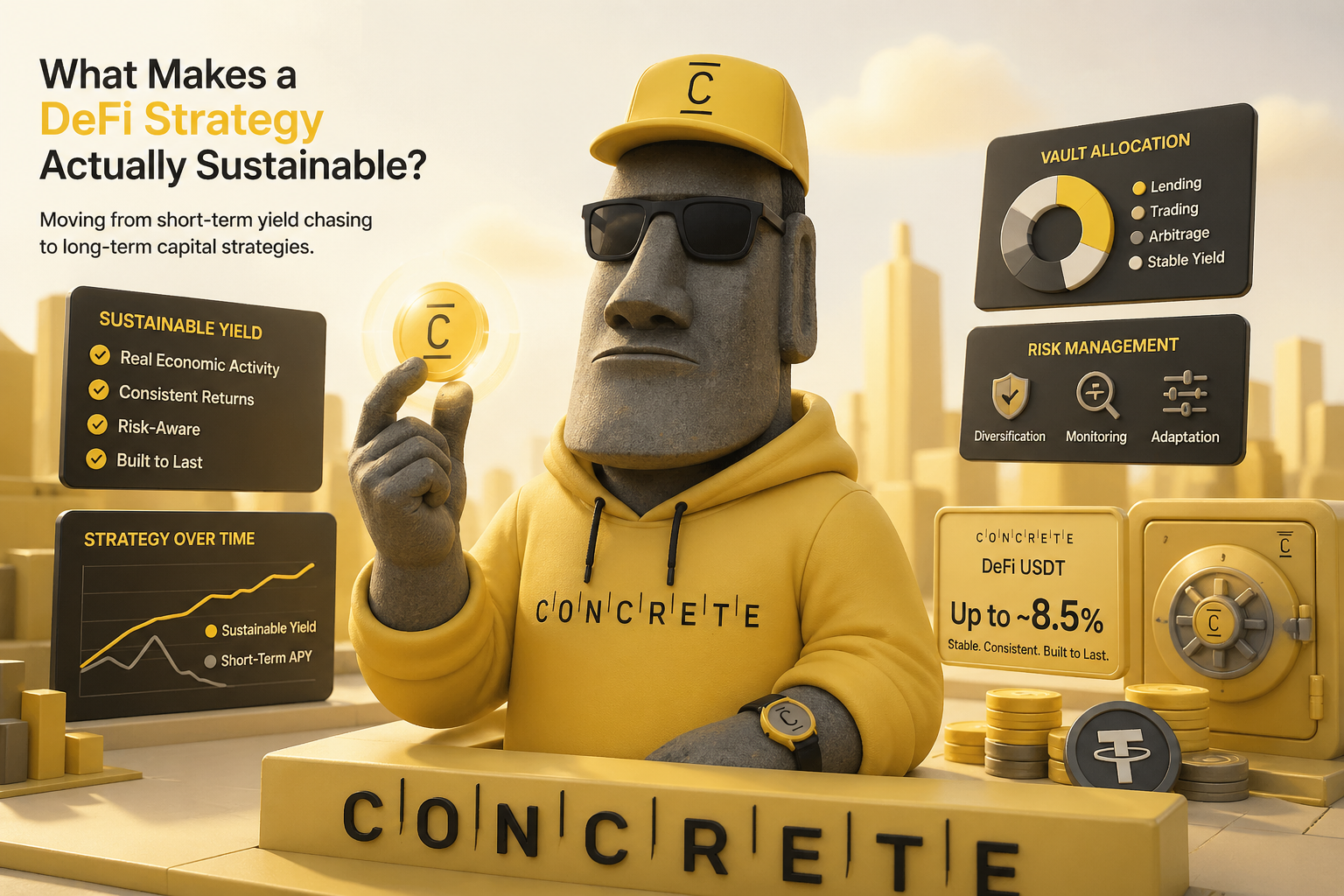
Concrete vaults are designed around this idea — prioritizing sustainable yield over short-term spikes.
Instead of reacting to opportunities, they are built to manage capital across them.
Vaults focus on:
- allocating capital across multiple strategies
- adapting to changing market conditions
- reducing reliance on temporary yield sources
- improving risk-adjusted yield over time
Through managed DeFi, users are able to participate in structured systems where capital is actively deployed and optimized.
This allows for continuous onchain capital management — without requiring constant manual intervention.
In other words, users are no longer chasing yield — they are allocating into a system designed to manage it.
Concrete DeFi USDT: A Practical Example
A practical example of this approach is Concrete DeFi USDT.
Rather than offering inflated returns, it targets approximately ~8.5% in stable yield.
At first glance, this may seem less exciting than higher APY opportunities.
But over time, stability matters — especially in volatile markets.
- consistent yield compounds more effectively
- lower volatility reduces drawdowns
- predictable outcomes attract long-term capital
This is how sustainable strategies outperform.
Not through spikes — but through consistency that compounds.
The Bigger Shift
DeFi is entering a new phase.
The first phase was driven by yield chasing.
The next phase is defined by sustainability.
- short-term opportunities → long-term strategies
- headline APY → risk-adjusted yield
- manual execution → managed systems
This is not just a shift in strategy — it’s a shift in how capital is managed.
In this environment, DeFi vaults become essential infrastructure — not optional tools.
They enable capital to be deployed efficiently, adaptively, and at scale.
Because in the long run, the market does not reward the highest yield.
It rewards the strategies that survive — and continue to perform when others disappear.
Explore Concrete: