What Makes a DeFi Strategy Actually Sustainable?
 ranbir singh4 min read·Just now
--
What Makes a DeFi Strategy Actually Sustainable?
1. The Familiar Cycle
Every month we see new protocols launch with eye‑catching APYs. Capital rushes in, liquidity pools swell, and the headline yield seems unbeatable. Within weeks those numbers compress — incentives fade, liquidity migrates, and the strategy loses its edge. The pattern repeats across the DeFi landscape, turning high‑flyer projects into yesterday’s news.
The crucial question isn’t “Which protocol gives the highest yield today?” but “Why do most strategies evaporate so quickly?”
2. Defining “Sustainable” in DeFi
A sustainable DeFi strategy is one that generates consistent, risk‑adjusted returns over time. Its durability comes from three core attributes:
Consistent Returns — Performance holds up across weeks, months, and market cycles.
Independence from Short‑Term Incentives — Yield isn’t solely driven by token emissions or temporary subsidies.
Cross‑Market Viability — The model works in both bull and bear environments, adapting to shifting liquidity and volatility.
In short, sustainability is about durability, not just a flash‑in‑the‑pan APY.
3. Real Yield vs. Temporary Yield
| Real Yield (Economic Activity) | Temporary Yield (Incentives) |
| — — — — — — — — — — — — — — — -| — — — — — — — — — — — — — — — |
| Comes from genuine lending, trading, arbitrage, or fee capture. | Comes from token emissions, liquidity mining, or promotional rewards. |
| Tied to on‑chain usage and demand, therefore more stable. | Declines as emissions taper or as the market reallocates capital. |
| Often lower headline numbers but offers predictable cash flow. | Can start high but erodes quickly once the incentive schedule ends. |
A strategy that leans heavily on emissions will look spectacular in the moment, yet its yield collapses once the program winds down. Real‑activity yield, while modest, is far more resilient.
4. Liquidity, Depth, and Market Conditions
Liquidity Depth — Deep pools can absorb large trades with minimal slippage, keeping yields stable. Shallow pools explode in price impact, making the strategy fragile.
User Activity — Persistent borrowing, trading, or fee generation signals a healthy use case.
Volatility — Some strategies thrive on volatility (e.g., option selling) while others (e.g., stable‑coin lending) prefer calm markets. Sustainable designs either adapt to volatility or deliberately avoid it.
Demand for the Underlying — If a protocol’s core service (e.g., stable‑coin borrowing) remains in demand, its yield source persists.
5. Risk & Cost Awareness
Even a mathematically sound yield curve can be eroded by hidden costs:
Execution Fees — Gas, bridge, and swap fees can eat a sizable share of returns, especially on high‑frequency tactics.
Rebalancing Overhead — Frequent position changes generate transaction costs that diminish net yield.
Slippage & Front‑Running — Low‑liquidity strategies are vulnerable to price manipulation.
Correlation Shifts — Assets that once moved independently may start to co‑move, increasing systemic risk.
A sustainable strategy incorporates these frictions into its risk‑adjusted yield calculations.
6. Designing Sustainable Strategies
Diversify Across Tactics — Combine stable‑coin lending, fee‑based protocols, and low‑slippage arbitrage to smooth returns.
Continuous Monitoring — Use on‑chain analytics to track changes in liquidity, emissions, and transaction costs.
Adaptive Allocation — Shift capital toward the strongest net‑yield sources as market conditions evolve.
Focus on Net Returns — Prioritize the after‑cost APY, not the headline figure.
When these principles guide the architecture, the strategy becomes a system rather than a fleeting opportunity.
7. Concrete Vaults: A Blueprint for Durability
Concrete vaults embody the sustainable‑yield mindset. Their design goals include:
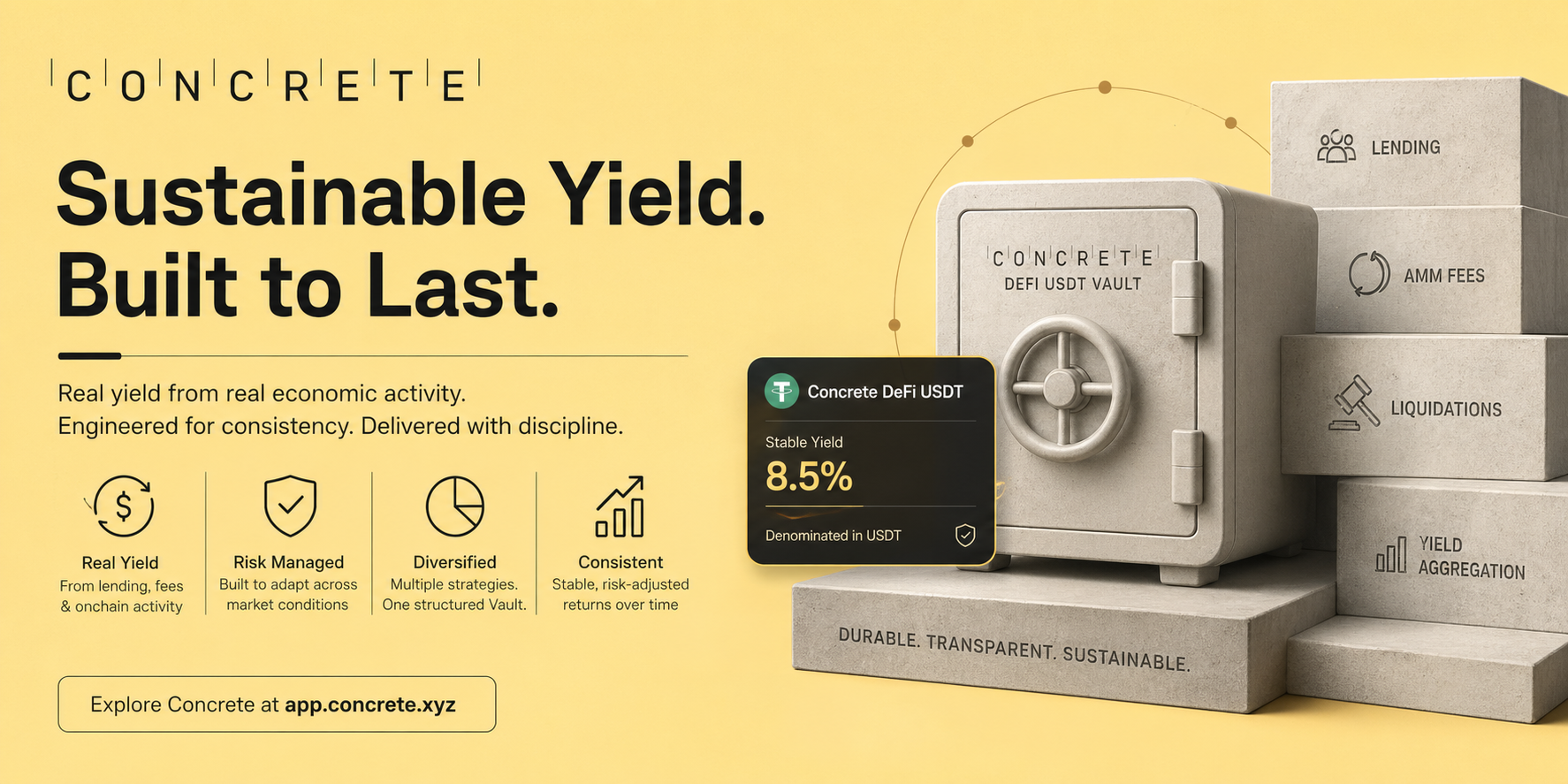
Prioritizing Real‑Activity Yield — Vaults allocate capital to protocols that generate fees from genuine lending, trading, or collateralization.
Dynamic Capital Management — Assets are re‑distributed across multiple strategies as liquidity and incentives shift.
Reduced Reliance on Short‑Term Emissions — By limiting exposure to token‑minting rewards, vaults protect investors from abrupt APY drops.
In practice, Concrete’s managed DeFi approach seeks to be a “steady‑hand” for on‑chain capital deployment.
8. Concrete DeFi USDT — A Real‑World Example
The Concrete DeFi USDT vault currently offers around 8.5 % stable yield on USDT. While the number may look modest compared to a 30 % launch APY elsewhere, its stability shines over time:
Consistent Cash Flow — Yield comes from lending pools and fee capture, not from diminishing token emissions.
Low Volatility — As a stable‑coin‑based vault, it’s insulated from the price swings that plague many crypto‑only strategies.
Attracts Long‑Term Capital — Steady returns encourage institutional and retail investors to stay put, reinforcing liquidity and further stabilizing yields.
Sustainable yield may lack the flashiness of high‑risk tactics, but it outperforms volatile, short‑term opportunities when measured across months and years.
9. The Bigger Shift Ahead
DeFi is moving from a “hunt‑the‑highest‑APY” mindset to a long‑term capital‑deployment model. As infrastructure matures, the emphasis will be on:
Risk‑Adjusted Yield — Evaluating returns after accounting for fees, slippage, and market stress.
Managed DeFi — Professional, on‑chain capital managers that continuously optimize allocations.
Institutional‑Grade Stability — Strategies that can survive multiple market cycles, attracting larger, more risk‑averse players.
The future of DeFi will be defined not by the brightest flash of APY, but by the strategies that last.
Explore Concrete at app.concrete.xyz to see how a sustainable‑yield vault works in practice and to start deploying capital with a focus on durability, not just headline numbers.