What Makes a DeFi Strategy Actually Sustainable?
 Obinna Isaac4 min read·Just now
--
We’ve all seen the pattern play out countless times in DeFi.
A promising new protocol launches with eye-popping APYs sometimes triple or even quadruple digits. Capital floods in as yield chasers rotate their bags. Liquidity pools swell, competition intensifies, and yields compress rapidly. Within weeks or months, the opportunity fades, incentives dry up or get diluted, and the same capital rotates to the next hot narrative. Rinse and repeat. This cycle has repeated across lending markets, liquidity provision, yield aggregators, and farming platforms. Most strategies deliver explosive short-term returns followed by sharp decay. The key question is: Why do most DeFi strategies fade so quickly?
What “Sustainable” Actually Means
Sustainability in DeFi is not about chasing the highest headline APY. It is about durability.
A genuinely sustainable strategy should deliver:
- Consistent returns over extended periods, not just during launch hype.
- Reduced dependence on temporary token emissions or short-term incentives.
- Resilience across different market regimes—bull, bear, and sideways.
It prioritizes longevity and capital preservation over peak performance. The goal is a strategy that can compound reliably rather than one that requires constant migration to stay profitable.
Real Yield vs. Temporary Yield
Not all yield is created equal.
Temporary yield usually comes from emissions, liquidity mining rewards, or inflationary token incentives. These programs bootstrap liquidity and TVL quickly, but they are structurally unsustainable. As token supply increases and rewards taper, APYs collapse. Providers who entered for the incentives often exit en masse, creating a death spiral of declining yields and shrinking liquidity.
Real yield by contrast, stems from genuine economic activity: borrowing demand in lending markets, trading fees in DEX pools, arbitrage opportunities, or other protocol revenue. This yield is tied to actual usage and value creation in the ecosystem. It tends to be more stable because it reflects organic demand rather than artificial incentives.
The difference is critical. Emissions-driven strategies often look spectacular on a dashboard but evaporate once the incentives end. Real-yield strategies may appear modest by comparison, yet they have a far better chance of persisting through market cycles.
The Role of Liquidity and Market Conditions
Sustainability also hinges on underlying market dynamics:
Liquidity depth determines how much capital a strategy can absorb without massive slippage.
User activity and demand drive the revenue that generates real yield.
Market volatility can amplify or destroy returns depending on the strategy’s design.
Changing conditions (interest rate shifts, correlation breakdowns, or new competing protocols) can render once-profitable strategies obsolete.
Some approaches only work in high-volatility environments or specific liquidity regimes. Adaptive strategies that can reallocate capital, adjust exposure, or shift between protocols tend to survive longer.
Risk and Cost Awareness: The Often-Ignored Erosion
Even promising strategies can degrade once real-world frictions are factored in.
Execution costs, gas fees, rebalancing expenses, slippage on large positions, and impermanent loss (or its equivalents) all eat into gross yields.
Correlations between assets can shift during stress events, turning diversified portfolios into concentrated risks. What looks like 30–50% APY on a static simulation often delivers far lower net returns or even losses after these factors compound over time.
Sustainable strategies explicitly account for these realities. They focus on net returns after costs and risks rather than gross headline numbers.
Building Better Strategies: From Opportunities to Systems
This is where DeFi matures from simple yield chasing into structured capital management. Sustainable strategies are typically built around:
- Diversification across multiple yield sources and protocols.
- Continuous monitoring and data-driven rebalancing.
- Adaptive rules that respond to changing market conditions.
- Emphasis on risk-adjusted performance and capital efficiency.
Instead of treating DeFi as a series of one-off opportunities, the best approaches treat it as an interconnected system—one that can be actively managed for durability.
How Concrete Vaults Approach Sustainability
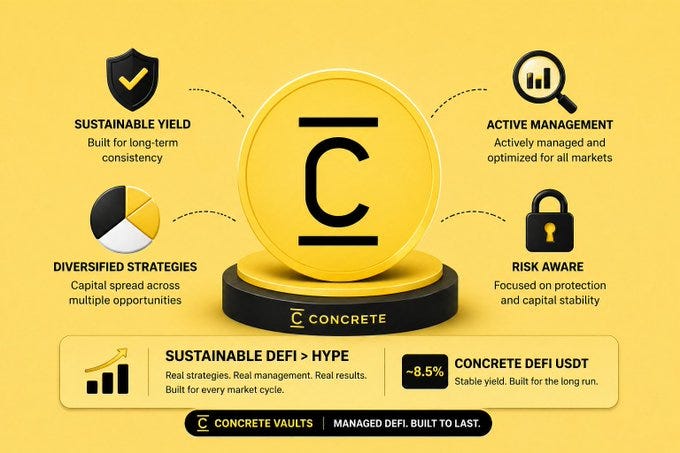
This philosophy sits at the heart of what Concrete is building. Concrete vaults are designed as institutional-grade infrastructure that prioritizes sustainable yield sources over short-term hype.
Rather than relying on fleeting incentives, the vaults allocate capital across diversified, real yield generating strategies. They automate allocation, rebalancing, and risk management so that capital remains productive without constant manual intervention.
By focusing on durability, Concrete reduces dependence on short-term emissions and aims to deliver consistent performance across varying market conditions.
A Concrete Example: Concrete DeFi USDT
The Concrete DeFi USDT vault provides a clear illustration. It currently offers around 8.5% stable yield on USDT deposits.
At first glance, 8.5% may not sound as thrilling as some triple-digit farming plays. But that consistency is precisely the point.
By drawing from real economic activity and employing automated, risk-managed strategies, the vault aims to generate steady returns without the volatility and drawdowns that come with chasing volatile opportunities. Over time, this stability combined with lower risk of sudden yield collapse often outperforms higher but unsustainable APYs, especially once costs, rebalancing, and opportunity losses are considered.
The vault keeps capital continuously productive, compounds efficiently, and attracts long-term depositors who value reliability over hype.
The Bigger Shift in DeFi
DeFi is evolving. The era of pure short-term yield chasing is gradually giving way to more sophisticated, long-term capital strategies. As the space matures, sustainability will matter more than peak returns. Infrastructure that can adapt, manage risk intelligently, and deliver durable yield will outlast incentive programs that inevitably fade.
The future of DeFi won’t be defined by who posts the highest APY. It will be defined by the strategies and the platforms that actually last.
If you’re looking for yield strategies built with durability in mind, explore Concrete at: app.concrete.xyz/earn