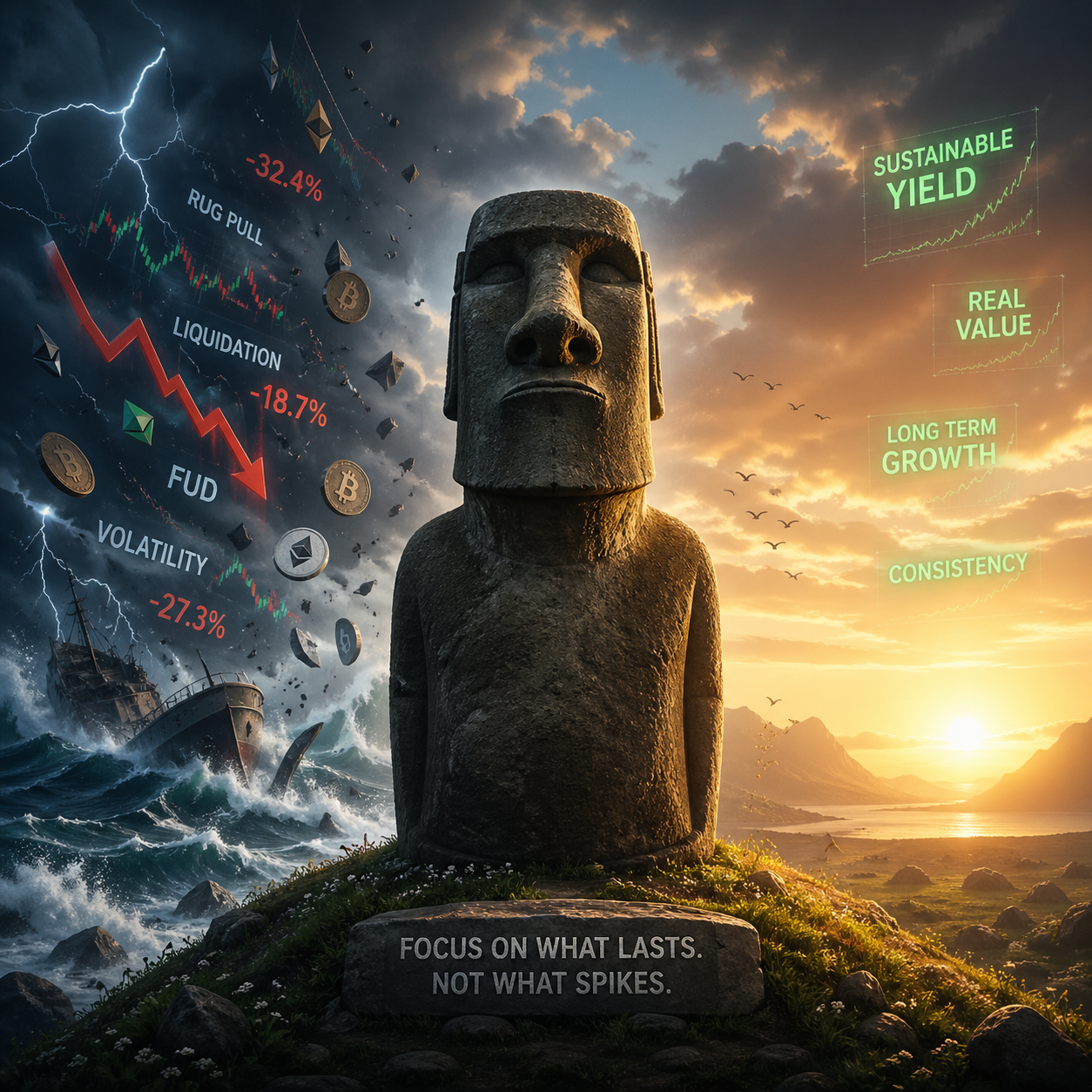
What Makes a DeFi Strategy Actually Sustainable?
 KOSALA3 min read·Just now
--
DeFi is full of yield.
Every week, new strategies emerge promising higher returns. APYs spike. Capital floods in. For a moment, everything looks efficient, profitable even revolutionary.
Then the cycle repeats.
Yields compress. Liquidity leaves. Opportunities disappear.
So the real question isn’t:
“What has the highest yield?”
It’s:
“What actually lasts?”
The Pattern We All Recognize
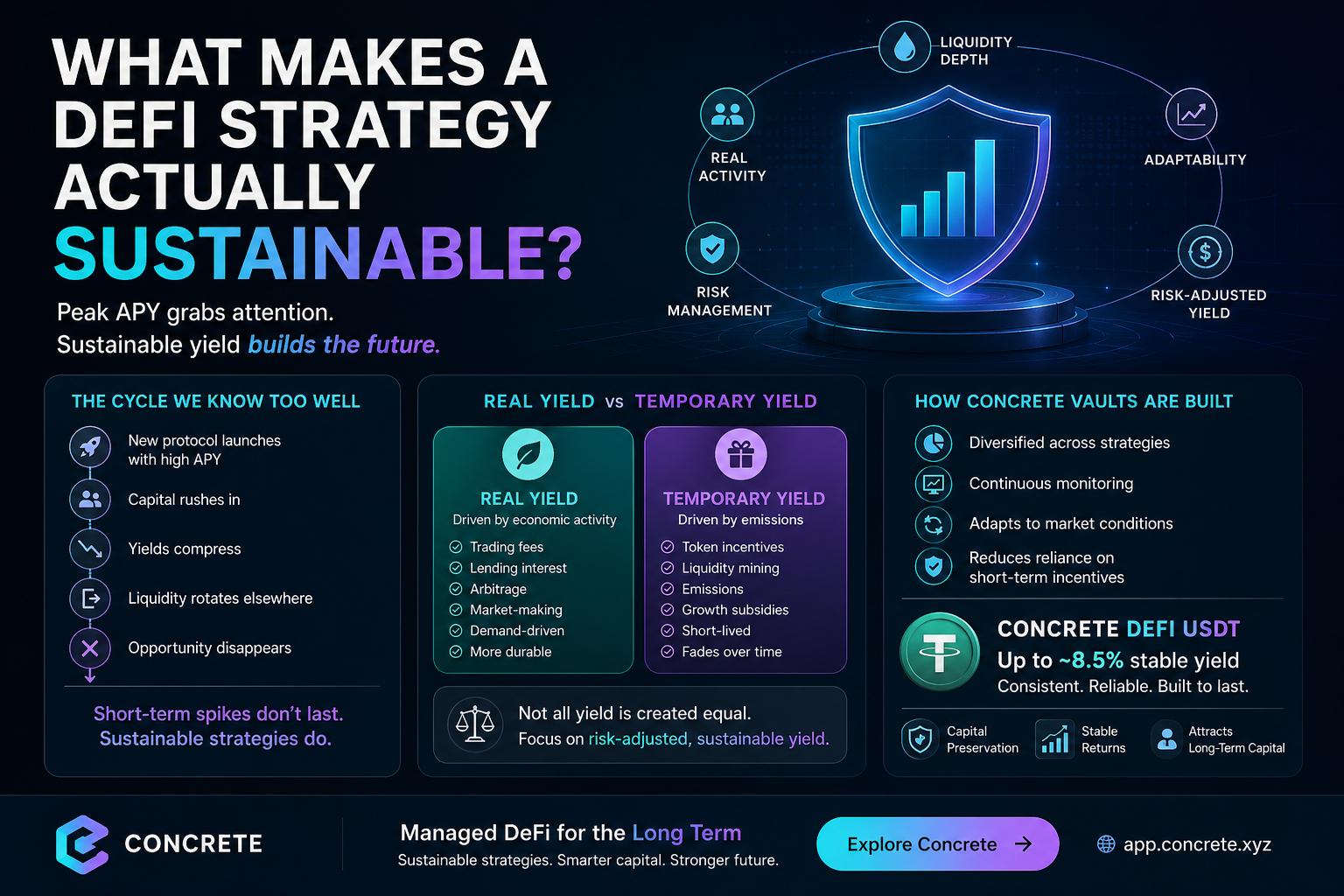
If you’ve spent any time in DeFi, you’ve seen this loop before:
- A new protocol launches with high APY
- Capital rushes in
- Yields quickly decline
- Liquidity rotates elsewhere
This isn’t case it’s structural.
Most DeFi strategies are designed to attract attention, not sustain it. They depend heavily on incentives, token emissions, or short-lived inefficiencies.
Which leads to a deeper question:
Why do most strategies fade so quickly?
What Does “Sustainable” Actually Mean?
A sustainable DeFi strategy is not just one that performs well today.
It’s one that:
- Delivers consistent returns over time
- Doesn’t rely entirely on external incentives
- Remains viable across different market conditions
Sustainability is about durability, not hype.
It’s the difference between a strategy that works for a week — and one that survives across market cycles.
Real Yield vs Temporary Yield
Not all yield is created equal.
In DeFi, returns generally come from two sources:
Temporary Yield
- Driven by token incentives and emissions
- Designed to attract liquidity
- Declines as rewards reduce or token prices fall
Real Yield
- Generated from actual economic activity
- Trading fees
- Lending interest
- Arbitrage and market demand
Temporary yield attracts capital.
Real yield sustains it.
Over time, strategies backed by real activity tend to outperform those driven purely by incentives.
Liquidity, Demand, and Market Conditions
No strategy exists in isolation.
Its sustainability depends on:
- Liquidity depth → Can it scale without breaking?
- User activity → Is there real demand?
- Market volatility → Does it benefit or suffer?
- Capital stability → Is liquidity sticky or transient?
Some strategies only work in perfect conditions.
Others adapt.
The ones that adapt are the ones that last.
The Hidden Layer: Risk and Costs
High APY can be misleading.
Because what you see isn’t always what you get.
Important factors often ignored:
- Execution costs
- Rebalancing frequency
- Slippage
- Changing correlations between assets
A strategy may look strong on paper — but degrade significantly in practice.
This is why risk-adjusted yield matters more than headline APY.
Because what matters is not gross return —
but what remains after friction, risk, and cost.
From Opportunities to Systems
Sustainable strategies are not built by chasing the next trend.
They are built as systems.
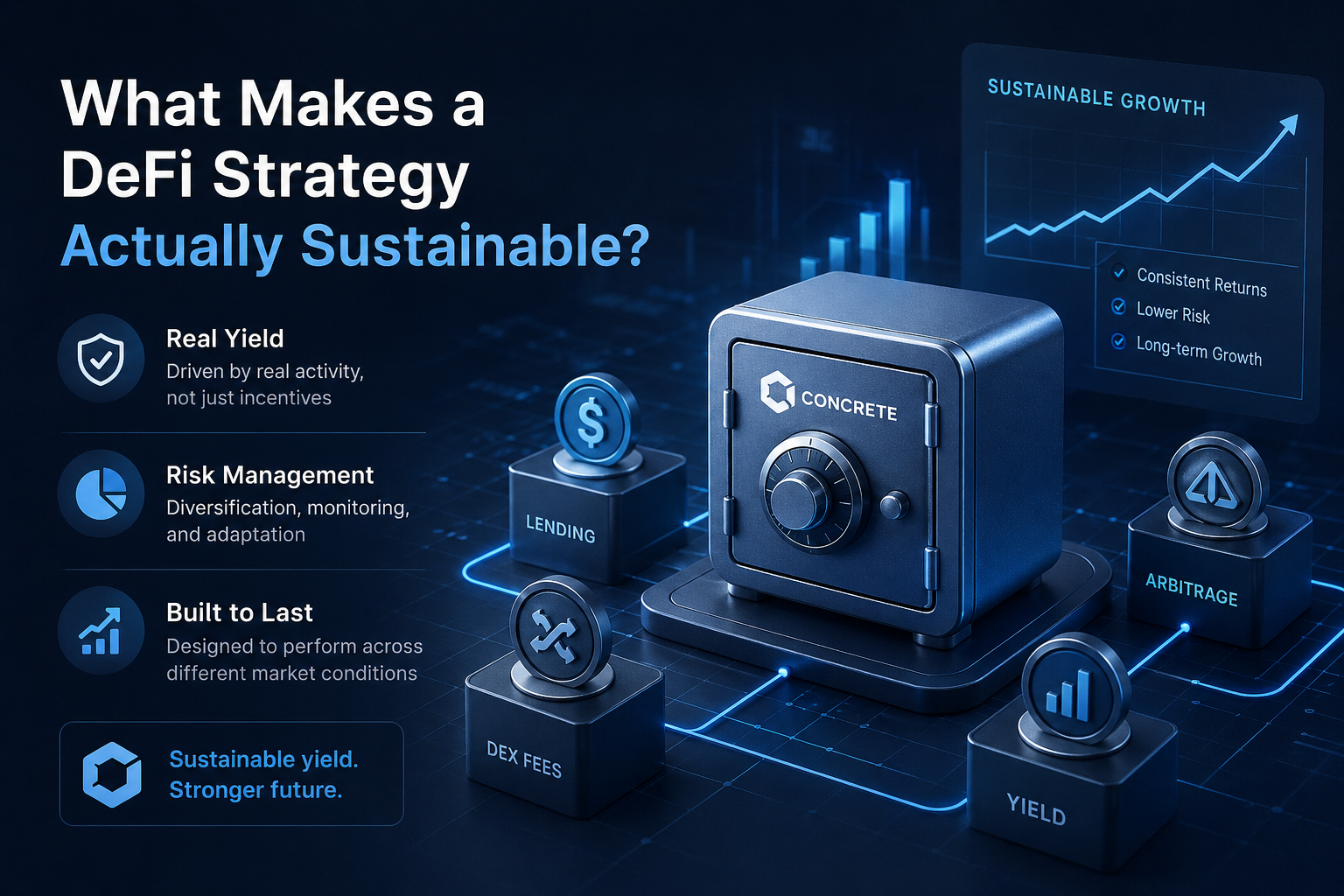
Strong DeFi strategy design includes:
- Diversification across multiple yield sources
- Continuous monitoring and optimization
- Dynamic allocation based on market conditions
- Focus on net returns, not just surface-level yield
This is where DeFi begins to evolve:
From fragmented opportunities → to managed systems of capital deployment
The Role of Concrete Vaults
This shift is exactly what Concrete vaults aim to solve.
Instead of forcing users to manually chase yield, they:
- Focus on sustainable yield sources
- Allocate capital across multiple strategies
- Adapt to changing market conditions
- Reduce dependence on short-term incentives
In short:
Concrete vaults optimize for durability — not just peak performance.
This is managed DeFi in action.
A Practical Example: Concrete DeFi USDT
Consider Concrete DeFi USDT, offering up to ~8.5% stable yield.
At first glance, it may seem less exciting than high-APY opportunities.
But zoom out.
- Stability reduces downside risk
- Consistency enables compounding
- Predictability attracts long-term capital
In many cases:
Steady returns outperform unstable spikes.
Sustainable yield doesn’t look flashy.
But it works.
The Bigger Shift
DeFi is changing.
We are moving:
- From short-term yield chasing
- Toward long-term capital strategies
Where:
- Sustainability matters more than peak returns
- Risk-adjusted yield becomes the standard
- Infrastructure outlasts incentives
The future of DeFi will not be defined by the highest APY.
It will be defined by the strategies that endure.
Explore Concrete at https://concrete.xyz/ 🧱