--
What Makes a DeFi Strategy Actually Sustainable?
What Makes a DeFi Strategy Actually Sustainable?
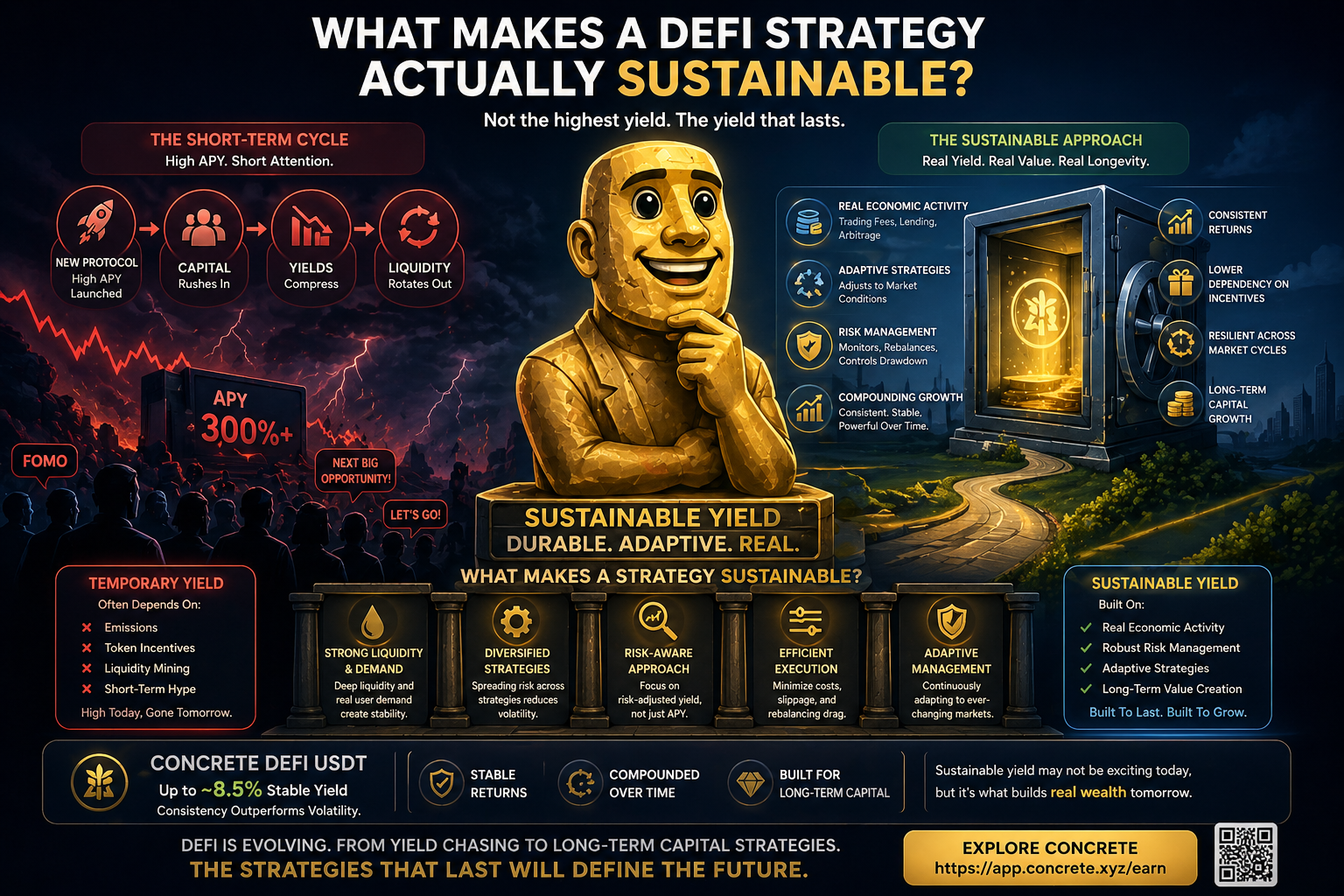
DeFi has a pattern.
A new protocol launches.
APY spikes.
Capital rushes in.
Then things change.
Yields compress.
Liquidity leaves.
Attention shifts elsewhere.
And the cycle repeats.
So the real question isn’t:
What has the highest yield?
It’s:
What actually lasts?
⸻
The Cycle of Short-Term Yield
We’ve all seen it.
High APYs attract capital quickly.
But as more liquidity enters, returns decline.
Incentives fade.
Participants move on.
Most strategies in DeFi are designed to perform in short bursts, not over long periods.
That’s why so many opportunities disappear as quickly as they appear.
⸻
What “Sustainable” Really Means
A sustainable DeFi strategy is not defined by peak performance.
It is defined by durability.
A sustainable strategy should:
Generate consistent returns over time
Avoid dependence on temporary incentives
Remain viable across different market conditions
This is not about chasing the highest number.
It is about maintaining performance through change.
⸻
Real Yield vs Temporary Yield
Not all yield is created equal.
Some yield comes from real economic activity:
Trading fees
Lending demand
Arbitrage opportunities
Other yield comes from incentives:
Token emissions
Liquidity mining rewards
The difference is critical.
Incentive-driven yield often declines as emissions slow.
Real yield, tied to actual usage, tends to be more stable.
Sustainable strategies rely more on real activity than temporary rewards.
⸻
Liquidity and Market Conditions
Sustainability also depends on the environment.
Key factors include:
Depth of liquidity
Level of user activity
Market volatility
Demand for the strategy
Some strategies only work under specific conditions.
Others are built to adapt.
The more adaptable a strategy is, the more likely it is to survive across cycles.
⸻
The Hidden Role of Risk and Cost
Many strategies look strong on paper.
But real performance is shaped by hidden factors:
Execution costs
Rebalancing frequency
Slippage during market moves
Changing asset correlations
Over time, these reduce effective returns.
A strategy that ignores cost and risk may appear strong initially, but degrade in practice.
⸻
Designing for Sustainability
Sustainable strategies are not accidental.
They are designed.
Key principles include:
Diversification across multiple strategies
Continuous monitoring and adjustment
Adaptation to changing market conditions
Focus on net returns, not headline APY
This is where DeFi begins to shift from isolated opportunities to structured systems.
⸻
How Concrete Vaults Approach Sustainability
Concrete vaults are built with this philosophy in mind.
Rather than chasing short-term yield spikes, they aim to optimize sustainable yield and capital efficiency.
They do this by:
Managing capital across multiple strategies
Adapting to market conditions over time
Reducing reliance on emissions-based incentives
Enabling automated compounding
This reflects the idea of managed DeFi, where systems handle complexity and optimize outcomes.
⸻
A Real Example: Concrete DeFi USDT
Concrete DeFi USDT offers a practical example of sustainable yield.
The vault targets around 8.5% stable yield.
Compared to high-volatility strategies, this may seem less exciting.
But over time, stability can outperform.
Why?
Because:
Returns are more consistent
Capital is preserved
Volatility impact is reduced
Sustainable yield attracts long-term capital — not just short-term attention.
⸻
The Bigger Shift
DeFi is evolving.
From:
Short-term yield chasing
To:
Long-term capital strategies
In this new phase:
Sustainability matters more than peak returns
Infrastructure matters more than incentives
Consistency matters more than hype
The future of DeFi won’t be defined by the highest APY.
It will be defined by the strategies that last.
⸻
👉 Explore Concrete at:
https://app.concrete.xyz/earn