--
What Makes a DeFi Strategy Actually Sustainable?
DeFi has made yield visible to everyone.
Open any dashboard and you’ll see it — double-digit APYs, new vaults, new farms, new strategies promising optimized returns.
And the cycle is familiar.
A new protocol launches.
Incentives go live.
Capital rushes in.
Yields look attractive.
Then reality follows.
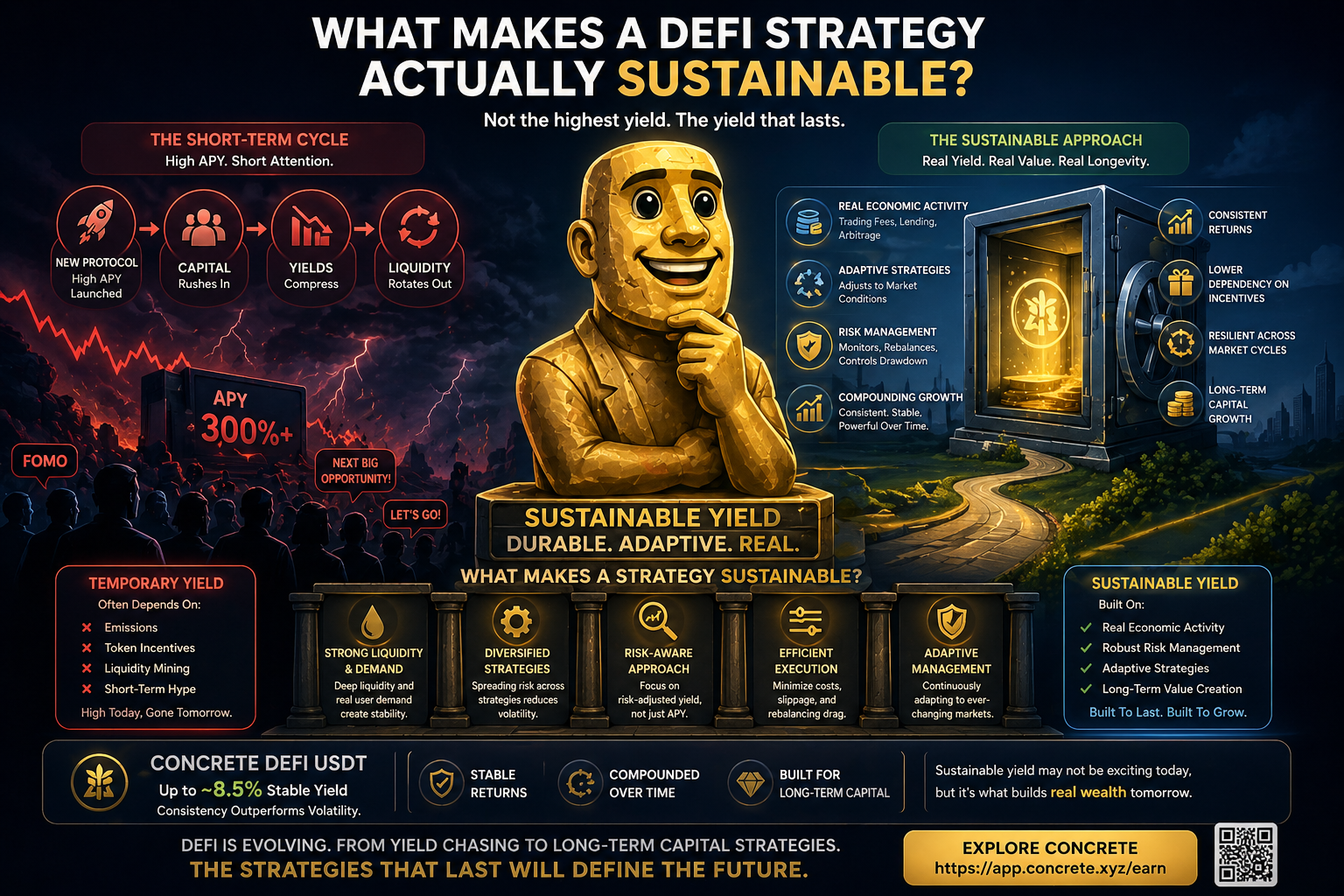
As liquidity deepens, yields compress. Incentive emissions slow down. Capital rotates toward the next opportunity.
And the process repeats.
This pattern has become one of DeFi’s defining behaviors: rapid capital migration in search of peak returns.
But that raises an important question:
Why do most DeFi strategies lose momentum so quickly?
Because high yield and sustainable yield are not the same thing.
And as DeFi matures, the difference between the two is becoming more important.
Defining Sustainability in DeFi
A sustainable DeFi strategy is not simply one that produces high returns.
It’s one that can continue producing meaningful, risk-adjusted yield over time.
That means three things:
Consistency — returns remain stable across market cycles
Independence from incentives — yield exists even when token emissions decline
Adaptability — the strategy remains viable under changing market conditions
This is where many DeFi strategies fail.
They optimize for attraction, not durability.
A strategy paying 40% APY for three weeks may look attractive, but if it collapses when incentives end, it was never sustainable.
Durability matters more than temporary performance.
Real Yield vs Temporary Yield
One of the most important distinctions in DeFi strategies is understanding where yield actually comes from.
Broadly, yield falls into two categories:
Temporary Yield
This usually comes from emissions.
Protocols distribute tokens to attract liquidity and bootstrap usage.
Examples:
liquidity mining rewards
farming incentives
governance token distributions
The problem?
Emissions are finite.
As rewards decline, the yield often disappears.
And when yield disappears, liquidity leaves.
This creates an unsustainable cycle.
Real Yield
Real yield comes from actual economic activity.
Examples include:
trading fees
lending interest
arbitrage opportunities
borrowing demand
This type of yield is tied to actual protocol usage.
It doesn’t rely purely on token inflation.
That makes it fundamentally more stable.
Not all yield is created equal.
The strongest DeFi vaults focus on real, recurring sources of value.
Why Liquidity and Market Conditions Matter
Even strong strategies depend on market structure.
Sustainability is heavily influenced by liquidity depth.
A strategy might work perfectly at $500,000 in capital but perform poorly at $50 million.
Why?
Because scale changes everything.
Liquidity affects:
slippage
execution efficiency
rebalancing costs
entry and exit quality
Market conditions also matter.
Some strategies perform well only during high volatility.
Others require strong borrowing demand.
Some rely on active trading environments.
This means strategy durability depends on environmental fit.
The best managed DeFi systems understand this and adapt.
Rigid strategies break.
Adaptive strategies survive.
The Hidden Costs of Yield
A major mistake in evaluating DeFi strategies is focusing only on gross APY.
Headline yield rarely tells the full story.
Real returns depend on costs.
These include:
Execution Costs
Entering and exiting positions creates costs.
Gas fees and routing inefficiencies reduce profitability.
Rebalancing
Strategies require maintenance.
Frequent repositioning can eat into returns.
Slippage
Large positions moving through shallow liquidity reduce realized gains.
Correlation Risk
Diversification can fail if strategies become highly correlated during market stress.
A strategy that looks profitable on paper may degrade significantly in practice.
That’s why sustainable yield must always be evaluated on a net basis.
Net returns matter.
Not advertised APY.
Better Strategy Design in DeFi
As the market matures, better DeFi strategies are starting to look less like isolated opportunities and more like systems.
Strong strategy design includes:
Diversification
Spreading capital across multiple yield sources reduces concentration risk.
Continuous Monitoring
Markets change quickly.
Strategies need active oversight.
Adaptability
Capital allocation should shift as conditions evolve.
Risk-Adjusted Thinking
A lower yield with lower risk often outperforms a higher yield with unstable exposure over time.
This is where institutional DeFi thinking becomes important.
Professional capital doesn’t chase every opportunity.
It prioritizes durable systems.
That mindset is becoming increasingly relevant for onchain capital.
Why DeFi Vaults Matter
This is where DeFi vaults have become essential infrastructure.
Vaults simplify complexity by managing capital across strategies.
Instead of manually chasing opportunities, users can access managed DeFi systems designed for optimization.
The best vaults focus on:
sustainable yield sources
active capital allocation
market adaptation
risk management
This is the foundation of long-term DeFi participation.
Not speed.
Structure.
How Concrete Vaults Approach Sustainability
Concrete vaults represent this shift toward durability-first design.
Instead of optimizing only for peak APY, Concrete vaults focus on building sustainable systems for capital efficiency.
That includes:
prioritizing yield from actual market activity
managing capital dynamically across DeFi strategies
adjusting to changing liquidity conditions
reducing dependence on short-term token incentives
This makes the system more resilient.
And resilience is what sustainability requires.
In managed DeFi, infrastructure matters.
Concrete vaults are built around that principle.
Concrete DeFi USDT: A Practical Example
A useful example is Concrete DeFi USDT.
It offers up to approximately 8.5% stable yield.
At first glance, that may seem less exciting than highly volatile double-digit farms.
But sustainability often looks less dramatic.
And that’s the point.
Stable yield matters because:
it compounds predictably
it reduces volatility exposure
it attracts long-term capital
it improves capital planning
Over time, consistency often outperforms unstable spikes.
This is one of the most important lessons in DeFi.
Peak yield attracts attention.
Sustainable yield builds wealth.
Explore Concrete at: https://app.concrete.xyz/earn
The Bigger Shift in DeFi
DeFi is evolving.
The early phase was dominated by aggressive yield chasing.
Fast capital.
Short cycles.
High incentives.
But the next phase looks different.
Capital is becoming smarter.
More selective.
More strategic.
The future of institutional DeFi will likely be built around:
sustainable yield
risk-adjusted yield
durable infrastructure
adaptive capital systems
Because in the long run, the strongest DeFi strategies won’t be the ones with the highest APY today.
They’ll be the ones still performing tomorrow.
And in the years ahead, that distinction will define the winners.
The future of DeFi won’t belong to the highest yield.
It will belong to the strategies that last.