Sup Mallick4 min read·Just now
--
What Makes a DeFi Strategy Actually Sustainable?
DeFi is full of yield.
New protocols launch every week.
APYs spike.
Capital rushes in.
For a moment, everything looks profitable.
Then the pattern repeats.
Yields compress.
Liquidity rotates.
Opportunities fade.
If you’ve spent enough time in DeFi, this cycle feels familiar. It plays out across chains, protocols, and market cycles.
Which leads to a deeper question:
Why do most DeFi strategies fade so quickly — and what makes some of them last?
Because in the long run, the real advantage isn’t finding the highest yield.
It’s finding sustainable yield.
---
The Pattern We’ve All Seen
A new protocol launches with eye-catching returns.
Maybe it offers triple-digit APY. Maybe it distributes aggressive token emissions. Either way, the opportunity spreads quickly across social feeds and dashboards.
Capital floods in.
At first, the numbers look impressive. Early participants benefit the most. Returns feel effortless.
But then reality sets in.
As more liquidity enters, rewards are distributed across a larger pool. Yield drops. Incentives begin to decline. Some participants exit, chasing the next opportunity.
Soon enough, the strategy that once looked unstoppable becomes just another historical chart.
This isn’t rare.
It’s the default lifecycle of many DeFi strategies.
So the real question isn’t:
“What has the highest yield?”
It’s:
“What actually lasts?”
---
What Does “Sustainable” Really Mean?
In DeFi, sustainability isn’t about short bursts of performance.
It’s about durability.
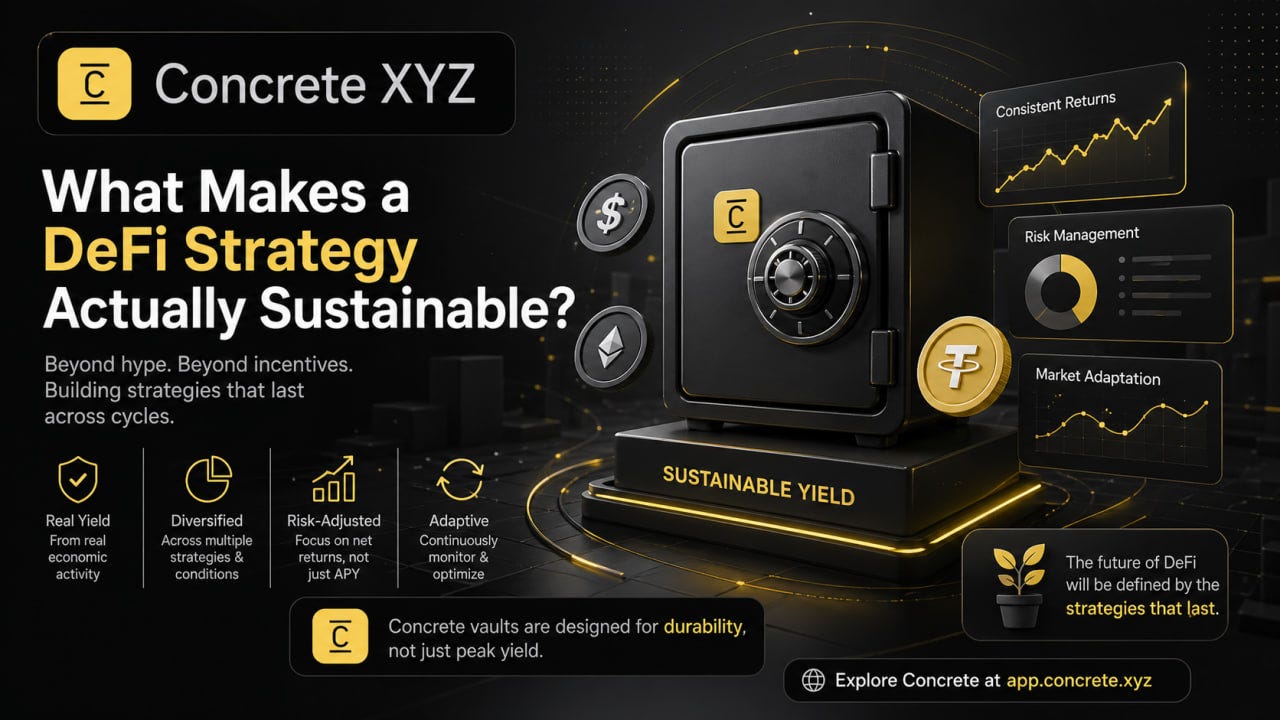
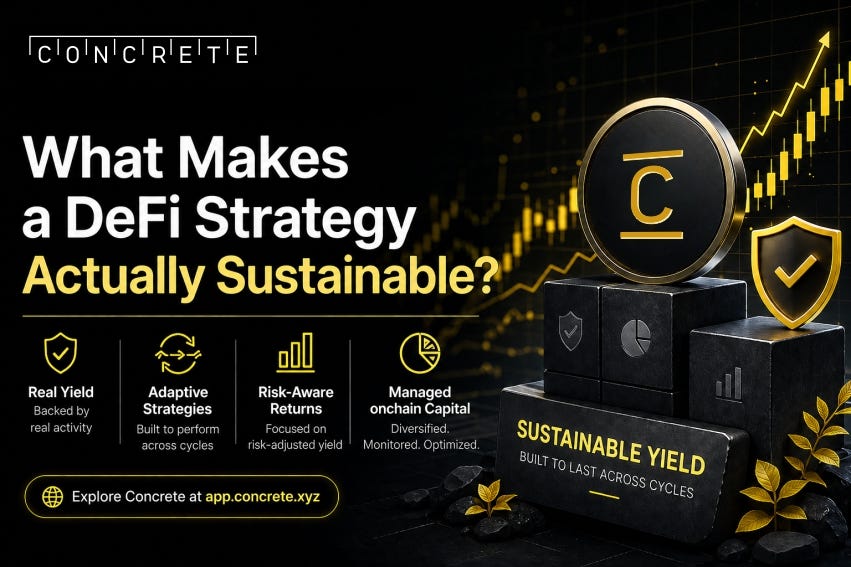
A sustainable strategy should:
Generate consistent returns over time
Avoid relying entirely on temporary incentives
Remain viable across changing market conditions
Deliver risk-adjusted yield, not just headline APY
This shifts the focus from excitement to endurance.
Short-term yield can be impressive.
Long-term yield builds trust.
And in financial systems, trust is what attracts lasting capital.
---
Real Yield vs Temporary Yield
Not all yield is created equal.
Some yield comes from real economic activity, while other yield is simply distributed as incentives.
Understanding the difference is critical.
Real Yield Sources:
Trading fees
Lending interest
Arbitrage opportunities
Market-making revenue
These activities generate value because users are willing to pay for services.
Temporary Yield Sources:
Token emissions
Liquidity mining rewards
Incentive programs
These rewards can bootstrap growth — but they rarely last forever.
Once incentives decline, yield often falls with them.
This is why emission-driven yield frequently compresses over time.
But yield backed by genuine activity tends to be more stable.
It reflects actual demand.
Not just temporary attention.
---
Liquidity, Demand, and Market Conditions
Even strong strategies depend on the environment around them.
Sustainability isn’t just about yield sources — it’s about context.
Some of the most important factors include:
Liquidity Depth
Deep liquidity supports smoother execution and reduces volatility. Without it, strategies become fragile.
User Activity
Active markets create fee revenue and arbitrage opportunities. Idle markets reduce returns.
Market Volatility
Some strategies thrive during volatility. Others require stable conditions.
Underlying Demand
If nobody needs the service a strategy provides, its yield won’t last.
Many strategies only work under perfect conditions.
Sustainable strategies are different.
They adapt.
---
The Hidden Side of Strategy Performance
A strategy may look profitable on paper.
But performance changes once real-world costs are included.
Often overlooked factors include:
Execution costs
Slippage
Rebalancing overhead
Gas fees
Changing correlations between assets
These costs compound over time.
A strategy that promises 12% APY might deliver far less after expenses.
That’s why net returns matter more than advertised returns.
And why risk-aware design is essential for sustainability.
---
Designing Strategies That Last
Sustainable DeFi strategies aren’t accidents.
They are built deliberately.
Strong strategy design often includes:
Diversification Across Strategies
Instead of relying on one yield source, capital spreads across multiple opportunities.
Continuous Monitoring
Markets evolve quickly. Static strategies rarely survive long.
Adaptive Rebalancing
Positions shift based on conditions, not assumptions.
Focus on Risk-Adjusted Yield
Returns are evaluated relative to risk, not just raw percentage.
This is where DeFi begins to resemble traditional finance — not as a collection of isolated opportunities, but as interconnected systems.
And increasingly, this system-driven approach is shaping managed DeFi.
---
How DeFi Vaults Support Sustainability
This shift toward durability is one reason DeFi vaults have become increasingly important.
Rather than relying on individual users to chase yield manually, vaults automate capital allocation across strategies.
Concrete vaults, for example, aim to:
Prioritize sustainable yield sources
Manage onchain capital deployment dynamically
Adapt to changing market conditions
Reduce dependence on short-term incentives
Instead of focusing only on peak returns, vaults focus on consistency.
That difference matters more than it first appears.
---
A Real Example: Concrete DeFi USDT
To understand sustainability in practice, it helps to look at stable yield strategies.
Concrete DeFi USDT is designed to offer approximately ~8.5% stable yield, rather than chasing unpredictable spikes.
At first glance, this may look less exciting than triple-digit APYs.
But over time, consistency can outperform volatility.
Why?
Because stable returns:
Encourage long-term participation
Reduce risk exposure
Attract more disciplined capital
Support institutional-scale deployment
This is particularly important in institutional DeFi, where reliability matters more than speculation.
Stable yield may not create headlines.
But it builds foundations.
---
The Bigger Shift Happening in DeFi
DeFi is evolving.
Early cycles were dominated by experimentation and rapid innovation. Incentives were used to attract liquidity quickly.
But the ecosystem is maturing.
And with maturity comes new priorities.
Capital is beginning to move:
From short-term yield chasing
Toward long-term capital strategies
From isolated bets
Toward structured systems
In this environment, sustainability becomes the competitive advantage.
Not speed.
Not hype.
Not peak returns.
Durability.
Infrastructure will outlast incentives.
Strategies that adapt will outlast speculation.
And the future of DeFi will not be defined by the highest APY — but by the strategies that survive across cycles.
---
🚨 Explore Concrete at:
https://app.concrete.xyz 🚨