What Makes a DeFi Strategy Actually Sustainable?
--
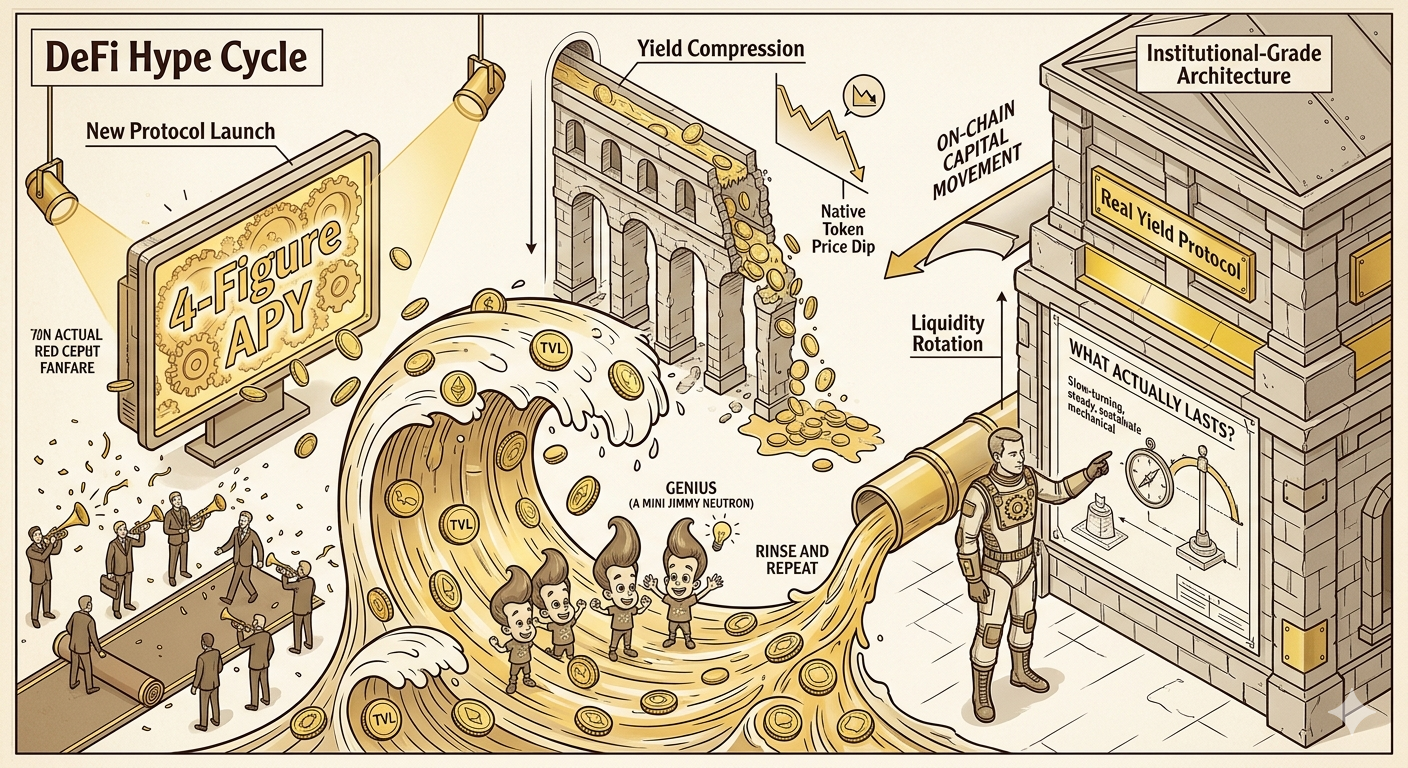
In the fast-moving world of Decentralized Finance, we are all familiar with the “yield cycle.” A new protocol launches with a staggering 4-digit APY, capital rushes in like a tidal wave, the yield compresses as the pool dilutes, and eventually, the liquidity rotates to the next shiny object.
This cycle repeats endlessly, but it leaves a trail of frustrated participants in its wake. As the ecosystem matures, the most important question for any participant is no longer “Where is the highest yield?” but rather: “What actually lasts?”
1. The Pattern of the Yield Cycle
We’ve all seen the charts: a vertical spike in Total Value Locked (TVL) followed by a slow, agonizing bleed. Most DeFi strategies fade quickly because they are built on a “mercenary capital” model. They attract liquidity with temporary rewards, but they fail to build a foundation of real economic utility. When the rewards dry up, the strategy collapses. To build wealth, we have to look past the spike and focus on the baseline.
2. Defining Sustainability in DeFi
In simple terms, a sustainable yield is one that doesn’t disappear when the marketing budget does. Sustainability is defined by three pillars:
- Consistency: The ability to generate returns over months and years, not just days.
- Independence: A lack of total reliance on inflationary token incentives.
- Durability: The capacity to remain viable whether the market is pumping, dumping, or moving sideways.
This isn’t just about performance; it’s about the survival of capital across entire market cycles.
3. Real Yield vs. Temporary Yield
Not all yield is created equal. Understanding the source of the return is the first step toward sustainability:
- Temporary Yield: Often driven by “emissions” — the protocol printing its own token to pay you. This is essentially a marketing expense. Once the token price drops or emissions slow, the yield vanishes.
- Real Yield: Generated from actual economic activity. This includes trading fees from DEXs, interest payments from borrowers on lending platforms, and arbitrage profits.
Real economic activity is more stable because it is tied to the actual usage of the financial system.
4. The Role of Liquidity and Market Conditions
A strategy is only as sustainable as the environment it lives in. Sustainability requires liquidity depth (the ability to enter and exit without moving the price) and consistent user activity. Some strategies, like certain delta-neutral loops, only work in high-volatility environments. Truly durable strategies are those that can adapt — shifting capital between different “real yield” sources as market demand changes.
5. Risk and Cost Awareness: The Hidden Degradation
A strategy might look like it’s yielding 15% on a dashboard, but once you factor in execution costs, slippage, and rebalancing taxes, the net return might be closer to 5%.
Sustainable strategies account for these frictions. They don’t over-trade, and they model the cost of capital movement to ensure that the “headline APY” isn’t being eaten alive by transaction fees.
6. Toward Better Strategy Design
The future of DeFi belongs to yield engineering rather than yield chasing. This means building systems that:
- Diversify across multiple vetted protocols to mitigate single-point-of-failure risk.
- Continuously monitor on-chain data to move capital before a yield source becomes toxic.
- Focus on Net Returns, prioritizing the growth of the underlying principal over the accumulation of volatile reward tokens.
7. The Concrete Approach to Durability
This is the core philosophy behind Concrete Vaults. We don’t chase the highest “flash APY.” Instead, Concrete infrastructure is designed to:
- Prioritize sustainable yield sources like organic lending and trading fees.
- Actively manage capital across a universe of strategies to ensure continuous productivity.
- Reduce the heavy reliance on short-term incentives that lead to capital flight.
By focusing on managed DeFi, Concrete creates a system where the infrastructure handles the complexity, allowing the user to benefit from institutional-grade logic.
8. Real-World Case: Concrete DeFi USDT
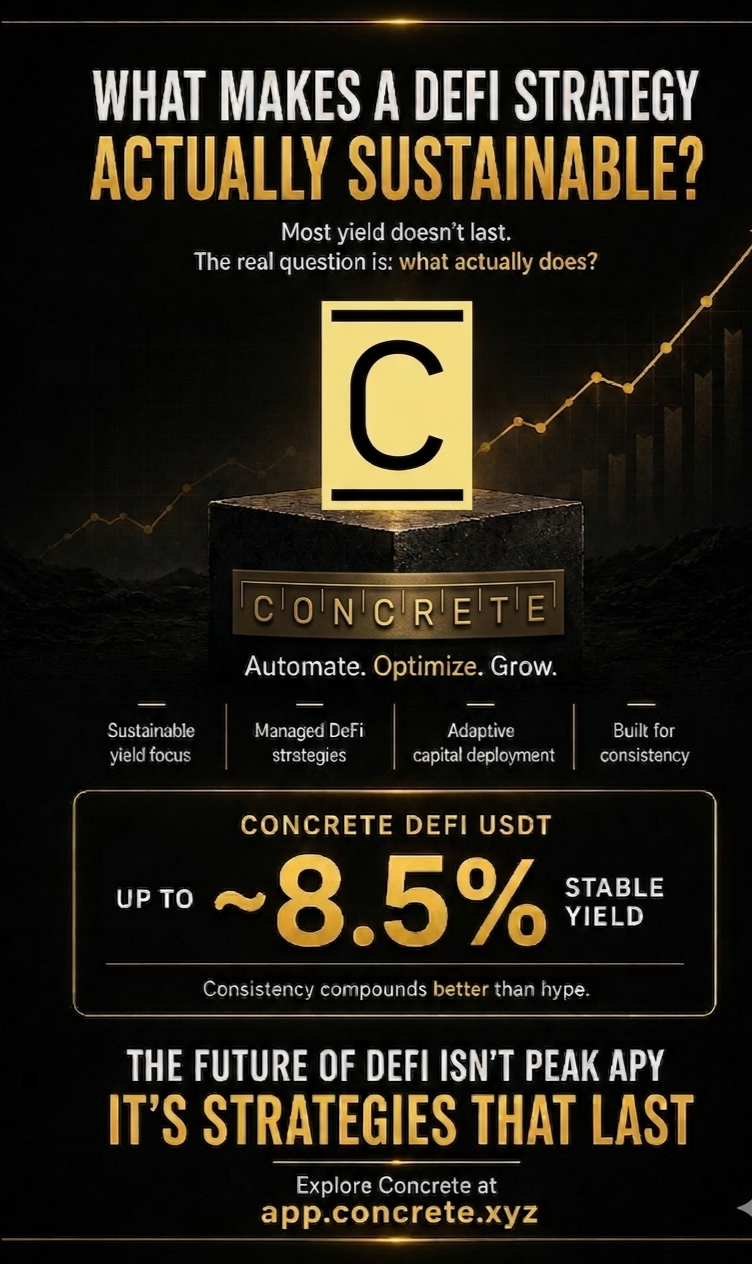
Look at Concrete DeFi USDT as a prime example. Offering up to ~8.5% stable yield, it might look “less exciting” than a 100% APY farm. However, when you factor in the consistency and the lack of downside risk, 8.5% often outperforms the volatile “moonshot” over a six-month horizon. Stability attracts long-term, onchain capital because it allows for predictable compounding.
The Bigger Shift
DeFi is growing up. We are moving away from a world of short-term gimmicks and toward a future of long-term capital strategies. The infrastructure we build today will outlast the incentives of tomorrow. In the end, the winners won’t be those who found the highest peak, but those who built the most durable path.
Explore sustainable, managed DeFi at: https://app.concrete.xyz/earn