What Is the Commit Boundary? The Missing Control Layer in Enterprise AI and Mortgage Systems
 Chakri Maganti3 min read·Just now
--
Approved ≠ Funded: Why approved decisions fail in execution — and the architectural layer enterprises don’t yet have
Apr 29, 2026
Across industries — especially in mortgage lending — we’re seeing the same pattern:
It’s correct.
It’s approved.
And yet…It never becomes real.
Loans are approved but never funded.
Actions are authorized but never executed.
Decisions exist — but outcomes don’t.
This is not a decisioning problem. It’s an execution problem.
We’re not improving the quality of the loan decision itself.
We’re ensuring that a good decision actually makes it to funding.
Most enterprises already have:
- Strong underwriting models
- Mature decision systems
- Robust platforms like Black Knight Mortgage Servicing Platform or other loan origination systems
They can determine:
- Eligibility
- Risk
- Approval
But something critical is missing:
The ability to ensure that a decision actually executes — correctly, safely, and completely.
There is a moment in every system where something changes from:
“should happen”
to
“has happened”
This is where:
- A loan becomes funded
- A transaction becomes committed
- A decision becomes real
We call this:
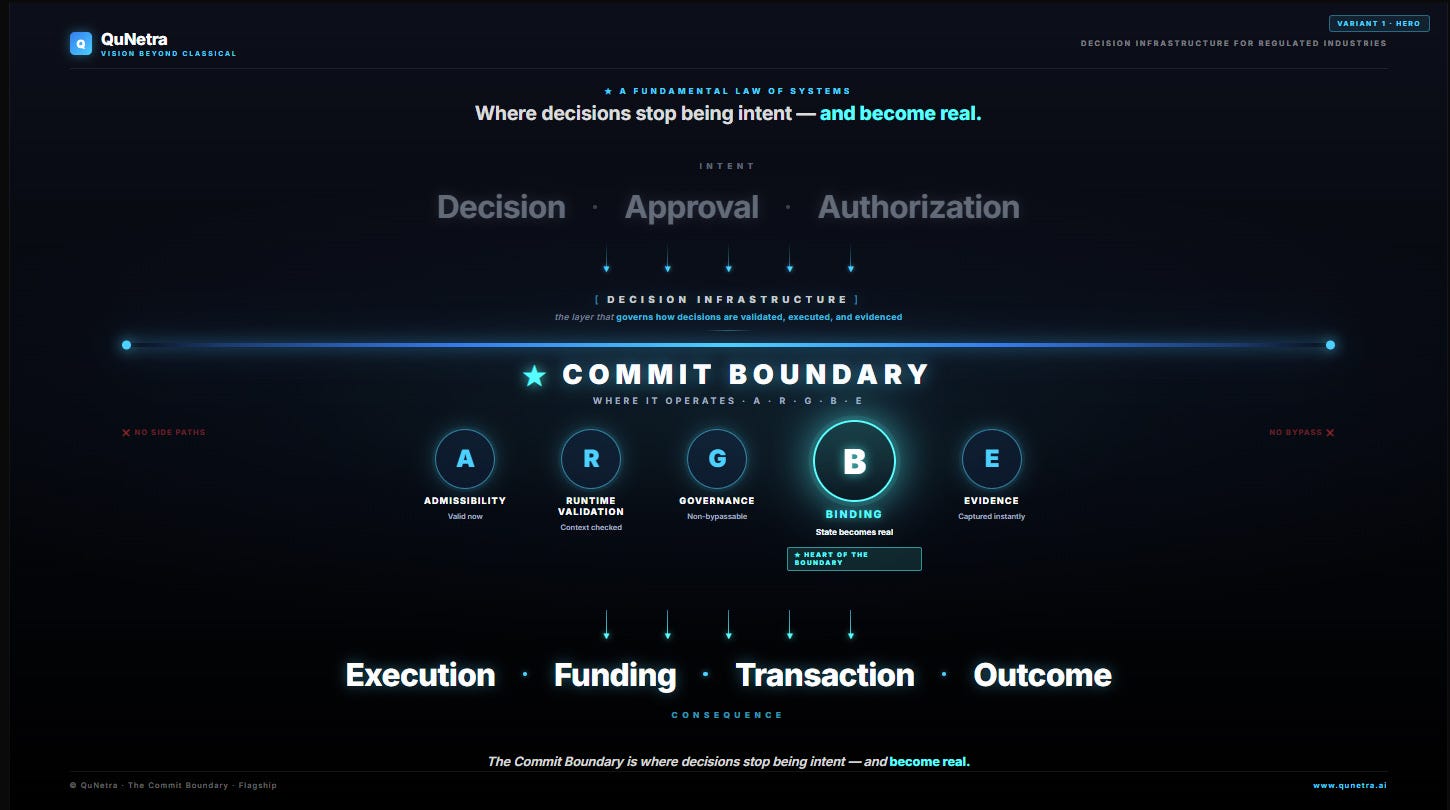
★ The Commit Boundary
At this exact point, five things must occur together.
This is the ARGBE model:
A — Admissibility
Is this decision still valid right now?
Not when it was approved — but under current state, authority, and policy.
R — Runtime Validation
Has anything changed?
Conditions, data, authority, or timing.
G — Governance (Execution Gating)
Allow, hold, or escalate — at the point of execution.
Non-bypassable.
B — Binding
The moment the decision becomes real.
Where the system of record changes.
E — Evidence
Captured at the moment of binding —
not reconstructed after the fact.
Why this matters (mortgage example)
Consider a loan:
- Approved in the LOS
- Conditions listed
- Pipeline progressing
The loan is already approved.
The decision is already correct.
We’re not improving the quality of that decision.
We’re ensuring it actually makes it to funding.
But between approval and funding:
- Documents expire
- Borrower delays occur
- Conditions change
- Ownership gaps appear
And no system verifies that the loan is still ready at the moment it needs to move forward.
Without a Commit Boundary:
- These issues are invisible
- Failures happen silently
- Loans fall out
This isn’t limited to loans
This pattern repeats across the enterprise.
The same pattern exists beyond mortgage.
Deposit account openings:
Accounts are approved — but fail during funding, KYC completion, or activation.
Fraud decisions:
Transactions are flagged or approved — but execution may be delayed, overridden, or misapplied under changing context.
Credit line adjustments:
Decisions are made — but not consistently executed due to downstream conditions or timing gaps.
In each case:
The decision is not the problem.
The execution path is.
And the failure happens at the same place:
The moment where the decision becomes real.
This is why the Commit Boundary matters.
It governs whether any decision — AI or non-AI — actually executes correctly under real-world conditions.
With a Commit Boundary
Every state transition must pass through ARGBE.
- Is the loan still admissible?
- Are all conditions valid right now?
- Should this proceed?
- If yes → bind
- If not → hold
The result
Approved loans actually fund
Failures are caught before they happen
Root causes become visible
Execution becomes reliable
This is Decision Infrastructure
Most systems:
- Make decisions
- Track workflows
- Monitor outcomes
Very few systems:
Govern how decisions are validated, executed, and evidenced — at the moment they act
That is the role of Decision Infrastructure.
Final thought
Enterprises don’t fail because they make bad decisions.
They fail because they don’t control what happens when those decisions become real.
CTA (very important)
If you’re seeing approved loans fail to fund, the issue isn’t your LOS or your underwriting model.
It’s the missing control layer at the Commit Boundary.
If you’re working on enterprise AI, architecture, or decision systems, I write about where these systems are heading — not just where they are today.
Subscribe to follow the evolution.
Follow me for more on Decision Infrastructure and enterprise AI: https://www.linkedin.com/in/chakri-maganti-mba-71b24b4/
and We’re applying this in mortgage at QuNetra: https://www.linkedin.com/company/qunetra/