Ever wondered how digital agreements in crypto execute themselves — without lawyers, banks, or intermediaries?
That’s exactly what smart contracts do. These are blockchain-based programs that automatically enforce agreements once predefined conditions are met.
No follow-ups. No trust issues. Just code doing what it was designed to do.
In this guide, we’ll break down how smart contracts work, why they matter, how they’re built, and where they’re heading next.
What Exactly Is a Smart Contract?
A smart contract is a self-executing program stored on a blockchain.
Unlike traditional agreements, which rely on legal systems or third parties, smart contracts operate autonomously. Once deployed, they execute exactly as written: no interference, no downtime.
Smart contracts are commonly built on platforms like Ethereum and written in languages such as Solidity.
Where are they used?
Smart contracts power a wide range of applications, including:
- Decentralized finance (DeFi)
- NFT marketplaces
- Supply chain tracking
- Real estate transactions
- Digital identity systems
One key feature: immutability. Once deployed, a contract cannot be changed. That makes it highly secure — but also unforgiving if mistakes slip through.
How Do Smart Contracts Work?
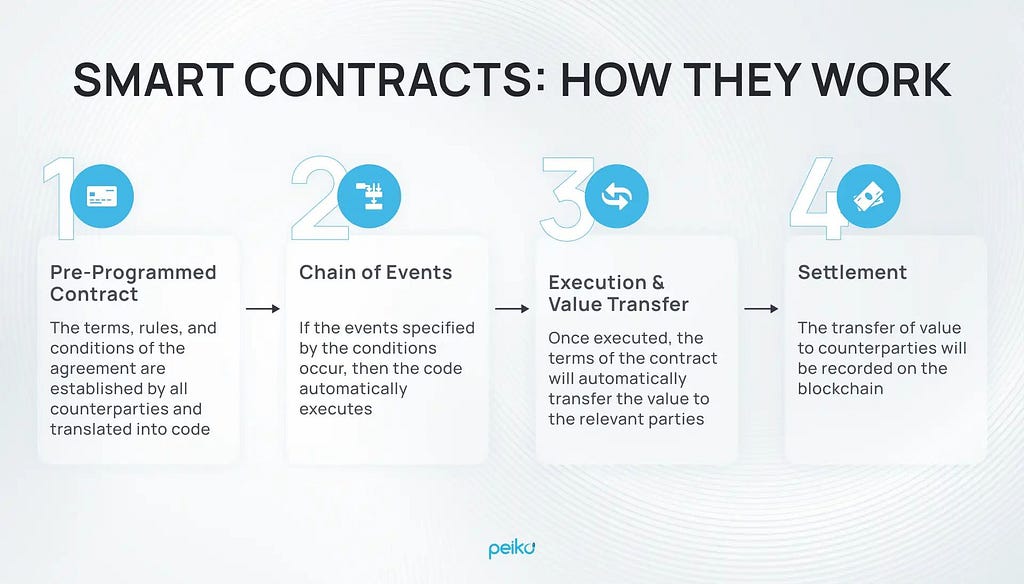
At their core, smart contracts follow a simple logic:
If X happens → then Y executes
For example:
- If a product is delivered → release payment
- If a course is completed → issue a certificate
Once deployed to the blockchain:
- The contract is distributed across a network of nodes,
- Each node verifies and executes actions,
- All transactions are recorded transparently.
This eliminates the need for trust between parties, because the system itself guarantees execution.
Why Smart Contracts Matter
Smart contracts are gaining traction for a reason. They offer clear, measurable advantages:
1. Automation
No manual intervention. Processes run instantly once conditions are met.
2. Trust & Transparency
All rules and transactions are visible on-chain.
3. Security
Protected by cryptography and decentralized infrastructure.
4. Cost Efficiency
No intermediaries like banks, escrow agents, or legal middlemen.
5. Accuracy
Code removes ambiguity and reduces human error.
6. Permanent Records
Every action is stored on-chain and can be audited anytime.
Challenges You Should Know About
Smart contracts aren’t perfect, and ignoring their limitations can be costly:
- Code vulnerabilities: Bugs can lead to major financial losses
- Immutability risks: You can’t easily fix deployed contracts
- Oracle dependency: External data sources can introduce risk
- Legal uncertainty: Regulation is still evolving globally
- Talent gap: Skilled blockchain developers are still in high demand
In short: smart contracts are powerful, but require precision.
How Smart Contracts Are Built (and Why It’s More Than Just Code)
It’s easy to think of smart contract development as just writing a few lines of Solidity and deploying them on-chain. In reality, it’s a much more structured process.
Every smart contract starts with clarity: what problem it solves, how the logic works, which blockchain it lives on, and what legal constraints might apply. From there, developers design the architecture — defining roles, permissions, and how the contract will stay secure and maintainable over time.
Only once all parameters are clearly defined does development begin.
Using languages like Solidity or Rust, developers focus on writing efficient, minimal logic. Because once a smart contract is deployed, there’s no easy way back. That’s why testing is not just important — t’s critical. Teams run simulations, test edge cases, and conduct audits to catch vulnerabilities before they become expensive mistakes.
After deployment, the contract goes live on the blockchain, where it can be accessed by users through apps, wallets, and external data sources. And even then, the work isn’t done — monitoring performance and planning upgrades remains an ongoing effort.
The Tech Behind the Scenes
Smart contracts don’t exist in isolation, they’re always part of a broader ecosystem.
They run on blockchains like Ethereum, Solana, or Polygon, each offering different trade-offs in speed, cost, and scalability. Developers choose from languages like Solidity, Vyper, or Rust, supported by tools such as Hardhat and Remix that streamline development and testing.
Since blockchains can’t access real-world data on their own, oracles like Chainlink act as bridges — bringing in everything from price feeds to external events.
With that added functionality comes additional risk, making careful implementation essential.
Why Security Is Everything
Smart contracts often handle real money. That alone changes the stakes.
A small bug isn’t just a bug — it can be a vulnerability worth millions. That’s why experienced teams rely on audited libraries, write clean and minimal code, and invest heavily in testing and security audits.
In this space, prevention is always cheaper than recovery.
Where Smart Contracts Are Headed
What started in DeFi is quickly expanding into the real world.
Enterprises are exploring smart contracts to automate operations. AI is beginning to assist in writing and auditing code. Cross-chain technologies are breaking down barriers between blockchains. And user experience is improving to the point where blockchain apps start to feel like traditional products.
At the same time, real-world assets (from real estate to financial instruments) are moving on-chain, unlocking entirely new models of ownership and exchange.
Final Thought
Smart contracts aren’t just a technical innovation, they’re a shift in how we think about trust.
By replacing intermediaries with code, they make agreements faster, more transparent, and more reliable. But they also demand precision, because once deployed, there’s little room for error.
For teams exploring blockchain products, having the right development approach — and the right expertise — can make the difference between a secure, scalable system and a costly mistake.
For a more detailed walkthrough and practical examples, read the full article on the Peiko website — https://peiko.space/blog/article/smart-contract-development
What Is Smart Contract Development? Your Quick Guide was originally published in Coinmonks on Medium, where people are continuing the conversation by highlighting and responding to this story.