What Is Lossless Cycle Restaking? The Mechanism That Changed How I Think About DeFi Risk
 DeFi Yield Strategies4 min read·Just now
--
Published by DeFi Yield Strategies | defi-yield-strategies.vercel.app
I’ve lost money in DeFi before.
Not to a hack. Not to a rug pull. To something more mundane: a yield strategy that went sideways and took my principal with it. The platform was audited. The APY was real — until it wasn’t. And when the position unwound, the base capital I’d deposited wasn’t protected. It was right there in the firing line the whole time.
That experience changed what I look for first when researching a new protocol. Before I ask “what’s the yield?”, I ask “what happens to my principal if the yield strategy fails?”
Lossless Cycle Restaking (LCR) is the architecture that finally gave me a satisfying answer to that question. This article explains what it is, how it works mechanically, and why the structural separation matters more than the return percentage.
The Problem With Standard DeFi Yield
Most yield-generating DeFi protocols work like this: you deposit capital, the protocol deploys that capital into one or more strategies — liquidity provision, lending arbitrage, leveraged farming — and you receive a share of the returns.
The problem is structural. Your principal and the yield strategy live in the same place. The protocol is using your base capital as the instrument. If the strategy underperforms, you lose yield. If it fails badly enough, you lose principal.
This is the risk profile most people accept without fully realizing it. The audit tells you the code is clean. It doesn’t tell you the strategy is safe.
What LCR Does Differently
Lossless Cycle Restaking separates the principal from the yield engine at the architecture level. Here’s the mechanism step by step.
Step 1: Your capital goes into Venus Protocol
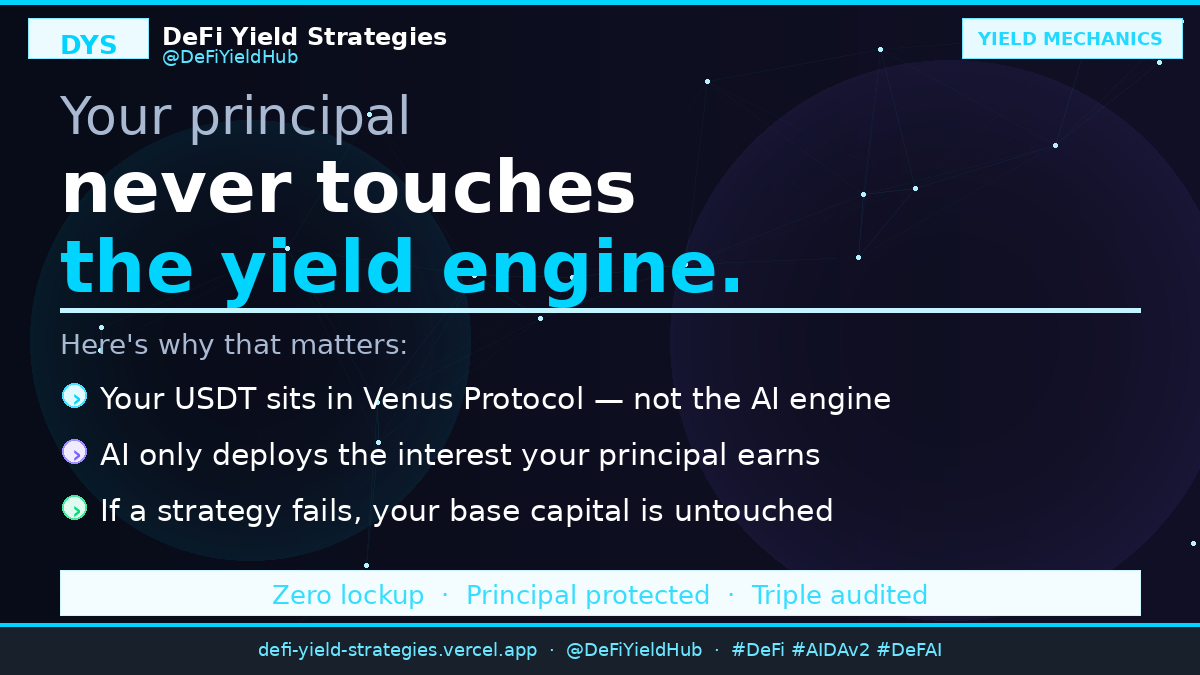
When you deposit USDT into AIDAv2, it doesn’t go directly into trading strategies. It routes to Venus Protocol — a battle-tested BSC lending platform with billions in total value locked. Venus is one of the most established DeFi primitives on Binance Smart Chain. Your deposit sits there, generating lending interest passively.
Step 2: Only the interest gets separated
Venus pays interest on deposits. Under LCR, that interest — not your principal — is what gets extracted and routed forward. Think of it like a savings account where someone takes only the monthly interest payment to invest, while the account balance itself stays locked.
Step 3: The AI Dual Yield Engine deploys the interest
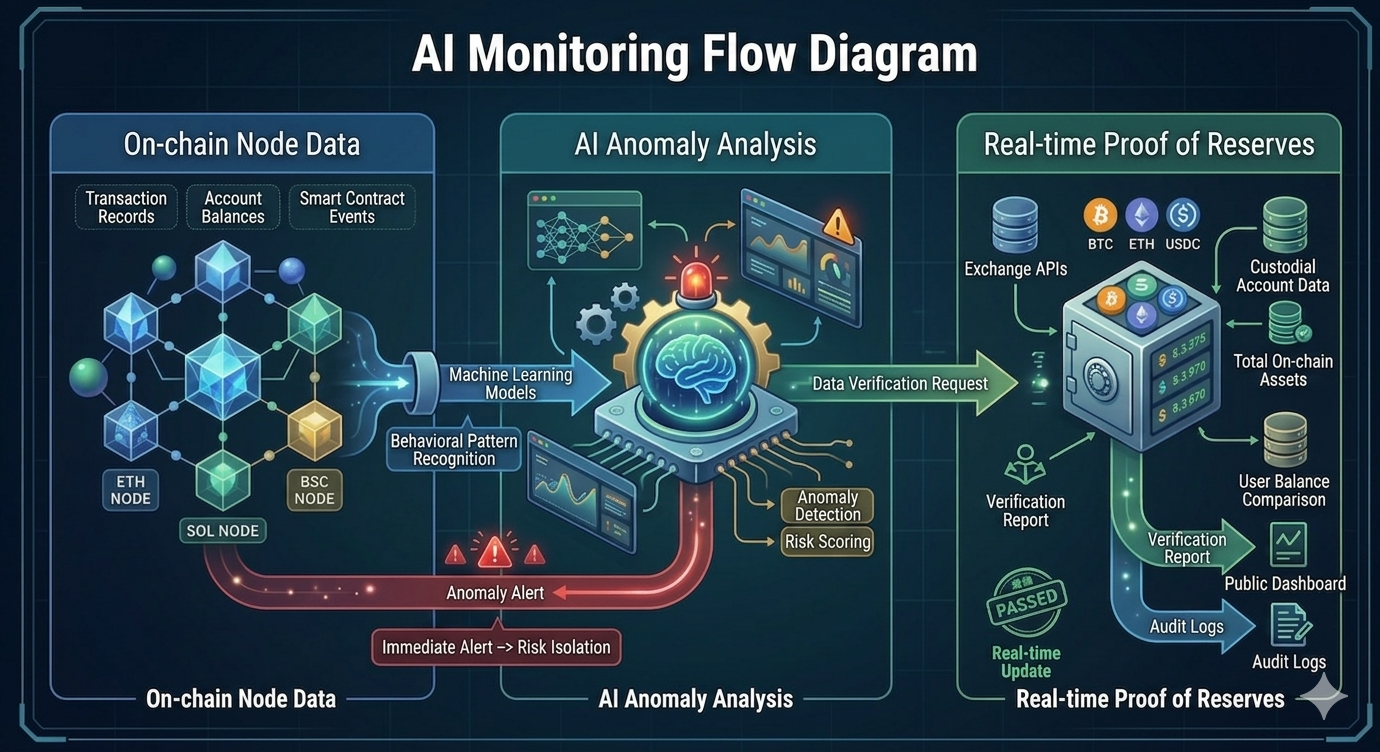
AIDAv2’s AI engine receives the separated interest and deploys it across multiple strategies: BSC, Ethereum, Arbitrum, and Polygon. It monitors 52,000+ smart contracts and 2,000,000+ daily active addresses to identify and execute optimal positions. This is where the active yield generation happens.
Step 4: 70% of profits return to you daily
The engine’s returns — generated entirely from the interest, not your principal — are distributed 70% to users and 30% to the incentive pool. Payouts are in USDT, processed daily. Your original deposit remains in Venus throughout.
Why the Structural Separation Matters
The consequence of this architecture is straightforward: the AI yield engine has no custody of your principal. It cannot lose what it doesn’t hold.
If a strategy the engine executes fails to generate returns on a given cycle, the worst outcome is a reduced yield payment for that period. Your underlying capital in Venus is unaffected.
This is categorically different from protocols where your deposit is the instrument being traded. The risk profiles aren’t comparable.
I want to be careful here: this doesn’t mean AIDAv2 is risk-free. Venus Protocol itself carries smart contract risk. The overall platform has smart contract risk. The AI engine’s strategies could underperform. These are real considerations and anyone deploying capital should weigh them honestly.
But the structural principal protection is real, verifiable on-chain, and meaningfully different from standard DeFi architecture.
Verifying It Yourself
The separation isn’t a marketing claim — it’s verifiable on-chain.
The admin key address for AIDAv2 is: 0x0000000000000000000000000000000000000000
All zeros. This means no admin authority exists to redirect principal, modify custody arrangements, or override the Venus deposit structure. You can check this yourself on the BSC block explorer.
The protocol has also been audited by three independent firms:
CertiK — BBB rating, live Skynet monitoring: skynet.certik.com/projects/aidav2
Beosin — Report №202408301054, August 2024, zero critical vulnerabilities
AVE.ai — BSC token contract analysis
None of these audits are a substitute for your own research. But they’re a starting point for verification, and the Beosin report in particular details the contract architecture in a way that supports the LCR mechanism claims.
What This Means for How You Think About Yield
Most DeFi marketing leads with the return percentage. I understand why — it’s the most immediately legible number. But after enough time in this space, I’ve come to think the more important question is: what’s the downside scenario?
LCR answers that question with a specific architectural choice rather than a vague promise. The principal sits in Venus. The yield engine works with interest only. The admin keys are gone.
That’s a structure I can reason about. And reasoning about structure — not chasing percentages — is what changed my outcomes in DeFi.
If you want to dig into the full platform architecture, the whitepaper is at aid-1.gitbook.io/aid. My running research and breakdown is at defi-yield-strategies.vercel.app.
Disclosure: This is an independent research publication. I earn referral rewards when users register for AIDAv2 using invite code 9CHDIYSQ. This is not financial advice. Always conduct your own research before deploying capital into any DeFi protocol.
Tags: DeFi, Cryptocurrency, Web3, Passive Income, Blockchain