What If Everything You Know About Yield Is Wrong?
--
Let’s start with a simple question.
You open a DeFi protocol. You see 180% APY. You deposit.
But before you did — did you ask yourself a single question about where that number comes from?
Probably not. And that’s not a criticism. It’s just how these interfaces are built. The number is big, it’s green, it’s updating in real time. It feels like information. It feels like a fact.
But what if it isn’t?
What Is Yield, Actually?
Here’s a question that sounds almost too basic to ask: what is yield?
Not APY. Not the number on the screen. Yield — as a financial concept. Where does it originate?
In traditional finance, the answer is straightforward. A bond pays yield because a borrower needs capital and agrees to pay for it. A dividend pays yield because a company generated profit and distributed it. A rental property pays yield because a tenant needs housing and pays rent.
Every dollar of return traces back to a real economic event. Someone needed something. Someone paid for it. That payment became your return.
Now ask yourself: in DeFi, when a protocol offers you 180% APY — what is the real economic event behind it?
Who needed something? What did they pay? And why does that payment flow to you?
If you can answer those three questions clearly — you understand your yield. If you can’t — do you actually know what you’re holding?
What Does the Dashboard Actually Show You?
Look at the number again. 180% APY.
Is that what you’ll earn? Or is that what you’d earn if conditions today stayed exactly the same for 365 consecutive days?
And when was the last time conditions in crypto stayed the same for 365 days?
So what is that number, really? It’s a snapshot. A projection built on assumptions that are already becoming outdated the moment you read them. The APY you see at 9am is not the APY you’ll experience by 9pm.
But here’s the deeper question: why is that number displayed so prominently? Why is it the first thing you see, in the largest font, updated constantly in real time?
Is it because that information is the most useful to you as an investor? Or is it because that information is the most effective at converting your hesitation into a deposit?
Those are two very different purposes. Which one do you think it’s serving?
Where Does the Money Actually Come From?
Let’s go deeper.
Some yield in DeFi comes from trading fees. Every time someone swaps tokens in a pool you’ve provided liquidity to, you earn a fraction of that transaction. Real activity. Real payment. Real yield.
Some yield comes from lending. Borrowers pay interest. Lenders receive it. Again — real economic activity, real source.
But some yield — particularly the highest yields, the ones that make you stop scrolling — comes from token emissions. The protocol mints its own token and distributes it to you as “yield.”
So ask yourself: where did that token come from? Who created it? What gave it value?
And perhaps most importantly: if everyone receiving this “yield” eventually wants to convert it back to something real — who is on the other side of that trade?
Is it a sustainable business generating real revenue? Or is it a system where your yield depends entirely on the next person believing in it as much as you do?
You know what that second structure is called when it exists outside of crypto, right?
What Are You Actually Paying to Earn This?
Assume for a moment the yield source is real. Trading fees, lending interest — legitimate.
Now ask: what does it cost you to earn it?
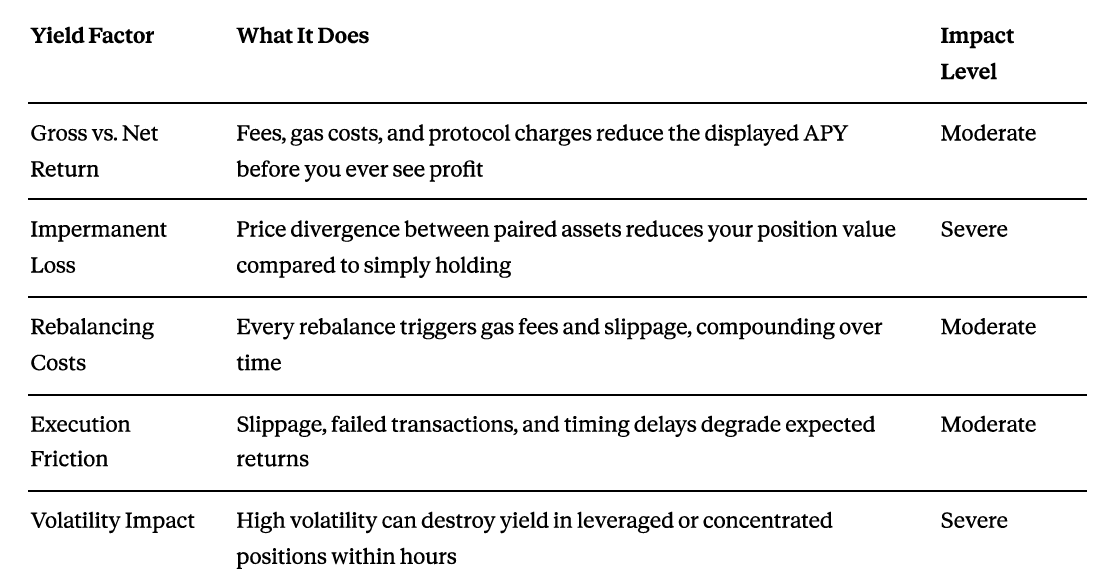
Gas fees on every transaction. Slippage when you enter and exit positions. The cost of rebalancing when the pool drifts. Impermanent loss — the quiet erosion that happens when the two assets in your pool move in opposite directions, forcing you to systematically buy more of what’s falling and sell more of what’s rising.
None of these appear on the APY ticker. All of them appear in your actual returns.
So here’s the real question: have you ever calculated your net yield? Not the gross APY. The actual dollar amount that ended up in your wallet — after every cost, every fee, every token price movement — divided by what you put in?
If you haven’t, do you actually know if you made money?
Why Do Different People Get Different Results From the Same Pool?
Here’s something worth sitting with.
Two participants. Same protocol. Same pool. Same entry date. Completely different outcomes six months later.
How is that possible?
One of them looked at the APY and deposited. The other modeled the position — mapped the yield source, estimated impermanent loss under different price scenarios, calculated net return after fees, sized the position according to their actual risk tolerance, and defined an exit strategy before entering.
Same system. Completely different levels of understanding. Completely different results.
Now ask yourself: which of those two participants are you? And which one are you funding?
What Would Change If You Approached This Differently?
What if, before your next deposit, you asked just one question: where is this yield actually coming from?
Not the APY. The source. The real economic event. The person or activity generating the return that eventually reaches you.
If you can answer it — you’re making an informed decision. If you can’t — you’re making a bet. And in a system populated by participants who model every variable before deploying capital, uninformed bets don’t stay neutral. They become the fuel that informed participants extract value from.
This is what yield engineering looks like in practice: not chasing the highest number, but understanding every number deeply enough to know which ones are real.
The infrastructure is catching up to this idea. Concrete Vaults automate the structural layer — allocation, rebalancing, strategy management — so that the engineering framework works for you even when you’re not actively managing every position.
Explore it at app.concrete.xyz
One Last Question
You’ve read this far. Which means somewhere in this piece, something made you pause.
Was it the question about where yield actually comes from? The one about who’s on the other side of your token sale? The one about whether you’ve ever calculated your real net return?
Whatever it was — that pause was the point.
Because the most important shift in DeFi right now isn’t happening in the protocols. It’s happening in the questions participants are willing to ask before they deposit.
Yield is revenue, minus cost, adjusted for risk.
Everything else — every dashboard, every APY ticker, every green number updating in real time — is just an answer to a question you haven’t asked yet.
Start asking.