What Happens to Crypto When Even Major Investors Lose Control: A Practical Guide to Keeping Access to Your Funds
 Xgram5 min read·Just now
--
A recent case demonstrates not just a private conflict within a single project, but something deeper — how the control system in the cryptocurrency market actually works today.
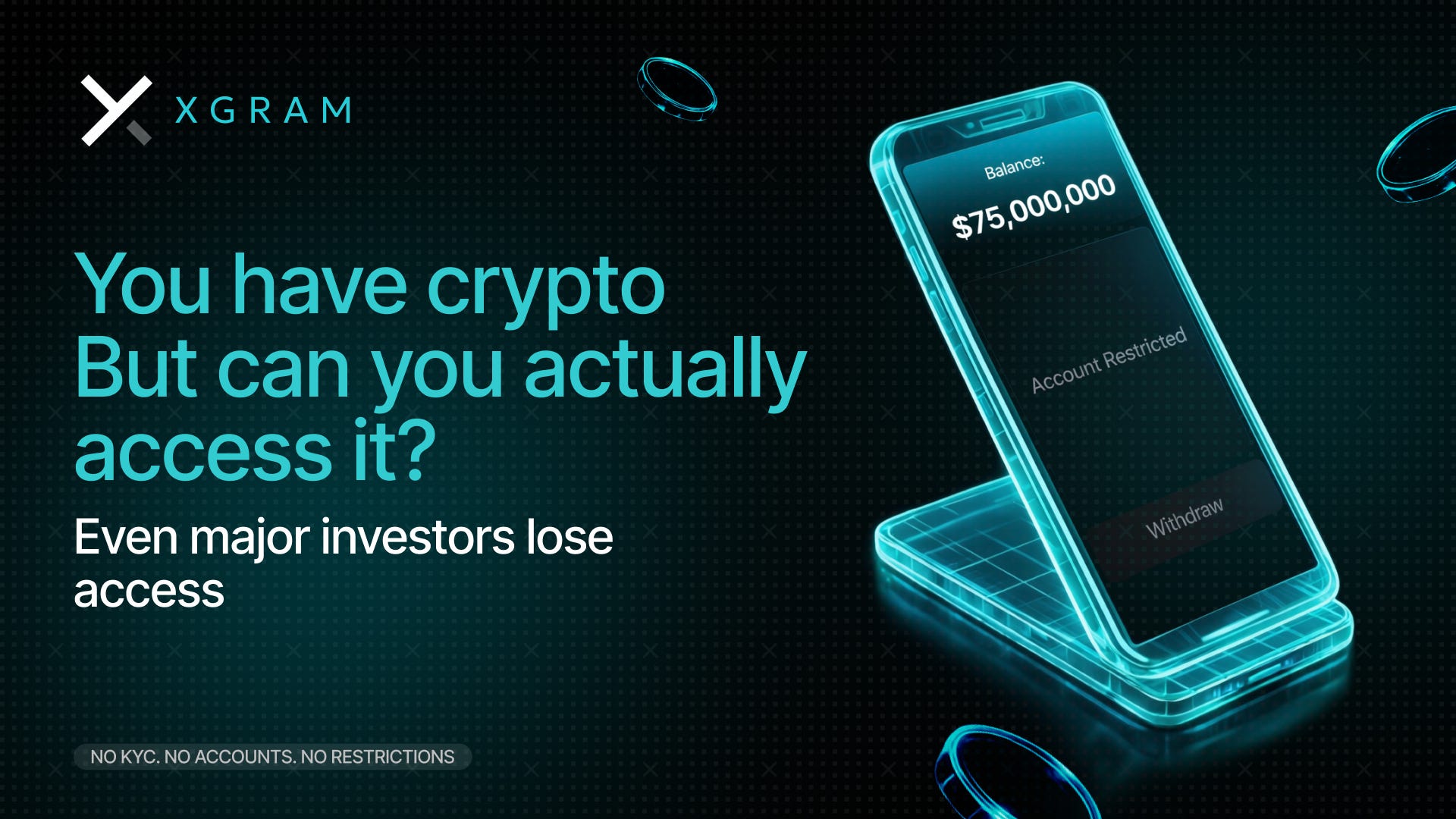
Justin Sun has sued World Liberty Financial after the project froze his WLFI tokens worth approximately $75 million and stripped him of voting rights. They explained it by saying that back in September 2025, he was placed on a blacklist due to suspicions of attempting to manipulate the price.
If you strip away the legal details, what remains is the fundamental fact: the asset may belong to you, but control over it can at a certain point fall outside your sphere of influence.
And the key point here is not the size of the amount or the prominence of the participant, but the very mechanics of what happened, which shows that access to assets can be regulated by the system rather than by their owner.
Why this case directly concerns ordinary users
At first glance, it may seem that such situations only apply to large investors. In practice, however, the same logic has long been manifesting at the level of everyday interaction with crypto.
Users are increasingly facing situations where access to funds and operations depends on additional conditions: accounts are restricted for verification, withdrawals can take an indefinite amount of time, and performing basic actions becomes impossible without going through procedures that were previously considered optional.
The only difference between these situations and the high-value case is the scale, while the system’s behavior model remains unchanged: access to assets can be restricted at any moment if it is mediated by a platform.
Where the real risk arises
The common perception of risk in crypto is associated with volatility. In practice, however, a much more significant risk is the inability to use your funds when you need them.
As long as assets remain within centralized infrastructure, the user depends on rules and processes outside their control. This means that in a critical situation, the speed and possibility of action are determined not by the user themselves, but by the system.
This is where the key substitution occurs: an illusion of control is created, which lasts until the first restriction.
How it manifests in real scenarios
In most cases, users don’t need trading — they need basic actions like exchanging, transferring, or fixing value.
However, at the moment when such an action is needed, the system can add extra steps: checks, restrictions, or waiting periods that effectively block the ability to act quickly.
As a result, the problem arises not from the lack of a strategy, but from the inability to execute an already-made decision.
Why this is becoming the new normal
Increased regulation is leading centralized platforms to introduce additional layers of control, including user identification and transaction analysis.
This means that every action increasingly goes through a filter, and access to funds becomes conditional.
It’s important to understand that this is not a temporary phenomenon, but a structural change in the market.
What this changes in the approach to crypto
If earlier the key question was choosing an asset, now it is shifting toward access control.
Because simply owning cryptocurrency does not guarantee that you will be able to use it.
What to do if you don’t want to depend on blocks: a practical action model
The first step is to determine where your funds are and to what extent you actually control them.
If they are on a platform, honestly ask yourself: can you right now perform any basic action without additional conditions? If you’re not confident, this indicates risk.
The next step is to partially withdraw funds from the platform’s control zone. Even moving part of your assets to a non-custodial wallet already reduces dependence and gives you direct access.
Then it’s important to separate storage and operations. Storage should be where you have control, while operations can be performed through separate tools.
You should also minimize the number of points where action can be stopped. Any registration, verification, or confirmation is a potential restriction.
How to perform operations without creating new restrictions
When the need for an exchange arises, the user actually faces two different models.
The first is to return to the centralized system, go through all the account and verification stages again, and thereby maintain dependence on the platform.
The second is to perform the action directly, without creating a new point of control.
If the task is a basic operation such as swapping one asset for another, it makes more sense to use a tool that doesn’t add new dependencies.
In this scenario, Xgram becomes not just an option, but the shortest path between decision and action, as it eliminates the elements that most often lead to blocks.
You don’t create an account, so there is no object that can be restricted. You don’t go through KYC and don’t depend on the verification process. You don’t wait for approval and perform the action at the moment it’s needed.
The process is reduced to a simple sequence: you choose the asset you’re sending, specify what you want to receive, enter the wallet address, and confirm the exchange.
At this moment, you are not returning to a system that can stop you — you are executing the decision directly.
What ultimately distinguishes users who maintain control
The difference is rarely related to asset selection or the depth of market analysis.
The key factor is having a system where storage, access, and execution of operations are structured to minimize dependence on external conditions.
This means distributing funds, using intermediary-free tools for basic actions, and the ability to implement decisions without delays.
Final conclusion
The case of freezing tens of millions of dollars shows not an exception, but the principle by which the system operates.
You may have assets, but if access to them depends on a platform, then at any moment you may face restrictions.
And at this point, a choice arises.
Either you accept the system’s rules and dependence on it.
Or you build your own model, in which storage is under your control and actions are performed without intermediaries.
And it is precisely this that determines whether you control your crypto — or simply have access to it on someone else’s terms.