What Actually Makes a DeFi Strategy Sustainable?
 Na4 min read·Just now
--
DeFi never runs out of yield.
Every week, new strategies show up.
APYs jump.
Liquidity rushes in.
And then, almost on schedule, it all cools off.
Returns shrink.
Capital rotates.
The edge disappears.
This isn’t a rare failure mode. It’s how most of DeFi behaves by default.
So the better question isn’t:
“Where’s the highest APY?”
It’s:
“What still works after the hype fades?”
The Cycle People Pretend Not to See
You’ve seen this play out repeatedly:
A protocol launches with aggressive incentives.
APY explodes into triple digits.
Liquidity floods the system.
For a brief window, it looks effortless.
But that window closes fast.
As capital piles in:
- rewards get diluted
- emissions lose effectiveness
- exit liquidity becomes the real game
And just like that, capital leaves.
Then the same pattern shows up somewhere else.
The issue isn’t that these strategies “break.”
They were never built for longevity to begin with.
What Sustainability Really Implies
Sustainability in DeFi has nothing to do with peak yield.
It’s about whether a strategy can hold up over time.
At a baseline, it should:
- produce stable returns across cycles
- function without relying on short-lived incentives
- remain effective under different market conditions
There’s a clear distinction here:
Chasing yield is opportunistic.
Sustainable yield is engineered for endurance.
Short-term gains can be manufactured.
Longevity cannot.
Real Yield vs Incentive-Driven Yield
Not all yield comes from the same place.
There are two fundamentally different engines:
1. Incentive-Driven Yield
Backed by:
- token emissions
- liquidity mining
- protocol subsidies
Its purpose is simple: attract capital.
Once incentives taper off, returns follow.
2. Real Yield
Comes from:
- trading volume
- borrowing demand
- arbitrage
- structural inefficiencies in the market
This is tied to actual economic activity.
And that’s the dividing line:
- incentive-driven yield fades
- real yield tends to persist
If emissions are doing all the work, the clock is already ticking.
Market Conditions Decide Everything
Sustainability isn’t fixed, it depends on context.
Performance shifts based on:
- liquidity depth
- participation levels
- volatility
- demand for the strategy itself
Some setups only work in bullish conditions.
Others need volatility to function.
Many break the moment conditions change.
The few that survive are flexible.
Most strategies fail not because they’re flawed, but because they’re too rigid.
The Silent Killers: Friction and Risk
On paper, plenty of strategies look great.
In practice, they deteriorate.
The usual culprits:
- execution costs
- slippage
- frequent rebalancing
- gas fees
- changing correlations
A high APY means little if friction eats the returns.
This is where most retail strategies collapse, they ignore net yield.
Sustainability isn’t about gross returns.
It’s about what remains after everything is accounted for.
How Durable Strategies Are Actually Built
Strategies that last don’t rely on a single edge.
They operate more like adaptive systems.
Common traits:
- diversification across multiple sources of yield
- continuous monitoring and reallocation
- dynamic capital deployment
- focus on risk-adjusted performance, not headline APY
This is where DeFi starts resembling professional capital management.
Not just chasing opportunities, but structuring them.
Where Concrete Fits Into This Shift
This is the direction platforms like Concrete are targeting.
Instead of jumping from one opportunity to another, the focus is on:
- identifying yield that can persist
- allocating capital across multiple strategies onchain
- adjusting exposure as conditions change
- minimizing reliance on temporary incentives
The objective isn’t to win a single cycle.
It’s to remain competitive across multiple ones.
That’s a fundamentally different design philosophy.
A Practical Example: Stability vs Hype
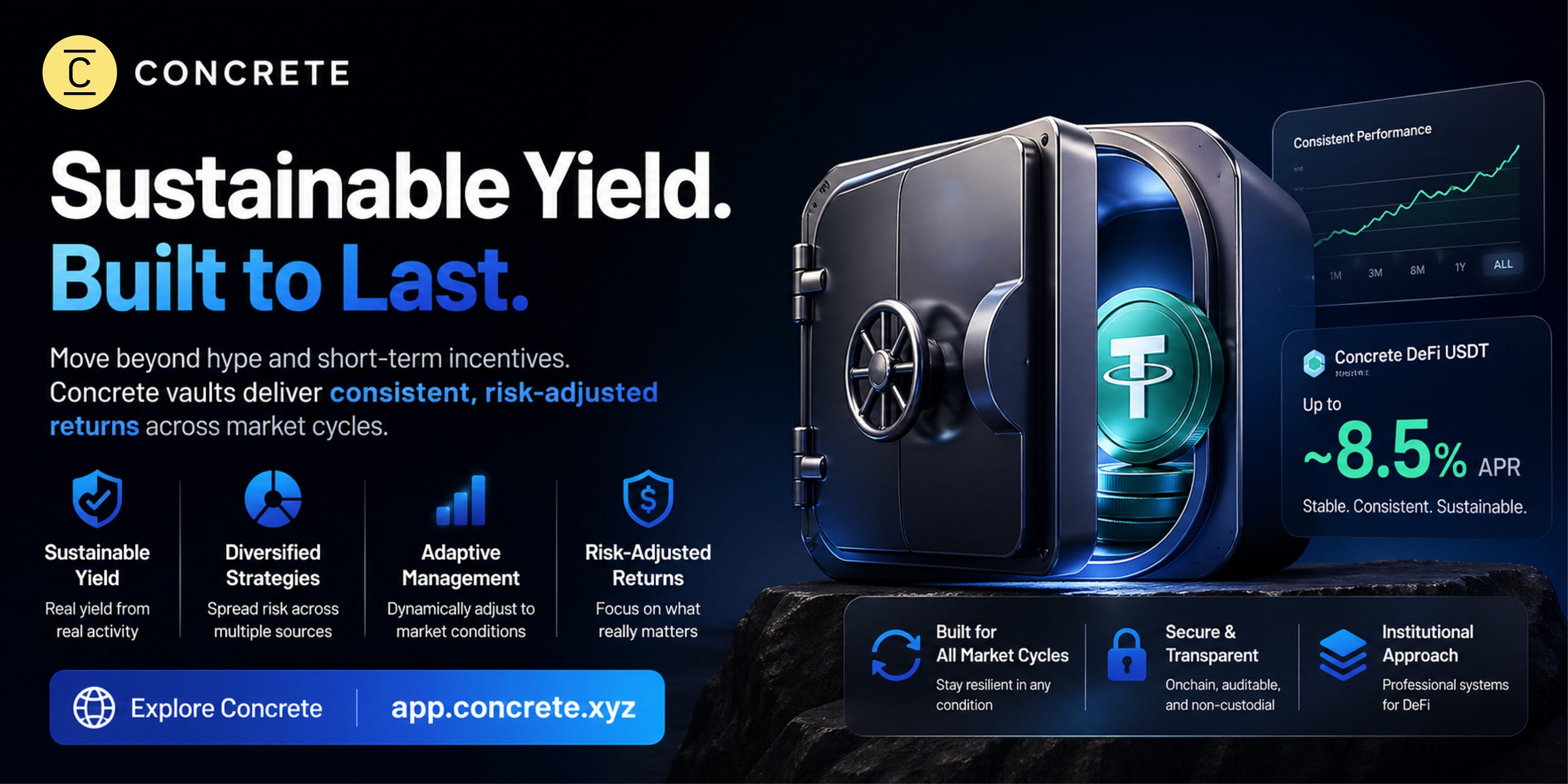
Take Concrete DeFi USDT.
It offers around ~8.5% yield.
Compared to aggressive strategies, that looks underwhelming.
But that comparison misses the point.
Over time:
- volatile yields collapse
- unstable setups fail
- capital moves toward consistency
A steady return often outperforms unstable high APY when measured across full cycles.
That’s what long-term capital actually looks for.
Not spikes, consistency.
The Direction DeFi Is Moving
DeFi is evolving, whether people notice or not.
The shift is clear:
- from yield chasing → to capital management
- from incentives → to infrastructure
- from isolated plays → to integrated systems
In this environment:
- sustainability beats peak performance
- risk-adjusted yield becomes the real metric
- systems outlast narratives
The next phase of DeFi won’t be defined by the highest APY.
It will be defined by what continues to work when conditions change.
Final Take
The real question isn’t:
“Where can I earn the most right now?”
It’s:
“What will still be generating returns next cycle?”
Because over time,
consistency compounds harder than hype.