What Actually Happens When You Send Crypto?
It’s not a bank transfer. It’s not instant. And your intuition about it is probably wrong.
 Ritika Prajapati6 min read·Just now
--
TL;DR
Sending crypto is not moving money. It is broadcasting a signed instruction that updates a shared ledger.
Every transaction competes for limited block space and fees determine priority.
Finality is not instant. It is probabilistic and strengthens with confirmations.
Stablecoins now dominate usage, with 33 trillion dollars in transfer volume in 2025.
The biggest risk is not volatility. It is irreversible user error.
The system is evolving into payments infrastructure, but it is not consumer ready yet.
Maria runs a textile export business in Lima. Her buyer in Istanbul owes her 14000 dollars.
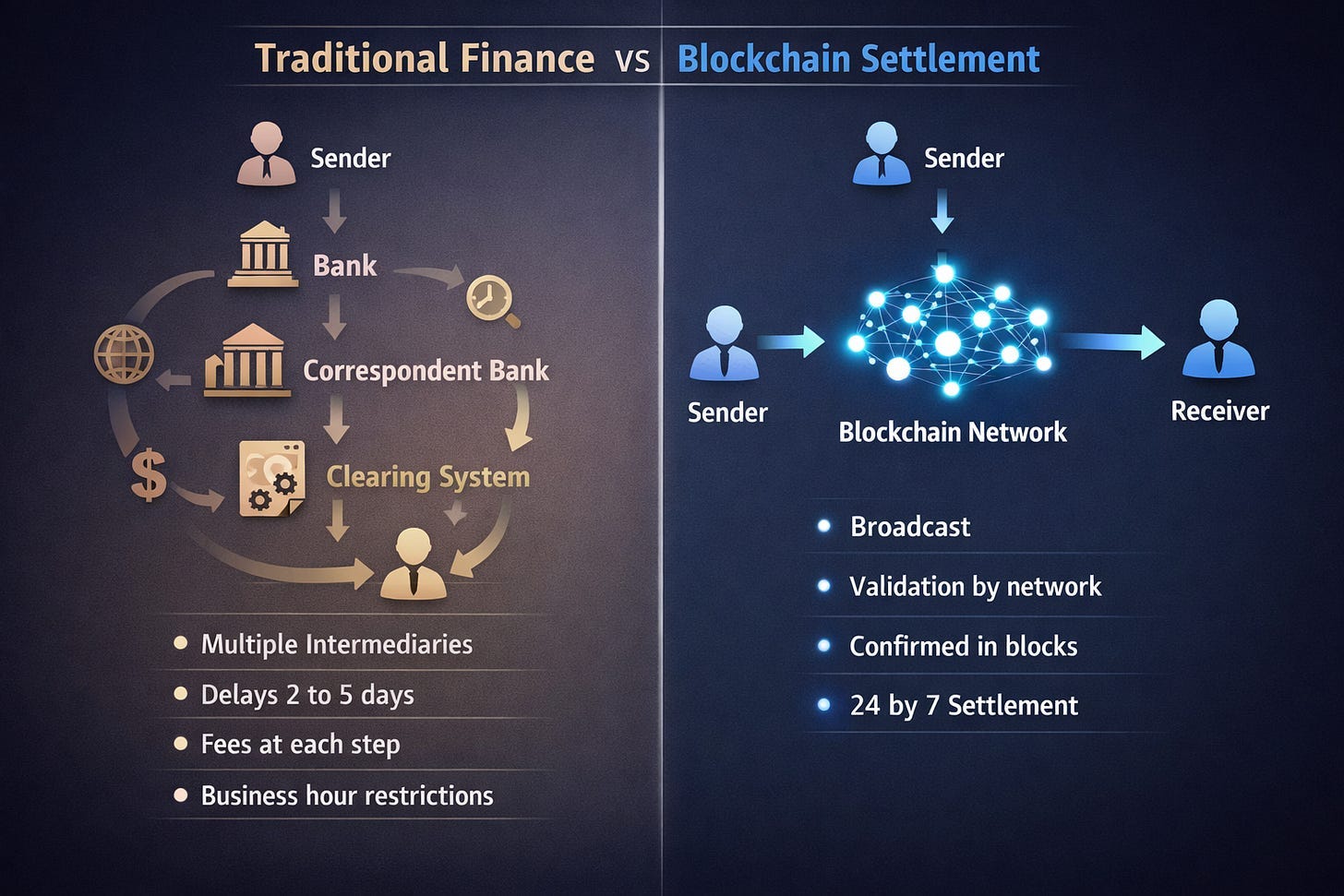
A bank wire would take days, touch multiple intermediaries, and quietly reduce the amount through fees.
So she asks for USDC instead.
Twenty three minutes later, the money is in her wallet.
No bank. No cutoff times. No approvals.
Simple at least on the surface.
What actually happened in those twenty three minutes was not a transfer. It was a process. Her payment entered a global queue, competed for space, got verified by thousands of machines, and was permanently recorded on a distributed ledger.
No one approved it. No one could stop it.
That difference between what it feels like and what actually happens is where most people misunderstand crypto.
Context and Problem
Most people think crypto works like email. You press send and it arrives.
It does not.
Traditional finance runs on trusted intermediaries such as banks, clearinghouses, and payment processors maintaining ledgers and guaranteeing settlement.
Crypto removes them.
Instead of trust, it relies on cryptography and distributed consensus. Thousands of independent nodes agree on what is true, and no single party controls the system.
That is a fundamental shift.
But it comes with trade offs and most users only discover them when something goes wrong.
By 2025, global crypto ownership reached 741 million people. Stablecoin transfers alone exceeded 33 trillion dollars, far beyond the speculation narrative.
This is no longer theoretical. It is infrastructure.
But it behaves very differently from what people expect.
System Breakdown
Think of sending crypto as a four step process, not a single action.
Act One: Construction and Signing
When you hit send, your wallet creates a transaction containing sender, receiver, amount, and metadata.
Then it signs it with your private key.
That signature proves authorization without revealing the key. Change even one detail and the transaction becomes invalid.
It is a tamper proof seal based on mathematics.
Act Two: Broadcast and Verification
The transaction is broadcast across the network.
Each node independently checks
Is the signature valid
Does the sender have the funds
Does it follow protocol rules
This happens globally in seconds without coordination.
Approval is not given by a central authority. It emerges from consensus.
Act Three: The Mempool
If valid, your transaction enters the mempool, the network waiting room.
This is where reality diverges from intuition.
Block space is limited. Not every transaction fits immediately.
Validators choose which transactions to include and they prioritize by fees.
Your fee is not just a cost. It is a bid.
A simplified view of how transactions compete for block space based on fees
Higher bid means faster inclusion. Lower bid means waiting longer.
Act Four: Confirmation and Finality
A validator includes your transaction in a block.
Now it is confirmed.
But not final.
Each additional block makes reversal exponentially harder. On Bitcoin, six confirmations is the practical standard for finality.
Finality is not a switch. It is a spectrum of certainty.
Deep Dive: The Mempool as a Market
The mempool is where crypto becomes economic, not just technical.
Every transaction carries a fee such as satoshis per byte on Bitcoin or gas on Ethereum.
Validators act rationally. They select the most profitable transactions first.
This creates a real time market for block space.
During peak demand, fees spike. In past cycles, Bitcoin fees exceeded 50 dollars. For a 30 dollar payment, that breaks the system. For a 500000 dollar transfer, it is negligible.
Ethereum improved this with EIP 1559 by introducing a base fee and optional priority tip. Layer 2 networks went further, batching transactions and reducing costs to near zero.
The takeaway is simple. Fees signal demand and allocate scarce block space.
Key Metrics
The numbers reveal the system priorities.
Bitcoin has a 10 minute block time by design. It prioritizes security over speed.
Ethereum fees once above 50 dollars averaged around 1.85 dollars in 2025, with Layer 2 costs often near zero.
But the real story is stablecoins. 33 trillion dollars in transfer volume.
That is not retail speculation. It is institutions moving capital such as exchanges, treasury operations, and cross border settlement.
The infrastructure is already in use at scale.
Risks
Irreversibility is the defining feature and the biggest risk.
In traditional finance, errors can be corrected. In crypto, they usually cannot.
Wrong address means funds are gone.
Wrong chain means the same outcome.
There is no support line or escalation.
The mempool introduces uncertainty.
A sent payment is not settled until confirmed. If fees are too low, transactions stall, creating real world friction.
Volatility creates value drift.
If you send Bitcoin, the value received may differ. That is why stablecoins dominate payments.
Security depends entirely on key management.
Lose your key and you lose your funds.
Fall for phishing and the result is the same.
The protocol does not protect you from mistakes.
Bull vs Bear Case
The bull case is already visible.
Cross border transfers settle in minutes with minimal fees and no intermediaries. For treasury operations, this is a structural improvement.
User experience is improving quickly. With Layer 2 and account abstraction, crypto payments may soon feel like traditional apps while running on open infrastructure.
The bear case is equally real.
Self custody is difficult. Mistakes are unforgiving. Fee volatility still exists. Compliance remains complex.
And there is a deeper question.
If stablecoins dominate, does the blockchain matter or does control shift to issuers like Circle, Tether, or central banks.
Scenario Analysis
High value B2B transfer
200000 dollars in USDC settles in minutes with minimal fees. This works.
Retail payment during congestion
A 25 dollar Bitcoin payment requires an 8 dollar fee and takes hours. This fails.
User error
Clipboard malware swaps an address. Funds are sent and lost permanently. The system worked exactly as designed.
These are not edge cases. They define the current system.
What Most People Miss
A crypto transaction is not binary.
It does not arrive instantly. It moves through stages such as broadcast, queued, confirmed, and finalized.
Second, the real users are not who people think.
The 33 trillion dollars in stablecoin volume is driven mostly by institutions, not retail users.
Third, low fees do not mean low demand.
They reflect better infrastructure, not reduced usage.
Key Variables
Fee selection determines speed.
Chain choice affects cost and reliability.
Confirmation requirements define certainty.
Counterparty requirements affect timing.
Small decisions create large outcomes.
Strategic Impact
For individuals, treat every transaction like a wire. Verify everything carefully.
For businesses, stablecoins are already viable for cross border settlement. The limitation is not technology but counterparties and compliance.
For the system, the shift is not about replacing banks.
It is about a new settlement layer that is always on, programmable, and global.
Conclusion
When Maria received her 14000 dollars, five things happened. The transaction was created and signed, verified by the network, queued in the mempool, included in a block, and finalized over time.
No bank processed it. No intermediary cleared it.
This is not just faster money. It is a different model of settlement.
But it comes with trade offs such as irreversibility, user responsibility, and probabilistic finality.
The 33 trillion dollars in stablecoin volume is not hype. It is proof that the system already works, just not in the way most people assume.
Understanding that difference is what separates confident users from costly mistakes.
Personal Note
The most misleading narrative about crypto is that it has to be everything or nothing.
In reality, it is already something very specific.
Stablecoins work for high value cross border settlement.
Bitcoin works for secure large transfers.
Retail payments on most chains still struggle.
That is not failure. It is clarity.
The real advantage is not belief. It is understanding how the system behaves.
Because the infrastructure is real.
It just does not behave like the financial system you are used to.