Warsh Doctrine: Leaner Fed and an AI-Led Productivity Bet
 MarketCrunch AI6 min read·Just now
--
Date: 04/21/2026
Warsh is signaling he wants to shift relief toward households and pain toward portfolio managers — a populist pitch that echoes 1990s anti-bubble rhetoric.
A new philosophy takes shape
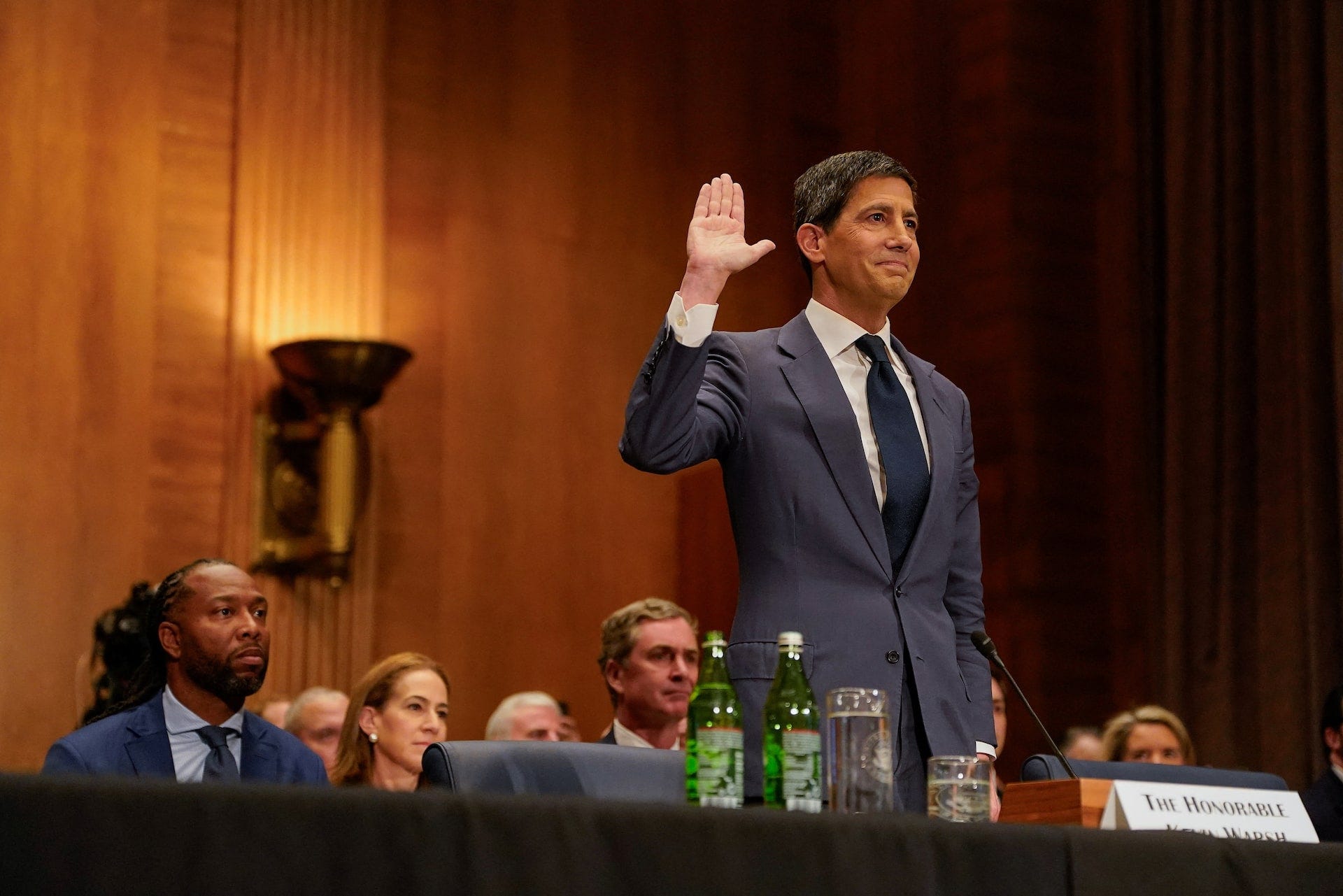
When Kevin Warsh sat before the Senate Banking Committee today, he offered a crisp diagnosis of the Federal Reserve’s ailments and an equally sharp prescription. “The Fed has an interest-rate tool and a balance-sheet tool,” he said. “My view is the interest-rate tool gets in the cracks… the balance-sheet tool disproportionately helps those with financial assets.”
That single remark distilled an agenda likely to ripple through bond desks from New York to Tokyo. Mr. Warsh wants to cut short-term rates to relieve households while shrinking the Fed’s $6.6 trillion portfolio to curb asset-price distortions — an inversion of the Powell-era playbook he once criticized from the sidelines.
You cut short-term rates while running off the balance sheet — would (in theory) shift relief to Main Street borrowers (cheaper credit cards, small-business loans, floating-rate mortgages) and put more of the adjustment burden on Wall Street asset holders (because QT withdraws the Fed as a big buyer of Treasurys and MBS).
1. A bias to move the overnight rate
Why exactly is the preference to move Fed funds rate. Well, think of the fed‑funds rate as the volume knob on your speakers — turn it and everything gets louder or softer at once. Warsh wants to adjust the master dial rather than fiddle with exotic equalizers (QE) that mainly benefit audiophiles (asset‑holders).
Warsh’s preference for using the fed-funds rate as the locomotive of policy springs from two beliefs:
- Fairness. Because every adjustable loan, savings account and corporate line is pegged to short-term benchmarks, rate moves “hit the entire economy,” he told lawmakers. This democratizes the cost of money — but it also spreads the pain. If inflation is supply‑driven, across‑the‑board hikes can still whack workers hardest.
- Accountability. The former governor argues that balance-sheet expansion is “fiscal policy in disguise,” blurring the Fed’s remit and inviting political meddling. QE by another name is debt‑monetization. Krugman would note that abandoning the tool entirely could leave the Fed toothless in a liquidity trap — see 2008–12.
The posture is consistent with his decades-long complaints that quantitative easing boosted Wall Street more than Main Street. In a recent WSJ op-ed he advocated “easing the Fed off QE” by pairing moderate asset run-off with clearer interest-rate guidance. Asset inflation is still inflation; when the S&P soars on cheap money, wealth inequality widens. Warsh is tapping that resentment.
2. The AI productivity boom — and rates
Warsh’s dovishness on rates is rooted less in classical output-gap modeling than in a conviction that an artificial-intelligence surge will expand supply, cool prices and warrant easier money. However, Productivity miracles are usually promised, rarely delivered on schedule. Betting policy on them risks rerunning the 1999 dot‑com narrative — only this time with bigger balance sheets.
He told senators that the “technology revolution… is happening insanely fast” and could generate an employment shock for entry-level white-collar jobs even as output climbs. Yes, tech boosts GDP per worker — but displaced workers don’t magically land in high‑wage jobs. Short‑term, that could be disinflationary or politically explosive, depending on whose job vanishes.
Privately, he has pointed to the late-1990s Internet boom as precedent. In remarks reported by the WSJ, Warsh suggested that an AI-driven productivity wave could “allow rate reductions without reigniting inflation” — a view that has met skepticism inside the current Federal Open Market Committee.
3. What that cocktail means for the yield curve
Markets have begun to price in a steeper curve — lower bills, firmer long bonds — under a Warsh-led Fed. Traders interviewed by Reuters expect “rate cuts while the balance sheet shrinks,” a mix that could pull term premia higher as the Treasury loses a captive buyer. A steeper curve can revive bank profitability (they borrow short, lend long) but also raise mortgage costs. Krugman would warn that doing both actions simultaneously is the monetary equivalent of tapping the brake and gas together.
Historically, yield curves flatten when the Fed tightens via short-term rates alone and steepen when it cuts amid rising inflation risk. Brookings research notes that rapid hikes in 2022 flattened the curve to recessionary levels. Warsh’s plan turns that logic on its head: short-term relief collides with reduced quantitative support for the long end. If enacted, strategists say near-term Treasury yields could fall 50–75 basis points, while 10- and 30-year bonds drift higher on larger risk premiums, producing a positive — or at least less negative — slope. Risk: If long yields rise too quickly, federal debt‑service explodes — handing Congress a fiscal headache just as baby‑boom retirements peak.
4. Political and geopolitical cross-currents
Policy will not unfold in a vacuum. The 2026 midterm elections loom, sharpening scrutiny of any move that juices growth or, conversely, fuels borrowing costs. Elections compress policymakers’ time horizons — bad news for long‑lag tools like monetary policy. Think 1972’s ‘Nixon shock’.
Democrats at the hearing cast Warsh as a “sock puppet” for Donald Trump, warning that pre-election easing could look expedient rather than data-driven.
Complicating matters further is the drag from a costly Iran conflict, which has boosted energy prices and fanned inflationary fears. Senator Elizabeth Warren argued that “Trump’s war with Iran is… driving up the cost of nearly everything.” Warsh must therefore balance a supply-side optimism about AI with the reality of wartime supply shocks. It must be said, supply shocks can’t be fixed with rate cuts; they need diplomacy or strategic reserves.
5. Mechanical transmission to the curve
Below is a schematic of how Warsh’s twin‑lever strategy could reshape the term structure:
- 25–50 bp rate cut: knocks the short end down hard — funding costs and three-month bills dive — while the long end barely notices, leaving the curve steeper.
- $60–$80 billion in monthly balance-sheet runoff (QT): does little to bills at first, but with the Fed no longer a captive buyer investors demand a fatter term premium, pushing 10- and 30-year yields up — another steepener.
- AI-powered productivity burst (the wildcard): if genuine, it tames near-term inflation expectations and caps long yields; if hype, long bonds sell off. Outcome is mixed, hinging on whether the promised efficiency boom arrives in time.
- Iran-war risk premium: geopolitical jitters jolt short-term markets and lift oil-driven inflation fears, but the bigger effect lands in the long end — higher defense outlays and deficit worries drive yields up, steepening the curve for the wrong reason.
6. Independence — or dependence?
Warsh insisted that “monetary-policy independence is essential,” adding that “Fed independence is up to the Fed” and must be preserved by staying “in its lane.” Yet critics note that his swift evolution from inflation hawk (2017) to would-be rate cutter (2026) aligns uncomfortably with the political cycle. The charge puts extra weight on transparent decision-making once he occupies the Marriner Eccles Building.
Bottom line
Kevin Warsh wants to cut short-rates while letting the Fed’s balance sheet shrink — easing at one end, edging tighter at the other. If the much-touted AI productivity boom shows up quickly, that combination could nudge living costs lower without reigniting big asset bubbles. If the boost proves slower or smaller, the same recipe could leave the yield curve steeper and Washington facing higher long-bond financing costs just as the midterms come into view. It’s an inventive play, and its success hinges less on ideology than on whether the technology dividend materializes in time.