What happens when the weekend project becomes a Tuesday production incident
As an almost thirty-year veteran of the software industry, I have two things: bad knees and the confidence to say vibe coding is real and it works. All I have to do is tell the AI what I want and, in a few minutes, it’s done. Anyone with an AI subscription is a weekend away from shippable MVP and things are only getting better.
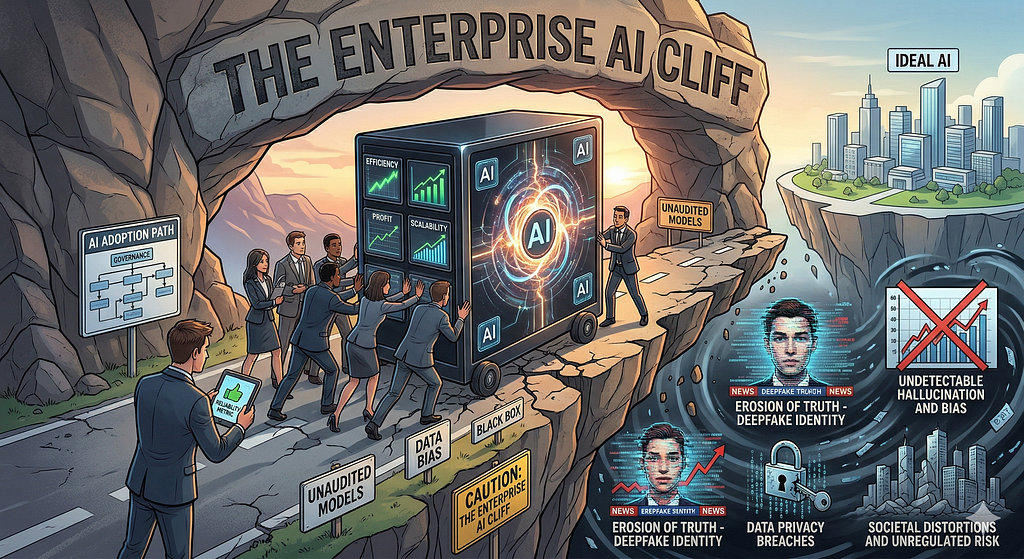
But there’s a cliff. Sadly, most people don’t see it until they’re already falling.
The cliff isn’t the doomsayers’ “vibe coding produces bad code.” Let’s be honest. Sometimes it does. Sometimes it doesn’t. The cliff is what happens when code that was built for speed of production meets an environment built for customers. When the weekend prototype gets traction and needs to survive Monday morning in production, the vibes can turn real bad. Real quick.
And in enterprise organizations, it’s worse. And it’s where vibe coding quietly collapses.
The Weekend Is Not the Problem
Let’s be clear: vibe coding is a legitimate prototyping technique. For hackathons, internal tools, MVPs, and validating ideas quickly, it’s a game-changer. But that’s not the whole story. As engineering leader Addy Osmani warns, the distinction between vibe coding and AI-assisted engineering matters because conflating the two gives newcomers a dangerously incomplete picture of what production software requires.
Still, to be clear: the problem isn’t the weekend. The problem is what happens when nobody transitions the weekend project into something engineered. Weekend projects often experience:
No explicit intent. Vibe-coded projects describe the what but never document the why. When someone else needs to modify the code six months later, there’s no spec, no architectural decision record, no explanation of tradeoffs. The code works, but why and how?
Optimized for the happy path. AI-generated code is remarkably good at making the demo work. Even as AI tools get more advanced, they are less good than they should be at handling edge cases, failure modes, retry logic, and graceful degradation. These are the things that separate a prototype from a production service. When the AI provider returns a 429, does the agent crash or queue the request? Does it tell the user or fall back to some hardcoded dummy data?
No operational surface area. Oftentimes vibe-coded apps have no monitoring, no alerting, no structured logging, and no runbook. The developer tested it by using it. That’s the entire QA process. At 50 users, this is fine. At 5,000, it’s a liability. At 50,000, it’s an incident.
Security as an afterthought. OpenClaw, Rabbit R1 and others highlight that agentic coders do not produce bulletproof code by default. We’ve known for years that the natural consequence of building fast is insecure code and AI-generated code makes it easy to build fast.
The Enterprise Cliff in Practice
Thoughtworks recently published a piece arguing that professional enterprise development needs to move beyond vibe coding entirely. Their prescription: structured prompts with defined scope, architectural constraints, and quality metrics. CI/CD integration where AI-generated code goes through the same pipeline as human code. Spec-driven workflows where the AI implements against a plan.
This isn’t anti-AI. It’s anti-unstructured-AI. This shift in mindset needs to happen quickly. Enterprises are now evaluating vibe coding tools for production use, not just prototyping. The evaluation criteria that matter at enterprise scale are exactly the ones vibe coding skips: integration with existing design systems, compatibility with organizational code standards, governance and audit trails, and the ability to produce maintainable output that a team can own long-term.
What the Cliff Actually Costs
Nobody wants to quantify it, but the worst cost of hitting the cliff isn’t technical debt. It’s organizational trust.
When an enterprise team ships a vibe-coded feature and it breaks in production, the conversation isn’t “let’s fix the code.” It’s “should we use AI at all?” One bad incident sets AI adoption back six months because leadership blames the tech, not the missing discipline.
Eventually, organizations end up in the worst possible position: they tried AI, it didn’t work, and now they’re skeptical of the thing that could genuinely transform their velocity.
Meanwhile, organizations that succeed with AI in production aren’t the ones moving fastest. They’re the ones that treated AI-generated code exactly like human-generated code: reviewed, tested, monitored, and owned by someone who can explain what it does and why. They found the right amount of friction and invested in operational measures.
The Framework That Bridges the Gap
I’ve been developing what I call the Five Facets of AI-Enabled Engineering. This includes Friction, Limitations, Processes, Verification, and Accountability. The short version:
Friction: Make the AI explain before it codes. Pause before accepting output to allow for engineering judgment.
Limitations: Know what the AI can’t do. Don’t discover boundaries in production.
Processes: Document how your team uses AI. Undocumented AI usage is shadow AI. Shadow AI is risk.
Verification: Test AI output the same way you test human output. “It works on my machine” is still not good enough.
Accountability: A human owns every line of code, regardless of what generated it.
These aren’t anti-speed principles. They’re what lets you keep the speed without lying to yourself about what you shipped.
The Real Takeaway
Vibe coding is a powerful first step, but it’s only the first step. The enterprise cliff exists not because AI is unreliable, but because production demands things that vibes can’t: explainability, maintainability, operational readiness, and accountability.
The founders who scale past the cliff are the ones who recognize that the transition from prototype to production isn’t a deployment problem. It’s an engineering discipline problem. Discipline, applied correctly, doesn’t slow you down. It’s what lets you stay fast without breaking things that matter.
The real lesson: vibe-code with passion. Deploy with discipline.
Vibe Coding Doesn’t Scale: The Enterprise Cliff was originally published in Level Up Coding on Medium, where people are continuing the conversation by highlighting and responding to this story.