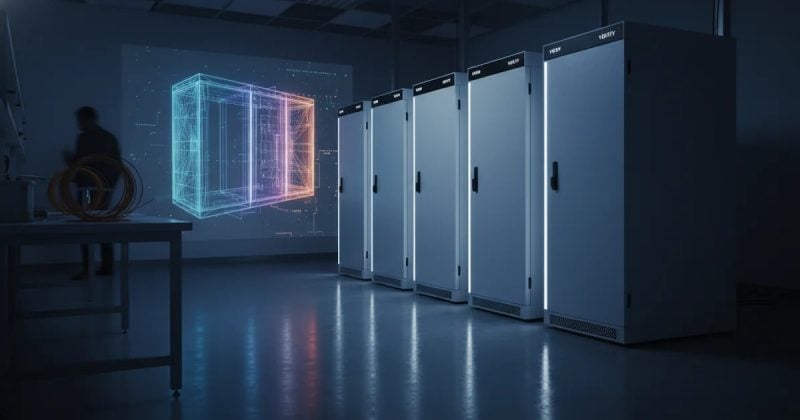
Vertiv introduces converged physical infrastructure digital twin for Nvidia’s Omniverse DSX platform
The data center infrastructure giant is building simulation-ready models that let engineers virtually test gigawatt-scale AI factories before a single rack gets bolted to the floor.
Share
Add us on Google by Editorial Team Jun. 1, 2026Vertiv just became one of the first companies to bring full-stack physical infrastructure models to Nvidia’s Omniverse DSX platform. The move lets engineering teams simulate power delivery, cooling systems, and facility layouts for massive AI data centers entirely in software, before spending a dime on concrete.
What Vertiv actually built
The company introduced converged physical infrastructure designs specifically tailored for Nvidia’s Vera Rubin DSX AI Factory reference design. These are simulation-ready power and cooling models, not just pretty 3D renderings.
Vertiv’s offering includes SimReady 3D assets covering generators, electrical equipment, and cooling systems. Each component is designed to behave realistically within Nvidia’s Omniverse simulation environment, meaning engineers can test how power flows from the grid to individual chips and how liquid cooling handles heat loads at scale.
AdvertisementThis builds on groundwork Vertiv laid back in October 2025, when the company released gigawatt-scale reference architectures. Those earlier designs incorporated the prefabricated Vertiv OneCore platform alongside 3D assets meant for digital twin simulations. The new announcement takes that foundation and integrates it directly into Nvidia’s DSX ecosystem.
The bigger ecosystem play
Vertiv isn’t operating in isolation here. Nvidia has assembled a coalition of infrastructure heavyweights, including Siemens, Schneider Electric, and Eaton, all contributing components to the DSX architecture. The goal is to enable full-scale virtual validation of AI factory designs before any physical construction begins.
Nvidia highlighted Vertiv’s contributions during its GTC announcement on March 16, 2026, placing the company among a broad array of partners building out the DSX vision.
The company’s earlier reference architectures claimed a reduction of Time to First Token by up to 50%. In English: the time between deciding to build an AI data center and actually getting useful computation out of it could be cut in half.
What this means for investors
Vertiv (NYSE: VRT) is positioning itself at the intersection of two enormous trends: the buildout of AI-specific computing infrastructure and the growing adoption of digital twin technology for industrial planning.
Vertiv’s focus on grid-to-chip power delivery and liquid cooling for high-density computing addresses what many operators consider the biggest bottleneck in AI deployment.
The risk to watch is competition. Schneider Electric and Eaton are in the same Nvidia partner ecosystem, and both have deep pockets and established customer relationships in data center infrastructure.
Disclosure: This article was edited by Editorial Team. For more information on how we create and review content, see our Editorial Policy.