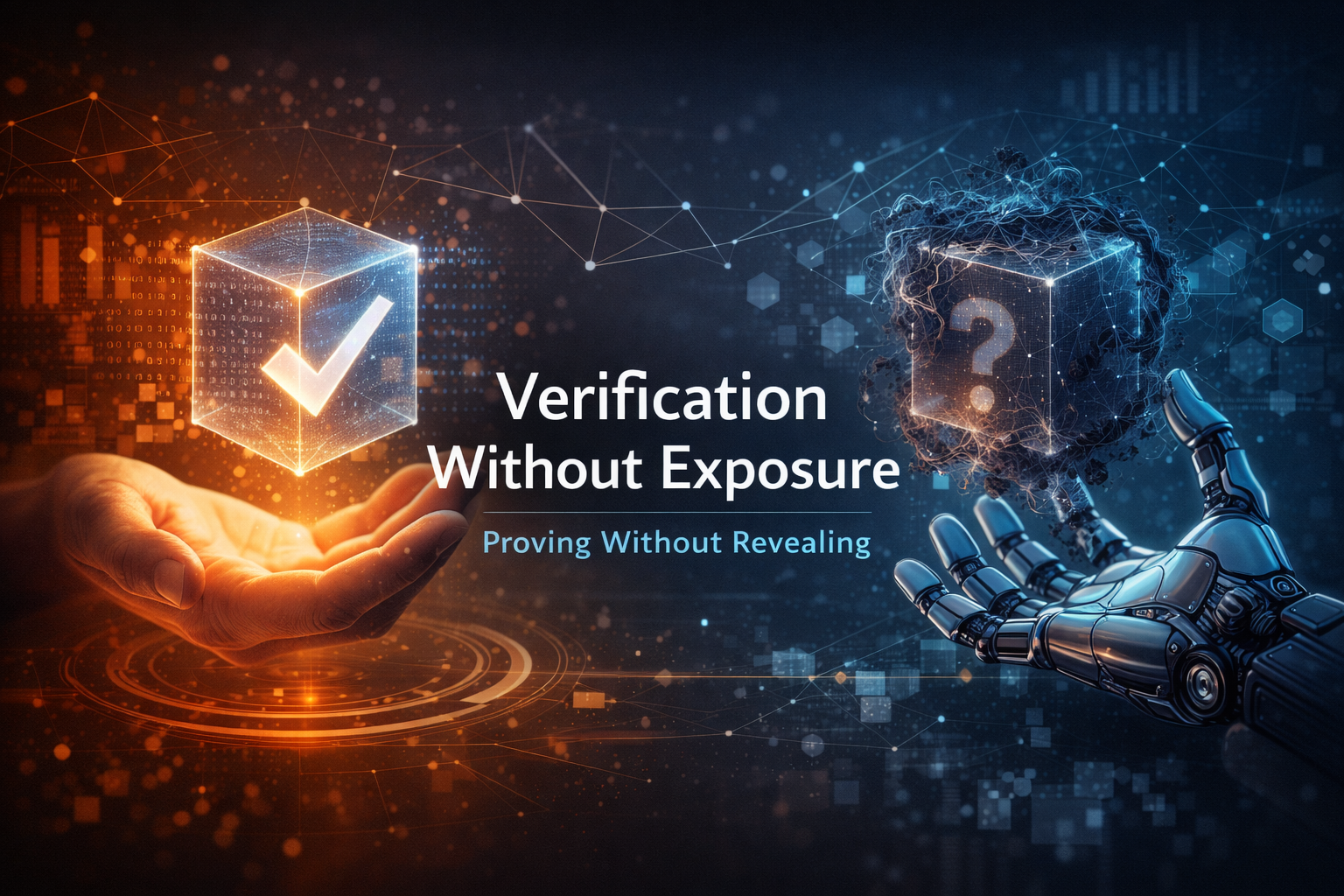
Verification Without Exposure: Proving Without Revealing
--
Introduction
Verification has traditionally required visibility.
To verify something, systems assumed they must see it, inspect it, and process it directly. This assumption shaped how security, computation, and trust were built.
But this creates a fundamental contradiction:
The more you expose to verify, the more you risk leaking.
Modern systems require a new capability:
To verify correctness without exposing underlying data.
The Exposure Problem
In conventional architectures:
- Data is submitted
- Systems process raw input
- Verification happens after execution
This introduces multiple risks:
- Data leakage during processing
- Expanded attack surface
- Trust dependency on execution environment
Even in encrypted systems:
- Data is often decrypted for computation
- Intermediate states become vulnerable
This leads to a critical limitation:
Security protects storage and transit — but not computation.
Decoupling Verification from Visibility
The next evolution is clear:
Verification must not require access to raw data.
Instead of asking:
- “What is the data?”
Systems must ask:
- “Is the result provably correct?”
This shifts the model from:
- Data-centric security → Proof-centric security
Zero-Knowledge as a Primitive
Zero-Knowledge systems enable this transformation.
They allow one party to prove:
- A computation was executed correctly
- A condition was satisfied
Without revealing:
- The input data
- The internal process
This creates a powerful property:
Correctness without disclosure
From Transparent Execution to Opaque Proofs
Traditional systems rely on transparent execution:
- Trust is derived from visibility
- Verification requires replication or inspection
Next-generation systems rely on:
Opaque proofs
- Execution happens privately
- Proofs are publicly verifiable
- Results are accepted without re-execution
This removes the need to:
- Trust the executor
- Access the underlying data
Security Implications
Verification without exposure fundamentally changes security:
- Sensitive data is never revealed
- Attack surfaces shrink dramatically
- Insider threats are minimized
Even if:
- Nodes are compromised
- Networks are observed
The system remains secure because:
There is nothing meaningful to steal.
Efficiency Trade-offs
This model introduces challenges:
- Proof generation can be computationally expensive
- Verification must remain lightweight
- Systems must balance latency and security
However, advances in:
- zk-SNARKs / zk-STARKs
- Hardware acceleration
- Recursive proofs
Are rapidly reducing these constraints.
Mytier Architectural Alignment
Mytier aligns directly with this paradigm.
Its architecture separates:
- Computation (off-chain)
- Verification (on-chain)
With key properties:
- No raw data is exposed to the network
- Only proofs are submitted
- Acceptance is based on verifiable correctness
Combined with:
- Post-Quantum Cryptography (PQC)
- AI-based validation layers
Mytier enables:
Secure computation without exposure
From Privacy to Structural Security
This is not just about privacy.
It is about structural security:
- Systems no longer depend on secrecy
- Systems depend on mathematical guarantees
This eliminates:
- Trust in operators
- Trust in infrastructure
Replacing it with:
Trust in proofs
Conclusion
Verification without exposure is not an optimization.
It is a necessity.
As systems become more distributed and adversarial:
The ability to prove without revealing becomes foundational.
Future architectures will not ask for data.
They will require:
Proof of correctness — nothing more.
Summary
- Traditional verification requires data exposure
- Exposure creates security risks
- Zero-knowledge enables proof without disclosure
- Systems must shift to proof-centric models
- Mytier enforces verification without exposing data