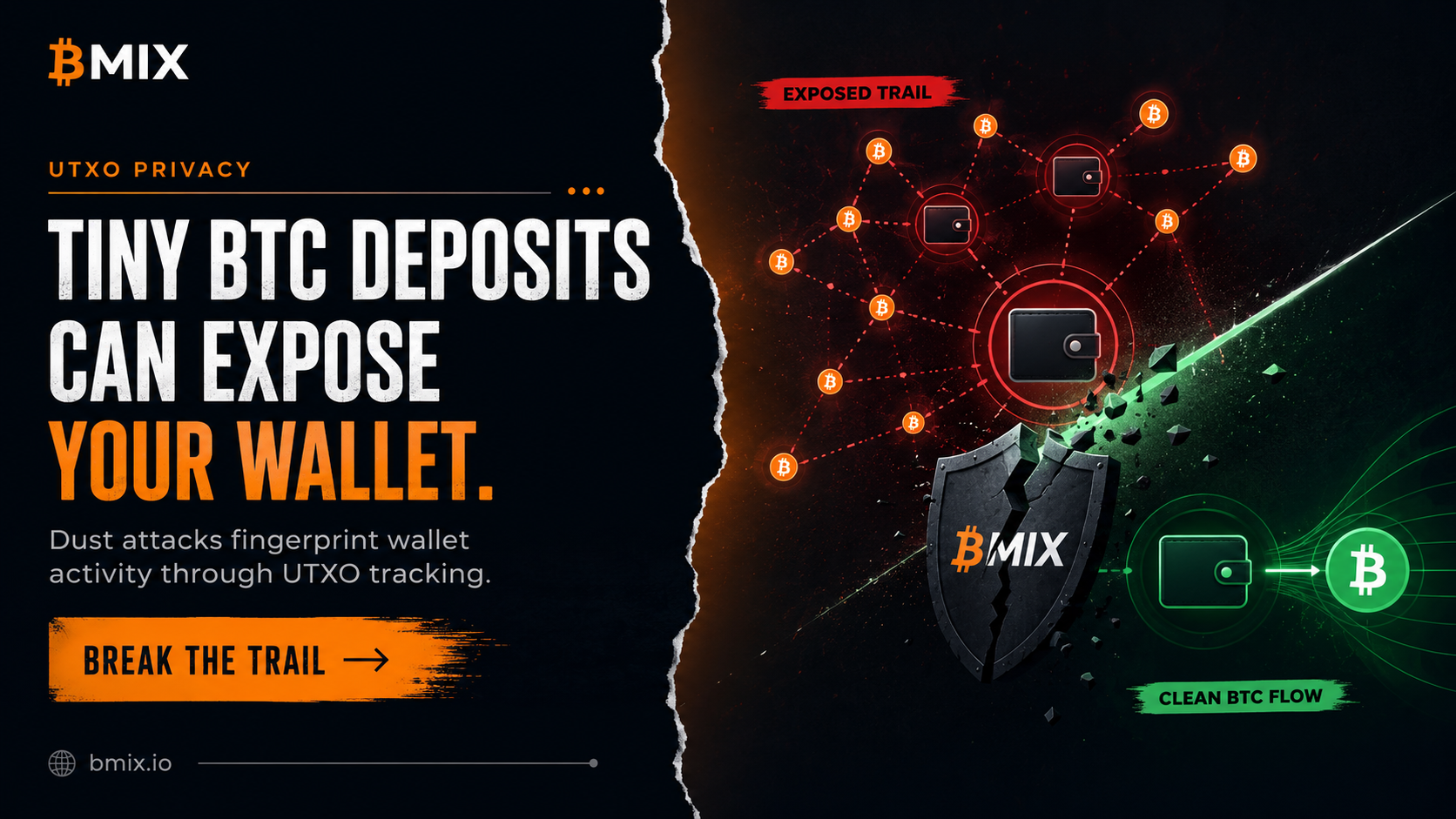
UTXO Dust Attacks: How Attackers Fingerprint Bitcoin Wallets Using Tiny Transactions
--
A wallet receives a tiny Bitcoin transaction worth almost nothing. Most users ignore it because the amount appears insignificant. Weeks later, blockchain analytics systems begin linking multiple wallet addresses together.
The original dust transaction quietly did its job.
Bitcoin dust attack protection is becoming increasingly important because blockchain surveillance techniques no longer rely solely on large transactional patterns. Tiny outputs can now serve as long-term behavioral markers used for wallet fingerprinting and transaction graph expansion.
This is one of the most overlooked privacy threats in Bitcoin today.
Understanding UTXOs and Why They Matter
Bitcoin does not operate like a traditional banking account.
Instead of maintaining balances internally, Bitcoin uses Unspent Transaction Outputs, commonly called UTXOs. Every wallet balance consists of separate outputs generated from previous transactions.
When users spend BTC, wallets automatically combine different UTXOs together to build a new transaction.
This behavior creates an opportunity for surveillance systems.
If an attacker can place a uniquely identifiable output into a wallet, later spending activity may reveal relationships between multiple addresses.
This is the foundation of a Bitcoin tracking attack through dusting.
What Exactly Is a Dust Attack?
Dust attacks involve sending extremely small BTC amounts to many wallets simultaneously.
The objective is not theft.
The objective is surveillance.
Once recipients unknowingly spend those dust outputs together with other funds, blockchain analytics systems monitor how the combined UTXOs move across the network.
This enables:
- Wallet clustering
- Address attribution
- Behavioral fingerprinting
- Transaction graph reconstruction
Over time, these small outputs become markers capable of identifying wallet ownership relationships.
This process is commonly referred to as UTXO dust wallet fingerprinting.
Why Dust Attacks Are Effective
Dust attacks succeed because users rarely notice them.
The amounts are often too small to trigger concern. Many wallets automatically include those outputs in later transactions without user awareness.
Once spent, the surveillance system gains new data points connecting wallets together.
These relationships become increasingly powerful when combined with:
- Exchange interaction data
- Public wallet disclosures
- Transaction timing patterns
- Repeated spending behavior
Even users who regularly generate new addresses may still become exposed through transaction graph analysis.
The Growing Role of Blockchain Analytics
Blockchain surveillance has evolved into a large commercial ecosystem.
Modern analytics firms maintain enormous transaction databases capable of reconstructing wallet behavior over many years. These systems analyze:
- UTXO relationships
- Transaction structures
- Cluster patterns
- Spending behavior
- Timing correlations
Dust attacks provide additional intelligence for these systems by expanding the available behavioral dataset.
As blockchain analysis improves, historical dust contamination becomes increasingly valuable.
Why Traditional Privacy Methods Often Fail
Many users attempt basic privacy strategies such as:
- Creating new wallets
- Splitting transactions manually
- Rotating addresses
- Using standard mixers
However, advanced analytics systems are designed specifically to reconnect fragmented activity through statistical modeling.
Older mixing systems often preserve some level of transactional continuity between deposited and returned coins.
This creates opportunities for:
- Equal-amount analysis
- Temporal correlation
- Cluster reconstruction
- Trait analysis
In many cases, contaminated dust outputs can still contribute to surveillance models.
How ₿MIX Handles Dust Trail Separation
₿MIX approaches privacy differently by removing transactional continuity entirely.
Instead of redistributing coins through a shared transaction pool, ₿MIX completely replaces deposited Bitcoin with clean Bitcoin coins sourced from independent investors on global exchanges including Binance, Coinbase, OKX, and Bybit.
This creates a complete break between original UTXOs and returned funds.
Because the returned BTC originates from unrelated exchange-sourced liquidity, the original dust-contaminated transaction graph no longer follows the user.
According to the platform:
- Returned coins pass AML checks
- No traces of mixer usage remain
- One or two unrelated return addresses may be specified
- Operational data is encrypted and auto-deleted
The system also implements randomized processing times between 1 and 6 hours to reduce temporal analysis risks.
Why Coin Replacement Matters
The difference between transaction shuffling and transaction replacement is significant.
Dust attacks depend on continuity.
If surveillance systems can follow UTXOs through the blockchain, they can continue building wallet relationships.
₿MIX removes this continuity by introducing entirely unrelated exchange-sourced outputs instead of recycled transactional chains.
This structure increases resistance against:
- UTXO dust wallet fingerprinting
- Cluster analysis
- Trait analysis
- Equal-amount analysis
Additional Operational Protections
The platform also includes:
- No registration
- No KYC
- No logs
- No tracking
- TOR mirror without JavaScript
- PGP-signed guarantee letters
The guarantee letter provides cryptographic verification that the deposit address belongs to the service infrastructure.
For users testing the platform, free test mode exists for exactly 0.001 BTC with 0% service fee.
Conclusion
Dust attacks demonstrate how small blockchain interactions can create long-term privacy consequences.
What appears insignificant today may later become a critical link inside transaction graph analysis systems.
As blockchain surveillance capabilities continue expanding, UTXO privacy becomes increasingly important for Bitcoin users seeking operational confidentiality.
₿MIX approaches this challenge through full coin replacement using exchange-sourced clean Bitcoin coins, helping break the transactional continuity that dust attacks rely upon.