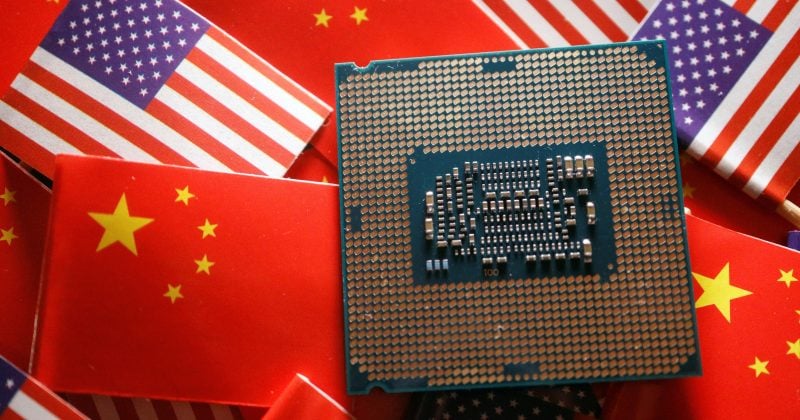
US moves to block advanced AI chip sales to Chinese entities
Washington's escalating semiconductor restrictions target NVIDIA and AMD exports to Chinese-owned operations worldwide, reshaping the global AI supply chain.
Share
Add us on Google by Editorial Team May. 31, 2026The US government is pushing to prevent NVIDIA and AMD from selling their most advanced AI chips to Chinese-owned entities operating abroad. AI and crypto have become deeply intertwined markets, with AI tokens, GPU-dependent mining operations, and decentralized compute networks all sensitive to the availability and pricing of advanced semiconductors.
The original export controls trace back to October 2022, when the Biden administration introduced rules specifically aimed at limiting China’s ability to use advanced AI chips for military purposes.
AdvertisementIn April 2025, the US banned exports of chips like NVIDIA’s H20 and AMD’s MI308, which had been specifically designed as “compliant” versions meant to skirt earlier restrictions. Then came July 2025, when Washington reversed course and allowed limited exports of the H20 and MI308, with a catch: a 15% revenue share payable to the US government.
By November 2025, the White House went further, directing federal agencies to block NVIDIA from selling its latest scaled-down AI chips, including variants of the B30 series, to Chinese companies. NVIDIA reportedly began exploring additional design modifications. As of February 2026, sales of NVIDIA’s H200 chips to China remain stalled due to a prolonged national security review.
In February 2026, a bipartisan congressional initiative advanced legislation that would give lawmakers a 30-day review and blocking power over export licenses for advanced chips headed to adversarial countries. The Entity List has been expanding in parallel. In March 2025, 42 entities were added to the Export Administration Regulations Entity List, with another 23 following in September 2025.
Decentralized compute networks like Akash, Render, and io.net rely on distributed GPU capacity. If Chinese entities are cut off from accessing the latest NVIDIA and AMD hardware, demand for alternative compute sources could increase, potentially benefiting decentralized GPU marketplaces. On the flip side, restrictions that reduce the global supply of advanced GPUs tend to push hardware prices up, squeezing margins for miners and compute providers alike.
China has been accelerating its push toward semiconductor self-sufficiency, with Huawei’s Ascend series representing its most prominent domestic AI chip effort. If these restrictions continue to tighten, they paradoxically strengthen the incentive for China to build a completely independent chip ecosystem.
Disclosure: This article was edited by Editorial Team. For more information on how we create and review content, see our Editorial Policy.