US home foreclosures rise 26% year-over-year in Q1 2026, highest level in six years
Nearly 119,000 properties received foreclosure filings last quarter as rising property taxes and insurance costs squeeze homeowners, though activity remains well below financial crisis peaks.
Share
Add us on Google by Editorial Team May. 27, 2026The American housing market just posted its worst foreclosure numbers since 2020. According to ATTOM Data’s Q1 2026 US Foreclosure Market Report, published on April 16, 118,727 properties received foreclosure filings during the first three months of the year, a 26% jump compared to the same period in 2025.
That’s also a 6% increase from the previous quarter, making it the highest level of foreclosure activity the country has seen in six years. The drivers aren’t exotic financial instruments or a subprime lending revival. They’re far more mundane: property taxes, insurance premiums, and the general cost of being alive in 2026.
The numbers tell a layered story
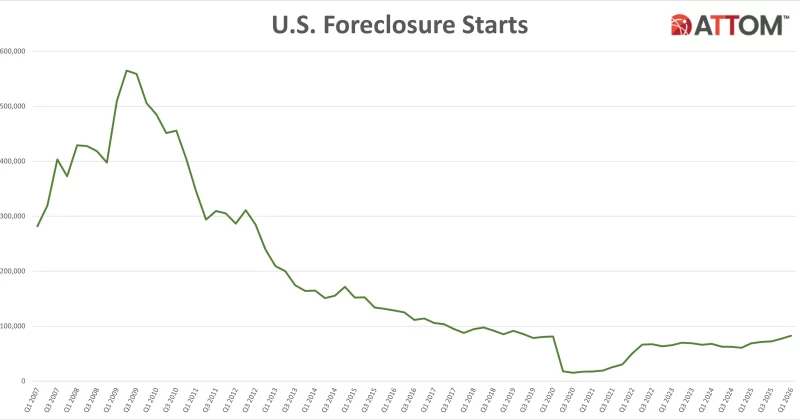
Look beyond the headline figure and the picture gets more interesting. Foreclosure starts, the initial legal filings that kick off the process, totaled 82,631 in Q1, representing a 20% year-over-year increase.
AdvertisementCompleted foreclosures, where banks actually take ownership of properties (known as REOs, or real estate owned), surged even more dramatically. That category climbed 45% compared to Q1 2025.
Geographically, the pain is unevenly distributed. Indiana leads the nation with the highest foreclosure rate at 1 in every 739 housing units. South Carolina and Florida follow closely behind. The national average sits at 1 in every 1,211 units.
Context matters: this isn’t 2008
The pandemic era created an artificially low floor for foreclosure activity. Federal moratoriums, forbearance programs, and stimulus payments effectively froze the foreclosure pipeline for the better part of two years. The numbers we’re seeing now represent a return toward pre-pandemic norms, not a march toward crisis-era territory.
During the 2007-2008 financial crisis, foreclosure filings were running at multiples of current levels. The underlying conditions were fundamentally different too: widespread subprime lending, negative equity on a massive scale, and a banking system leveraged to the hilt on mortgage-backed securities that turned out to be worth considerably less than advertised.
ATTOM CEO Rob Barber acknowledged the financial pressures homeowners face while noting that the broader market context is stabilizing, supported by a recovery in homeowner equity following the pandemic-era downturn.
What this means for investors
The geographic concentration matters for real estate investors. States like Indiana, South Carolina, and Florida with elevated foreclosure rates could see localized price pressure as distressed properties hit the market. An influx of bank-owned properties typically creates buying opportunities for investors who can move quickly, but it can also put downward pressure on comparable home values in the surrounding area.
For the broader market, the key metric to watch going forward is whether foreclosure starts continue accelerating. The 20% year-over-year increase in starts suggests the pipeline is still filling, meaning completed foreclosures could keep rising in subsequent quarters even if new financial stress levels off.
Disclosure: This article was edited by Editorial Team. For more information on how we create and review content, see our Editorial Policy.