
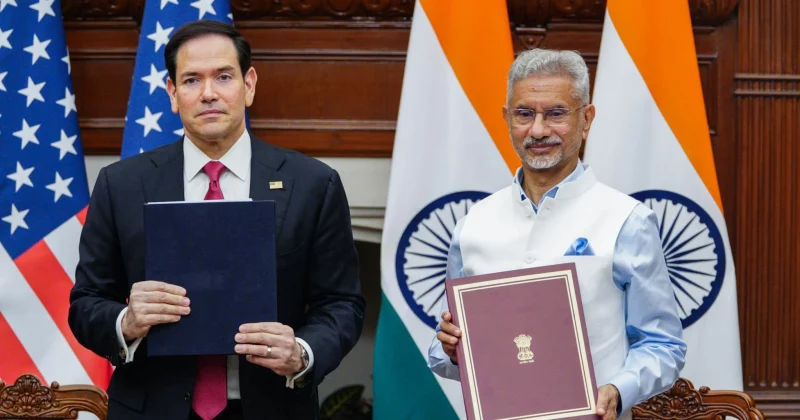
US and India sign Critical Minerals Framework to enhance supply chains
The bilateral deal, backed by over $30 billion in planned investments, targets rare earth and critical mineral supply chains from exploration to recycling.
Share
Add us on Google by Editorial Team May. 26, 2026The United States and India formalized a Critical Minerals Framework on May 26, covering the full lifecycle of rare earth and critical mineral supply chains. US Secretary of State Marco Rubio and Indian External Affairs Minister S. Jaishankar signed the agreement in New Delhi, with over $30 billion earmarked for investments and related projects.
The deal is designed to reduce both nations’ dependence on single-source suppliers for the minerals that power everything from electric vehicle batteries to semiconductor chips to defense systems.
What the framework actually covers
The scope spans exploration, mining, processing, recycling, investment, and financing, essentially every link in the chain from dirt to finished product.
AdvertisementThe agreement also explicitly targets what it calls “coercive market practices,” a diplomatic way of describing the leverage that dominant mineral suppliers can exert during geopolitical disputes.
The framework builds on several initiatives launched earlier in 2026, including the Forum on Resource Geostrategic Engagement, known as FORGE, and India’s involvement in the Pax Silica initiative. It also connects to a 2024 agreement between the two countries focused specifically on battery minerals.
The geopolitical chess match for minerals
The February 2025 US-India Joint Leaders’ Statement had already flagged secure supply chains as a priority, emphasizing the critical need for reliable mineral access amid rising global competitiveness in semiconductors, clean energy, and defense technology.
A parallel Quad Critical Minerals Framework was proposed around the same time, signaling that this isn’t just a bilateral effort.
What this means for investors
Critical minerals are essential inputs for the hardware that powers data centers, AI infrastructure, and the semiconductor supply chain. Bitcoin mining operations, AI compute farms, and blockchain infrastructure all depend on chips manufactured with rare earth elements.
For traditional markets, companies involved in critical mineral mining, processing, and recycling stand to benefit from the capital flows this framework is designed to generate. The $30 billion investment target could create meaningful opportunities for firms positioned in the exploration and processing segments, particularly those operating in India or partnered with Indian entities.
Electric vehicle manufacturers, battery producers, and renewable energy companies all depend on stable access to lithium, cobalt, and nickel. A diversified supply chain reduces input cost volatility, which directly impacts margins and valuations for companies across those sectors.
Disclosure: This article was edited by Editorial Team. For more information on how we create and review content, see our Editorial Policy.