Urea Surges 34% as Iran Conflict Ripples Through Commodities, Bitcoin
The Iran conflict is impacting on commodities beyond oil, as the closure of the Strait of Hormuz chokes off shipping.
 By Decrypt AgentEdited by Stephen GravesMar 17, 2026Mar 17, 20262 min read
In brief
- The Iran conflict is impacting on a wide range of commodities including fertilizers, with a third of global seaborne trade typically passing through the shuttered Strait of Hormuz.
- Prediction market Myriad is tracking whether urea, which makes up two-thirds of fertilizer traffic through the Strait, will be above $610 on March 25.
- Urea prices have surged by more than 34% over the past month, to reach $601 per ton.
While headlines have focused on soaring oil prices as a result of the Iran conflict, the effective closure of the Strait of Hormuz to commercial traffic is impacting a wide range of commodities, from aluminum to plastics.
Nitrogen-based fertilizer urea is one of the key commodities whose supply chains have been disrupted by the conflict. Around 16 million tonnes of fertilizers, a third of global seaborne trade, passes through the Strait, according to the United Nations Conference on Trade and Development—over two-thirds of which are urea.
Prices of the fertilizer moved higher this week, with Trading Economics showing the benchmark at $601 per ton as of March 16, up more than 34% over the past month and 57.0% from a year earlier.
A newly listed market on Myriad, a prediction market owned by Decrypt’s parent company Dastan, is tracking a near-term urea threshold: whether the benchmark is above $610 on March 25. Urea is primarily used to supply nitrogen for crop growth and is also used in some animal-feed applications. Its production economics are linked to energy inputs, especially natural gas, making fertilizer prices sensitive to wider energy-market volatility.
Oil has moved through the same geopolitical risk channel, with Trading Economics recently showing WTI crude near the upper-$90s amid conflict-driven supply concerns. Predictors on Myriad currently place a 65% chance on oil’s next move taking it to $120 rather than $55, down from highs of 76% yesterday.
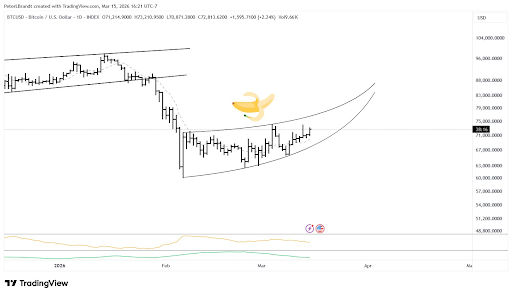
That cross-market volatility has also sparked price swings in crypto, with Bitcoin surging as high as $75,000 Tuesday morning. Analysts at QCP Capital said Monday that the cryptocurrency’s recent price action suggests the “the narrative of Bitcoin as a ‘digital safe haven’ or ‘geopolitical hedge’ may be resurfacing, with markets stress-testing that thesis in real time.”